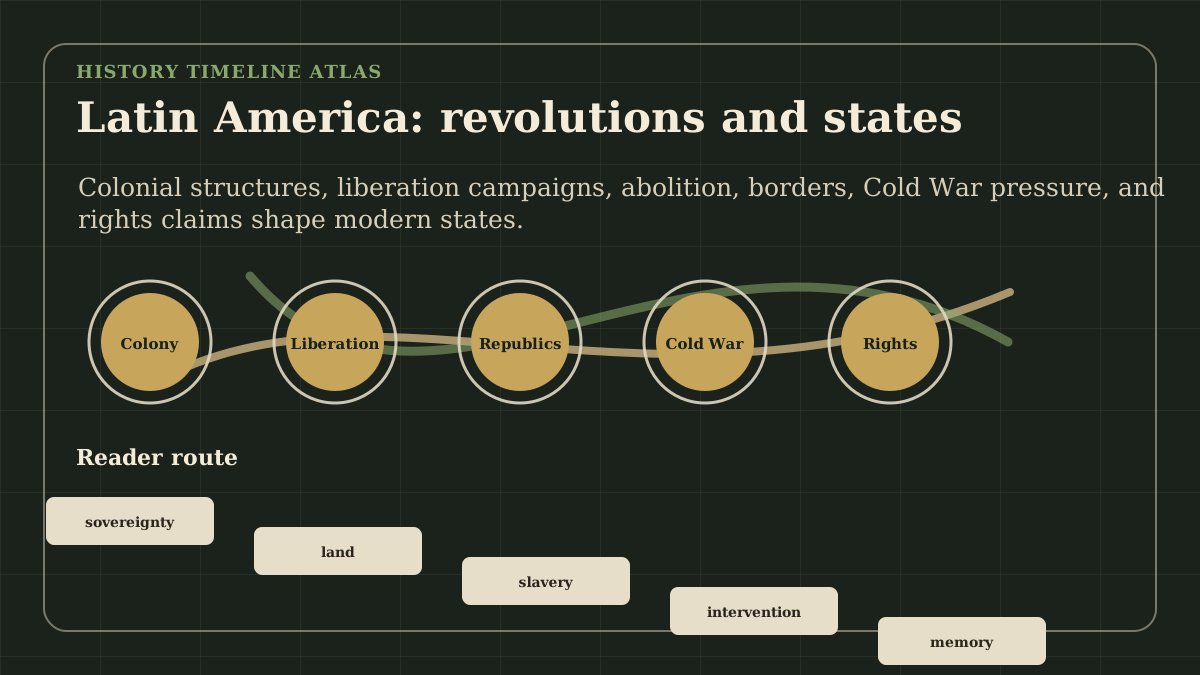
Central Question
How did Latin America move from colonial empires into independent states, and why did sovereignty still leave conflicts over land, labor, race, democracy, and intervention?
Start With These Dates
- 1521 CEFall of the Aztec Empire
Spanish forces and Indigenous allies captured Tenochtitlan after conflict, epidemic disease, and political fracture undermined Aztec power.
- 1533Fall of the Inca Empire
Spanish forces exploited civil conflict, alliances, disease, and coercion to break Inca imperial power and occupy Cusco.
- 1545Potosi Silver Boom Begins
Silver mining at Potosi became a massive colonial enterprise linking Andean labor, Spanish finance, and global silver flows.
- 1780-1781Tupac Amaru II Rebellion
Tupac Amaru II led a major Andean rebellion against Spanish colonial taxation, labor demands, and administrative pressure.
- 1879War of the Pacific Begins
Chile, Peru, and Bolivia fought over nitrate-rich territory and Pacific access in the War of the Pacific.
- 1994NAFTA Takes Effect
NAFTA created a North American free-trade framework linking the United States, Mexico, and Canada.
- 1994Zapatista Uprising
The Zapatista uprising in Chiapas challenged Mexican state power, Indigenous marginalization, land inequality, and neoliberal globalization.
Sources Used Here
- Primary Source Set: Latin American Revolutionaries
Primary-source set reference for Latin American revolutionary leaders, documents, and independence politics.
- Library of Congress: Hispanic Reading Room Collections
Archive and collection reference for Latin America, the Caribbean, Iberian worlds, and related primary materials.
- Cambridge University Press: The Cambridge History of Latin America
Specialist scholarly synthesis for colonial society, independence, republic-building, regional variation, and modern Latin American historiography.
- Oxford Research Encyclopedia of Latin American History
Peer-reviewed reference for Latin American history themes, regional debates, social history, and competing interpretations.
- John Carter Brown Library: Spanish America collection
Primary-source collection reference for Spanish American independence, printed political culture, maps, and early republican debate.
Latin American Revolutions and Modern States is designed as a route, not a folder. It gathers events that answer related reader questions about power, belief, conflict, exchange, institutions, and memory. The strongest way to read the page is to move from the earliest events toward the later ones, watching how one kind of pressure changes form across different places.
The route currently runs from 1521 CE to 1994. That span lets readers compare immediate turning points with slower consequences: the founding of institutions, the spread of ideas, the shock of war or disease, and the way later societies reused earlier events as warnings, models, or symbols.
Start with Fall of the Aztec Empire, Fall of the Inca Empire, Potosi Silver Boom Begins, Tupac Amaru II Rebellion, Grito de Dolores and then follow the internal links into people, timelines, years, maps, and source lists. The route structure stays visible when each event explains why it belongs with the others and where the next useful page is.
Compare the events by scale. Some are concentrated moments, such as a battle, proclamation, trial, or publication. Others are long processes, such as a reform movement, pandemic, trade route, or diplomatic order. Reading both types together helps prevent the page from becoming a list of dates.
A useful route keeps uncertainty visible. Historical change rarely has one cause or one clean ending, so the reader can separate background pressure, immediate trigger, turning point, result, and later memory. That pattern is what makes the atlas expandable without making the reader start over each time.
This route is also a comparison tool. After reading one event, compare it with a later event on the same page and ask what changed in scale, language, geography, technology, authority, or public memory. The comparison is often more useful than the individual summary because it reveals the pattern the topic page is built to expose. When a claim feels too neat, open the full event page and check whether the evidence supports one cause, several causes, or a contested interpretation before moving on.
This hub gives Latin America a full route instead of treating the region as a few famous revolutions. It begins with conquest and silver because colonial labor, race, land, and extraction shaped later conflicts. It then moves through Tupac Amaru II, Mexico, Buenos Aires, Paraguay, San Martin, Bolivar, Brazil, Ayacucho, and Gran Colombia to show independence as several regional processes, not one continental script.
The post-independence section is just as important as liberation. Paraguay, the War of the Pacific, abolition in Brazil, Cuba, and the Mexican Revolution show that sovereignty left unresolved arguments over borders, army power, land, slavery, labor, race, church authority, resources, and constitutional order. A flag did not automatically produce state capacity or social justice.
The twentieth-century route follows Cold War and democratization pressures through Guatemala, Cuba, Chile, Nicaragua, the Falklands, Brazil's constitution, NAFTA, and the Zapatistas. These pages keep external intervention visible without erasing local actors. They also connect revolution to economic policy, Indigenous rights, dictatorship, human rights, and globalization.
A reader arriving with a broad question about Latin American independence needs more than a list of leaders. The stronger answer is a route through colonial structures, wars of independence, state-building, regional conflict, Cold War pressure, democratization, and ongoing claims over land, rights, memory, economy, citizenship, political repair, sovereignty, labor, dignity, democracy, and belonging.
The route begins under Iberian rule because later independence movements inherited colonial categories as well as colonial grievances. Viceroyalties, audiencias, municipal councils, tribute, caste language, church institutions, mining circuits, coerced labor, and Atlantic trade shaped how people imagined authority before 1808. The collapse of legitimacy in Spain and Portugal opened a door, but the doorway led into societies already divided by region, status, race, landholding, and local political memory.
Indigenous and Afro-descended communities keep the route from becoming a Creole elite story. Tupac Amaru II, Haitian memory, maroon communities, enslaved laborers, free people of color, Indigenous villages, urban artisans, and rural militias all affected the language of freedom. Some movements promised equality while preserving hierarchy; others used monarchy, religion, or local autonomy rather than liberal nationalism. Latin American revolution becomes clearer when popular mobilization and elite negotiation are followed together.
Geography made independence uneven. The Andes, Rio de la Plata, Caribbean islands, Mexican highlands, Brazilian ports, Amazonian frontiers, and Pacific coast all created different military and economic problems. A campaign across mountains demanded different alliances than a port uprising or plantation revolt. Geography also explains why some armies moved as liberation forces, some regions fragmented into rival republics, and some imperial centers could survive longer than expected.
Brazil belongs inside the same route because its path shows another way empire could become nation. The Portuguese court's transfer to Rio de Janeiro, monarchy, slavery, coffee, regional elites, and gradual constitutional bargaining produced a different settlement from Spanish American fragmentation. Brazil's territorial unity was not proof of simpler history. It rested on monarchy, coercive labor, provincial bargaining, and delayed abolition.
The post-independence decades reveal the hard work hidden behind the word nation. New states needed taxes, armies, courts, schools, currencies, roads, diplomatic recognition, constitutions, and borders. Caudillos, federalists, centralists, landowners, clergy, merchants, Indigenous communities, and foreign creditors all contested those tools. The route treats state formation as the next chapter of revolution, not as a neat ending after a declaration.
Wars between new states make sovereignty concrete. Paraguay's catastrophic war, the War of the Pacific, border disputes, and resource conflicts show how nitrate, guano, river access, army organization, and diplomatic alliances shaped national maps. These conflicts also remind readers that independence from Europe did not remove violence from the region. It relocated arguments over territory, labor, and state capacity into republican settings.
The abolition layer links Latin America to Atlantic slavery without making every country identical. Haiti made antislavery revolution unavoidable in the political imagination; Cuba and Brazil show slavery's endurance after many independence settlements; the Golden Law shows legal abolition arriving late and leaving land, labor, racial hierarchy, and memory unresolved. Freedom in law and freedom in social life move at different speeds.
The twentieth century adds a second cycle of revolution and counterrevolution. Mexico turned land and dictatorship into constitutional struggle. Guatemala, Cuba, Chile, Nicaragua, and Brazil reveal how Cold War pressure interacted with local inequality, military institutions, reform movements, business interests, church networks, and U.S. policy. External intervention mattered, but the route keeps local organizers, soldiers, workers, students, peasants, and exiles in view.
Evidence changes across the route. Colonial petitions reveal local grievances; military proclamations reveal public legitimacy; letters and newspapers reveal rumor and persuasion; constitutions reveal political ideals; land records reveal social conflict; diplomatic archives reveal foreign pressure; testimony and human-rights reports reveal dictatorship and disappearance. Reading Latin America well means comparing sources created by rebels, states, empires, victims, and later memory projects.
The source trail has several anchors. The DPLA Latin American Revolutionaries set keeps independence documents and leader records visible. The Library of Congress Hispanic collections widen the archive toward Iberian, Caribbean, and Latin American materials. Cambridge and Oxford scholarship help keep the route inside specialist debates about independence, state formation, social history, and regional variation. UNESCO's Potosi record grounds silver extraction in a real mining city. Britannica helps steady chronology, but the route's harder claims depend on reading those references beside primary documents, urban landscapes, labor systems, and memory archives.
Contested claims need explicit handling. Independence can look like Creole elite politics in one archive, Indigenous rebellion in another, and enslaved or Afro-descended struggle in a third. Cold War pages can look different from state, guerrilla, U.S. diplomatic, human-rights, and local testimony records. This hub therefore treats event pages as evidence doors: when readers reach Tupac Amaru II, Brazil's independence, the Mexican Revolution, Guatemala, Chile, Nicaragua, or the Zapatistas, they should expect an evidence trail that separates what happened, who recorded it, and why later interpretations disagree.
The next-click structure is comparative. Mexican independence, Bolivar's campaigns, Brazil's independence, Haiti, Paraguay, Cuba, Chile, Nicaragua, and the Zapatistas each answer a different version of the same question: who gets to define sovereignty? Readers can move from causes to campaigns, then to state formation, then to Cold War crisis, then to rights and Indigenous claims. The pattern keeps a broad region readable without flattening it into one national story.
Memory remains politically active. Statues, schoolbooks, bicentennials, truth commissions, land claims, disappeared-person archives, revolutionary songs, and national holidays all decide which actors are visible. A route that follows memory as well as chronology explains why independence heroes, dictatorships, guerrilla movements, and Indigenous uprisings still shape public argument. Latin American history becomes compelling when liberation, exclusion, reform, repression, and memory all remain in the same frame.
Economic history gives the route its long afterlife. Silver, sugar, coffee, cattle, guano, nitrate, oil, bananas, copper, debt, and foreign investment repeatedly shaped what governments could promise and what communities could demand. Export booms built railways, ports, banks, and urban elites, but they also concentrated land, hardened labor hierarchies, and made states vulnerable to world prices. The route is richer when political freedom is read beside commodity dependence.
A final people-first path follows families through disruption. A miner in Potosi, an Indigenous village defending land, an enslaved person hearing rumors from Haiti, a soldier crossing the Andes, a Brazilian abolitionist reading newspapers, a Chilean student facing repression, and a Zapatista organizer using media all reveal different scales of the same story. Sovereignty becomes readable when it is attached to work, land, fear, hope, and memory.
The strongest closing comparison pairs promise with machinery. Independence promised self-rule, but courts, tax offices, armies, schools, prisons, railways, plantations, mines, newspapers, and foreign loans determined who could use that promise. Reading those institutions across two centuries turns the region from a chain of uprisings into a long argument over how freedom becomes governable and how government can betray freedom. That comparison gives students a durable way to connect causes, effects, and significance without reducing the region to heroic biography. It also gives casual readers a reason to follow the next card because each event reveals another institution that translated ideals into daily life.
Read the events in order first; the page is built to reveal change over time.
Ask which pressures existed before the visible turning point and which actors had room to choose.
Follow what changed afterward in institutions, borders, law, belief, or everyday life.
Notice which events became symbols and why later generations kept returning to them.
Compare Mexico, Spanish South America, Paraguay, and Brazil instead of assuming one independence model.
Watch how borders, armies, federalism, debt, slavery, and regional elites shaped new republics.
Use Guatemala, Cuba, Chile, Nicaragua, Brazil, and the Zapatistas to connect intervention, dictatorship, democracy, and Indigenous claims.
Keep Indigenous villages, enslaved people, free people of color, artisans, peasants, workers, students, and exiles visible beside generals and presidents.
Read wars and treaties through silver, guano, nitrate, coffee, sugar, land, debt, railways, and ports as well as ideology.
Follow national holidays, monuments, truth commissions, disappeared-person archives, and land claims as later arguments over the meaning of revolution.
Choose a Reading Path
Start With the Timeline
Use the related timeline first when you want a chronological route through the topic.
Start with 1521 CE: Fall of the Aztec EmpireOpen a Person Page
Use people pages when the topic is easier to understand through leadership, resistance, reform, or memory.
Start with 1533: Fall of the Inca EmpireUse Year Pages
Use year pages when you need a fast answer to what changed in a specific year.
Start with 1545: Potosi Silver Boom BeginsReturn to the Map
Use the map to keep geography visible while moving between events and regions.
Start with 1780-1781: Tupac Amaru II RebellionStart With Colonial Structures
Use conquest, silver, caste language, church authority, tribute, and local councils to see what independence movements inherited.
Start with 1879: War of the Pacific BeginsCompare Liberation Campaigns
Move through Mexico, Buenos Aires, San Martin, Bolivar, Brazil, Ayacucho, and Gran Colombia to compare routes to sovereignty.
Start with 1994: NAFTA Takes EffectFollow Unfinished Freedom
Use Haiti, Cuba, Brazil, abolition, Indigenous communities, and land struggles to track freedom beyond formal independence.
Start with 1994: Zapatista UprisingRead Cold War Latin America
Open Guatemala, Cuba, Chile, Nicaragua, and Brazil when the question is reform, intervention, dictatorship, exile, and human rights.
End With Rights Claims
Use NAFTA and the Zapatistas to connect globalization, Indigenous politics, land, media, and post-revolutionary memory.
How the Story Builds
Begin with Fall of the Aztec Empire. The opening event usually shows the pressure that made the route necessary: a crisis of authority, an expanding exchange system, a new technology, a contested idea, or a conflict that older institutions could no longer contain.
War of the Pacific Begins works as a checkpoint because it lets readers ask what had become irreversible, which actors still had choices, and how the route changed scale between the opening event and the later consequences.
The later edge of the route includes Brazil's Democratic Constitution, NAFTA Takes Effect, and Zapatista Uprising. These pages help readers see what survived beyond the first shock: institutions, borders, laws, memories, technologies, movements, or arguments that kept shaping later history.
The route is easier to remember through people and places. Watch figures such as Hernan Cortes, Cuauhtemoc, Malintzin, Atahualpa, Francisco Pizarro, and Andean laborers move through settings such as Tenochtitlan, Cusco, Potosi, Cusco region, and Dolores; that is where large structures become visible as choices, risks, costs, and memories.
Viceroyalties, mines, plantations, tribute, church institutions, caste language, and local councils create the structures later movements contest.
Napoleonic disruption, loyalty debates, juntas, monarchic claims, and local militias make authority uncertain across Spanish and Portuguese America.
Campaigns across Mexico, the Andes, Rio de la Plata, Brazil, and northern South America turn sovereignty into military and diplomatic practice.
Constitutions, borders, debt, armies, slavery, federalism, and church-state conflicts expose the work still required after independence.
Mexico, Guatemala, Cuba, Chile, Nicaragua, and Brazil show reform movements colliding with military power, Cold War policy, and social inequality.
Abolition, democratization, truth claims, Indigenous movements, globalization, and public memory keep the revolutionary question alive.
- Which event in Latin American Revolutions and Modern States feels like the true point of no return, and why might another reader choose a different event?
- What changes if the route is read from the perspective of ordinary people rather than rulers, armies, inventors, reformers, or institutions?
- Which consequence was immediate, and which consequence only became clear decades later?
- Where does the map change the interpretation by showing distance, borders, routes, ports, capitals, or frontiers?
- Why did Spanish America fragment while Brazil stayed territorially unified?
- How did slavery and race shape independence and state-building?
- When did revolution create institutions, and when did it create new conflicts?
- How did Cold War intervention change Latin American political possibilities?
- Which sources reveal popular participation when official histories focus on presidents and generals?
- How did land, debt, military power, and export economies shape the limits of republican citizenship?
- Why do independence heroes and dictatorship memories remain politically contested in the present?
Interactive Timeline
Follow Latin American Revolutions and Modern States by sequence
Fall of the Aztec Empire
Spanish forces and Indigenous allies captured Tenochtitlan after conflict, epidemic disease, and political fracture undermined Aztec power.
Read the full event pageMap Layer
Latin American Revolutions and Modern States geography
Gold pins mark the approximate locations of published event pages. This is a schematic locator map, not a historical border map.
Coordinates are approximate and are used to help readers orient themselves before opening a full event page.
Route Events
Events in This Topic
Fall of the Aztec Empire
Spanish forces and Indigenous allies captured Tenochtitlan after conflict, epidemic disease, and political fracture undermined Aztec power.
Fall of the Inca Empire
Spanish forces exploited civil conflict, alliances, disease, and coercion to break Inca imperial power and occupy Cusco.
Potosi Silver Boom Begins
Silver mining at Potosi became a massive colonial enterprise linking Andean labor, Spanish finance, and global silver flows.
Tupac Amaru II Rebellion
Tupac Amaru II led a major Andean rebellion against Spanish colonial taxation, labor demands, and administrative pressure.
Grito de Dolores
Miguel Hidalgo's call at Dolores helped launch the Mexican War of Independence against Spanish colonial rule.
May Revolution
The May Revolution in Buenos Aires formed a local junta amid the crisis of Spanish monarchy and imperial authority.
Paraguay Declares Independence
Paraguayan leaders broke from Spanish authority and from Buenos Aires, creating a distinct independence path.
San Martin Crosses the Andes
Jose de San Martin led an army across the Andes to support Chilean independence and open a path toward Peru.
Battle of Boyaca
Simon Bolivar's victory at Boyaca secured control of Bogota and accelerated independence in New Granada.
Mexico Achieves Independence
Mexico achieved independence after years of insurgency, royalist realignment, and the Plan of Iguala.
Brazil Declares Independence
Brazil separated from Portugal under Pedro I, preserving monarchy and territorial unity in a different independence path from Spanish America.
Battle of Ayacucho
Patriot victory at Ayacucho ended major Spanish military power in South America and turned the independence wars into a continental break with Spanish imperial rule.
Gran Colombia Dissolves
Gran Colombia fractured into separate states as regional interests, geography, factionalism, and institutional disputes overwhelmed Bolivar's union.
Paraguayan War Begins
The Paraguayan War began as a regional conflict involving Paraguay, Brazil, Argentina, and Uruguay.
War of the Pacific Begins
Chile, Peru, and Bolivia fought over nitrate-rich territory and Pacific access in the War of the Pacific.
Cuba Abolishes Slavery
Spanish authorities ended legal slavery in Cuba in 1886 after decades of plantation expansion, resistance, gradual emancipation measures, and political pressure.
Brazil's Golden Law
Brazil's Lei Aurea, or Golden Law, abolished slavery in the last major slaveholding society in the Americas.
Cuban War of Independence Begins
Cuban revolutionaries launched a renewed war for independence from Spain after decades of colonial conflict and reform failure.
Mexican Revolution Begins
Opposition to Porfirio Diaz opened a revolutionary period in Mexico shaped by demands for democracy, land reform, labor rights, and regional power.
Mexican Constitution of 1917
Mexico's 1917 constitution embedded revolutionary claims around land, labor, education, church-state relations, and national resources.
Guatemalan Coup
A United States-backed coup overthrew Jacobo Arbenz after land reform and Cold War fears made Guatemala a target of intervention.
Cuban Revolution Triumphs
Cuban revolutionaries overthrew Fulgencio Batista, creating a revolutionary government that soon became central to Cold War politics.
Chilean Coup
The Chilean military overthrew Salvador Allende's elected government and established a dictatorship under Augusto Pinochet.
Sandinista Revolution
The Sandinista revolution overthrew the Somoza dictatorship and made Nicaragua a central Cold War battleground in Central America.
Falklands War
Argentina and the United Kingdom fought over the Falkland Islands, turning sovereignty claims into a short but consequential South Atlantic war.
Brazil's Democratic Constitution
Brazil's 1988 constitution marked a democratic turn after military rule, expanding rights language and civilian institutions.
NAFTA Takes Effect
NAFTA created a North American free-trade framework linking the United States, Mexico, and Canada.
Zapatista Uprising
The Zapatista uprising in Chiapas challenged Mexican state power, Indigenous marginalization, land inequality, and neoliberal globalization.
References
Where to Check the Facts
- Primary Source Set: Latin American RevolutionariesPrimary-source set reference for Latin American revolutionary leaders, documents, and independence politics.
- Library of Congress: Hispanic Reading Room CollectionsArchive and collection reference for Latin America, the Caribbean, Iberian worlds, and related primary materials.
- Cambridge University Press: The Cambridge History of Latin AmericaSpecialist scholarly synthesis for colonial society, independence, republic-building, regional variation, and modern Latin American historiography.
- Oxford Research Encyclopedia of Latin American HistoryPeer-reviewed reference for Latin American history themes, regional debates, social history, and competing interpretations.
- John Carter Brown Library: Spanish America collectionPrimary-source collection reference for Spanish American independence, printed political culture, maps, and early republican debate.
- Encyclopaedia Britannica: Latin America independenceReference for Spanish American and Portuguese American independence movements.
- Encyclopaedia Britannica: History of Latin AmericaReference for Latin American colonial, independence, national, and modern history.
- Official UNESCO World Heritage Centre: City of PotosiInstitutional reference for Potosi's mining city, colonial extraction, and global silver economy.
- Encyclopaedia Britannica: Mexican RevolutionReference for the Mexican Revolution, social conflict, constitutionalism, and revolutionary politics.
- Encyclopaedia Britannica: Cuban RevolutionReference for the Cuban Revolution, Batista's overthrow, revolutionary government, and Cold War significance.
- Encyclopaedia Britannica: Fidel CastroBiographical reference for Castro's revolutionary leadership, Cuban government, and Cold War role.