At a Glance
The shape of the event
- Date
- 1822
- Place
- Sao Paulo and Rio de Janeiro
- Type
- Independence
Brazil separated from Portugal under Pedro I, preserving monarchy and territorial unity in a different independence path from Spanish America.
1822; place the event in Sao Paulo and Rio de Janeiro before comparing causes or consequences.
The event shows that Latin American independence did not produce one political model.
Pedro I / Brazilian elites are the first names or groups to compare before widening the story.
Brazil became an independent empire rather than a republic.
Brazil became an independent empire rather than a republic.
The event shows that Latin American independence did not produce one political model.
Follow the next timelines and related events to see how Brazil’s imperial choice played out in law, diplomacy, and everyday life.
Background
By 1822, imperial ties between Brazil and Portugal had been strained by decades of administrative entanglement, wartime displacement of the royal household, economic interdependence, and competing claims of legitimacy. Political authority in Brazil had developed its own centers — capitals such as Rio de Janeiro and commercial regions like São Paulo — where local elites accumulated wealth, influence, and distinct expectations of governance. Those elites faced a choice: press for full republican rupture, negotiate autonomy within a dynastic frame, or seek a middle path that preserved existing hierarchies. International diplomacy loomed as well; independence would not only sever legal ties with Lisbon but also require recognition by other states, with consequences for trade and legitimacy.
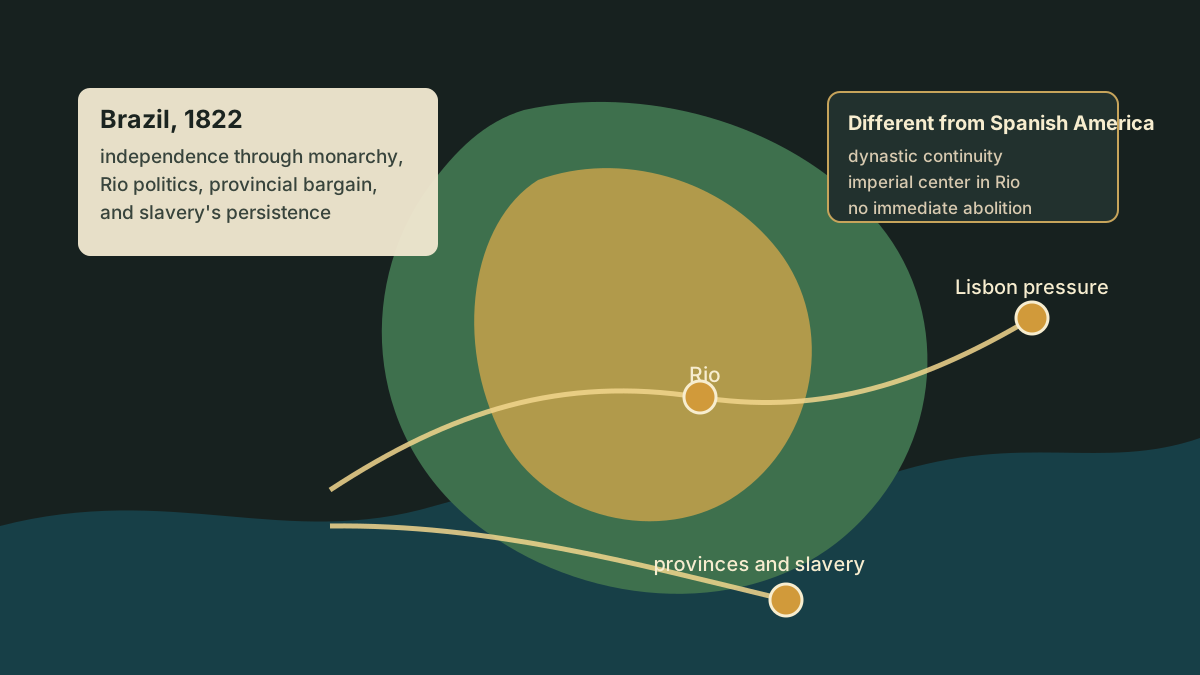
These background pressures did not push a single cause forward but combined unevenly across regions, social groups, and institutions — law, diplomacy, military presence, and elite calculation all mattered, even as other voices and experiences remained less visible in official records. Brazil's independence followed a path unlike most Spanish American revolutions. The Portuguese royal court had moved to Rio de Janeiro during the Napoleonic wars, making Brazil a center of empire rather than a distant colony. When politics in Portugal demanded that Brazil return to subordinate status, Dom Pedro faced pressure from Brazilian elites who wanted autonomy without social revolution. Slavery, monarchy, provincial loyalties, Atlantic commerce, and fear of fragmentation all shaped the result.
Independence was dramatic, but it was also conservative in important ways.
The Turning Point
The decisive moment around Brazil’s separation from Portugal turned on concrete choices by Pedro I and the country’s elites in Rio de Janeiro and São Paulo. Rather than turning toward republican experiments sweeping parts of Spanish America, key actors opted to transfer sovereignty from a distant monarch to a resident imperial ruler. That choice preserved a monarchical framework: a crown remained, but its political center shifted from Lisbon to a Brazilian court. Leaders who might have sought radical social or institutional reordering instead prioritized continuity of central authority and territorial integrity. The decision was enacted through political negotiation, symbolic assertion of independence, and administrative reorganization that reconfigured legal and diplomatic ties.
Crucially, the process prioritized some evidence over others: official proclamations and diplomatic correspondence emphasized unity and legality, while less formal sources — local testimony, material culture, and the memories of communities affected by change — reveal contested meanings and uneven experiences of the separation. The turning point thus combined visible high-level decisions with quieter disruptions on the ground. The turning point came when Pedro chose to remain in Brazil and then declared independence rather than obey Lisbon's demands. This choice was personal, dynastic, and political at once. It gave Brazilian elites a monarch who could claim continuity while rejecting Portuguese control. That helped prevent some of the fragmentation seen elsewhere in Latin America, but it also preserved deep hierarchies.
The new empire did not abolish slavery or democratize power. It transformed sovereignty while protecting much of the social order.
Consequences
In the near term, the separation produced a new imperial polity — Brazil became an independent empire rather than a republic — with Pedro I as its figure of authority and elites largely maintaining influence. That continuity smoothed some transitions: administrative functions, diplomatic negotiations, and the framework of governance remained recognizable even as sovereignty shifted. In the longer term, Brazil’s path complicated common narratives of Latin American independence as uniformly republican or fragmented. The preservation of territorial unity under a monarchy shaped subsequent debates about centralization, regional power, and the forms of political legitimacy available across the hemisphere.
It also left a layered historical record: official archives and constitutional texts tell one story; oral traditions, local legal disputes, and material traces can tell different ones about who benefited, who resisted, and how communities experienced the change. Because historians and publics center different kinds of evidence, interpretations of Brazil’s independence continue to diverge — each source reveals limits and possibilities that the others do not. The consequences made Brazil a rare postcolonial monarchy in the Americas. The empire held together a vast territory, but regional revolts, slavery, Indigenous dispossession, and elite politics remained central problems. Independence created a Brazilian state without resolving who belonged fully inside it.
The long delay before abolition in 1888 shows how political independence and social emancipation can move on very different timelines. The page matters because it complicates any simple equation between independence and freedom.
Interpretation Notes
Interpretations of Brazil Declares Independence depend on whose evidence is centered: rulers and official records, affected communities, oral memory, archaeology, law, diplomacy, labor, and later public memory do not always tell the same story.
Why Keep Reading
Follow the next timelines and related events to see how Brazil’s imperial choice played out in law, diplomacy, and everyday life. Tracing subsequent constitutional debates, regional uprisings, and international recognition reveals how a monarchical independence affected governance, trade, and claims to citizenship. Reading what happened next also shows the tension between elite decision-making and the lived experiences of towns, plantations, and hinterlands — the places where official continuity met practical contestation. If you want to understand how one independence could produce very different political futures across Latin America, the next entries show the consequences across decades and across social groups. Read next into Spanish American independence, Brazilian abolition, Haiti, and Atlantic slavery.
Brazil helps readers compare different routes from empire to nationhood. That comparison makes the survival of monarchy and slavery impossible to miss.
Reading Path
Follow the story without losing the thread
Before This
After This
Same Period
Wider Timeline
Mind Map
How to think about Brazil Declares Independence
Elite calculation
Brazilian elites chose a path that preserved their influence by supporting monarchical continuity rather than radical republican reform.
Map Layer
Where this event sits geographically
Gold pins mark the approximate locations of published event pages. This is a schematic locator map, not a historical border map.
Coordinates are approximate and are used to help readers orient themselves before opening a full event page.
References
Where to Check the Facts
- Primary Source Set: Latin American RevolutionariesPrimary-source set reference for Latin American revolutionary leaders, documents, and independence politics.
- Library of Congress: Hispanic Reading Room CollectionsArchive and collection reference for Latin America, the Caribbean, Iberian worlds, and related primary materials.
- Cambridge University Press: The Cambridge History of Latin AmericaSpecialist scholarly synthesis for colonial society, independence, republic-building, regional variation, and modern Latin American historiography.
- Oxford Research Encyclopedia of Latin American HistoryPeer-reviewed reference for Latin American history themes, regional debates, social history, and competing interpretations.
- John Carter Brown Library: Spanish America collectionPrimary-source collection reference for Spanish American independence, printed political culture, maps, and early republican debate.
- Encyclopaedia Britannica: Latin America independenceReference for Spanish American and Portuguese American independence movements.
- Encyclopaedia Britannica: History of Latin AmericaReference for Latin American colonial, independence, national, and modern history.
- Official UNESCO World Heritage Centre: City of PotosiInstitutional reference for Potosi's mining city, colonial extraction, and global silver economy.