At a Glance
The shape of the event
- Date
- 1888
- Place
- Rio de Janeiro
- Type
- Legislation
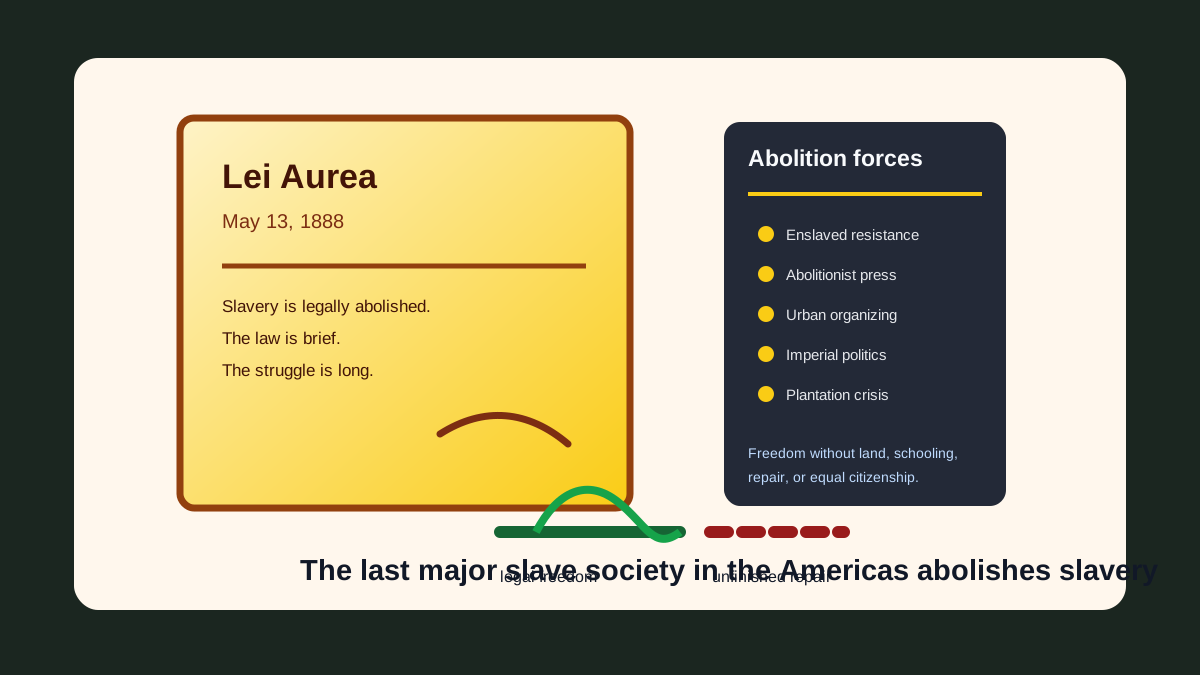
Brazil's Lei Aurea, or Golden Law, abolished slavery in the last major slaveholding society in the Americas.
1888; place the event in Rio de Janeiro before comparing causes or consequences.
The event makes Latin American abolition part of the Atlantic slavery route, not an afterthought to United States history.
Princess Isabel / Afro-Brazilian abolitionists are the first names or groups to compare before widening the story.
Legal slavery ended in Brazil without land redistribution or broad material repair for formerly enslaved people.
Legal slavery ended in Brazil without land redistribution or broad material repair for formerly enslaved people.
The event makes Latin American abolition part of the Atlantic slavery route, not an afterthought to United States history.
Follow this event into linked timelines and sources to see how law, memory, and material life diverged.
Background
By 1888, abolition in Brazil arrived after long, uneven pressures from many directions. Afro-Brazilian abolitionists organized, litigated, protested and kept freedom on the public agenda; their evidence—personal testimony, community memory, and local activism—records the human stakes. At the same time, legal and diplomatic documents, elite correspondence, and parliamentary debate show pressures on the monarchy and ruling classes to change course. Export markets, labor shortages, and international anti-slavery opinion were part of the scene, but no single cause explains the outcome. Historians looking at law and government find decisions made in courtrooms and palaces; historians centering communities and oral memory emphasize networks of self-emancipation and everyday resistance. Archaeology and labor studies reveal further disjunctures between formal freedom and continued economic dependence.
That contested evidentiary landscape means the Golden Law can be told as an elite legal act or as the culmination of popular struggle—often both at once. The context for 1888 is therefore a braided set of pressures: grassroots action, institutional choice, and shifting international currents that together made abolition possible and incomplete. Brazil's Golden Law needs more than a celebratory abolition date. It came after a long crisis of slavery shaped by enslaved resistance, quilombos, lawsuits, urban abolitionists, journalists, provincial politics, military change, plantation labor needs, and international pressure. The law was short, but the movement behind it was not. The monarchy's role also needs careful reading.
Princess Isabel's signature became famous, yet abolition weakened slaveholding support for the empire and did not provide land, compensation, schooling, or citizenship protections for freed people. Freedom arrived without a social repair program.
The Turning Point
The passage of the Golden Law in Rio de Janeiro marked a clear legal turning point: slavery, as recognized and sanctioned by the state, ended. Princess Isabel figures centrally in this moment as the member of the imperial household associated with the law’s enactment; Afro-Brazilian abolitionists supplied the sustained moral, political, and social pressure that placed emancipation on the agenda. The choice at the heart of 1888 was not simply whether to end slavery but how to end it. Lawmakers and the imperial authorities moved to eliminate legal bondage without instituting broad programs of land redistribution or state-led material reparation.
That decision closed one chapter of coercive labor by removing legal status but left unresolved how freedom would be lived and sustained in everyday work, housing, and civic life. In practice, the law transformed the legal status of millions overnight while leaving the structure of property and much of the economy intact. The turning point thus combined decisive legal abolition with a set of political choices that limited the state’s commitments to social and economic remedies for newly freed people. The turning point was the collapse of slavery's political defensibility. Flight, resistance, abolitionist organizing, and changing elite calculations made immediate abolition possible even in the hemisphere's last major slave society.
Consequences
In the immediate aftermath, the most straightforward consequence was the end of legal slavery in Brazil: the state no longer recognized the ownership of human beings. Yet the law’s framers and enforcers did not accompany abolition with widespread redistribution of land or substantial material repair; as a result, many newly freed people confronted precarious livelihoods, limited access to land, and persistent racialized inequality. Over the longer term, this combination—formal freedom without broad economic remedy—shaped settlement patterns, labor systems, and social hierarchies across Brazil. The Golden Law also altered historical geography: Brazil’s abolition moved Latin American emancipation from an appendix to U. S. -centered slavery histories into the foreground of Atlantic slavery studies.
Scholars and communities continue to wrestle with the law’s legacy because different sources tell different stories. Official records highlight the legal closure of slavery; community memory and material culture document continuities of marginalization and resistance. Archaeological and labor histories uncover everyday adaptations that official texts ignore. The result is a layered legacy in which legal change was necessary and decisive, but incomplete as a guarantor of social and economic justice. The afterlife includes the fall of the Brazilian monarchy, republican racial ideology, unequal labor markets, land exclusion, Afro-Brazilian activism, and memory struggles over who made abolition happen. The page therefore needs to follow both the legal endpoint of slavery and the social structures that survived abolition.
Interpretation Notes
Interpretations of Brazil's Golden Law depend on whose evidence is centered: rulers and official records, affected communities, oral memory, archaeology, law, diplomacy, labor, and later public memory do not always tell the same story.
Why Keep Reading
Follow this event into linked timelines and sources to see how law, memory, and material life diverged. If you want to understand what legal abolition did—and didn’t—do, read the petitions, newspapers, and community testimonies that immediately preceded and followed the Golden Law. Trace Afro-Brazilian abolitionist networks to learn how grassroots action shaped elite choices. Explore comparative abolition across the Americas to place Brazil on the Atlantic route of emancipation, not as an afterthought but as a central node. Each strand—legal records, oral memory, archaeology, and labor history—reveals different consequences and offers concrete entry points for the next chapter of the story. Read the Golden Law with Haiti, the Atlantic slave trade, Cuba abolition, the U. S.
Civil War, and Latin American independence to compare emancipation without equal citizenship.
Reading Path
Follow the story without losing the thread
Before This
After This
Same Period
- Haitian Revolution Begins1791 CE
- American Civil War BeginsApril 12, 1861
- Emancipation ProclamationJanuary 1, 1863
Wider Timeline
Mind Map
How to think about Brazil's Golden Law
abolitionist pressure
Afro-Brazilian activists and communities sustained public campaigns and local resistance that made abolition politically salient.
Map Layer
Where this event sits geographically
Gold pins mark the approximate locations of published event pages. This is a schematic locator map, not a historical border map.
Coordinates are approximate and are used to help readers orient themselves before opening a full event page.
References
Where to Check the Facts
- Primary Source Set: Latin American RevolutionariesPrimary-source set reference for Latin American revolutionary leaders, documents, and independence politics.
- Library of Congress: Hispanic Reading Room CollectionsArchive and collection reference for Latin America, the Caribbean, Iberian worlds, and related primary materials.
- Cambridge University Press: The Cambridge History of Latin AmericaSpecialist scholarly synthesis for colonial society, independence, republic-building, regional variation, and modern Latin American historiography.
- Oxford Research Encyclopedia of Latin American HistoryPeer-reviewed reference for Latin American history themes, regional debates, social history, and competing interpretations.
- John Carter Brown Library: Spanish America collectionPrimary-source collection reference for Spanish American independence, printed political culture, maps, and early republican debate.
- Encyclopaedia Britannica: Latin America independenceReference for Spanish American and Portuguese American independence movements.
- Encyclopaedia Britannica: History of Latin AmericaReference for Latin American colonial, independence, national, and modern history.
- Official UNESCO World Heritage Centre: City of PotosiInstitutional reference for Potosi's mining city, colonial extraction, and global silver economy.
- The National Archives: British transatlantic slave trade recordsOfficial research guide reference for British slave-trade records and digitised legislation including the Abolition of the Slave Trade Act 1807 and Slavery Abolition Act 1833.
- Official archive: Emancipation ProclamationReference for the United States Emancipation Proclamation and its legal setting.
- Legifrance: French abolition decree, 1848Official legal reference for the 1848 abolition of slavery in French colonies and possessions.
- Gilder Lehrman Institute: Frederick Douglass, 1852Primary-source teaching reference for Douglass's abolitionist Fourth of July address.
- Yale Archives: Cuban slavery collectionArchival reference for Cuban slavery and the 1886 abolition date.
- Encyclopaedia Britannica: William WilberforceBiographical reference for Wilberforce, parliamentary abolitionism, the 1807 slave-trade abolition, and the 1833 slavery abolition act.
- Encyclopaedia Britannica: Slavery Abolition ActReference for British abolition of slavery in much of the empire.