At a Glance
The shape of the event
- Date
- 1791 CE
- Place
- Saint-Domingue
- Type
- Revolution
Enslaved people in Saint-Domingue rose against plantation slavery, turning the French colony into the center of the Atlantic world's most radical revolution.
1791 CE; place the event in Saint-Domingue before comparing causes or consequences.
The revolution challenged racial slavery, terrified slaveholding societies, and widened the meaning of revolutionary freedom.
Toussaint Louverture / Jean-Jacques Dessalines are the first names or groups to compare before widening the story.
The struggle eventually destroyed slavery in the colony and led to Haitian independence.
The struggle eventually destroyed slavery in the colony and led to Haitian independence.
The revolution challenged racial slavery, terrified slaveholding societies, and widened the meaning of revolutionary freedom.
Explore the years that followed 1791 to see how the revolution moved from revolt to state-building: how leaders navigated alliances with France and other powers, how emancipatory politics became law, and how a new nat...
Background
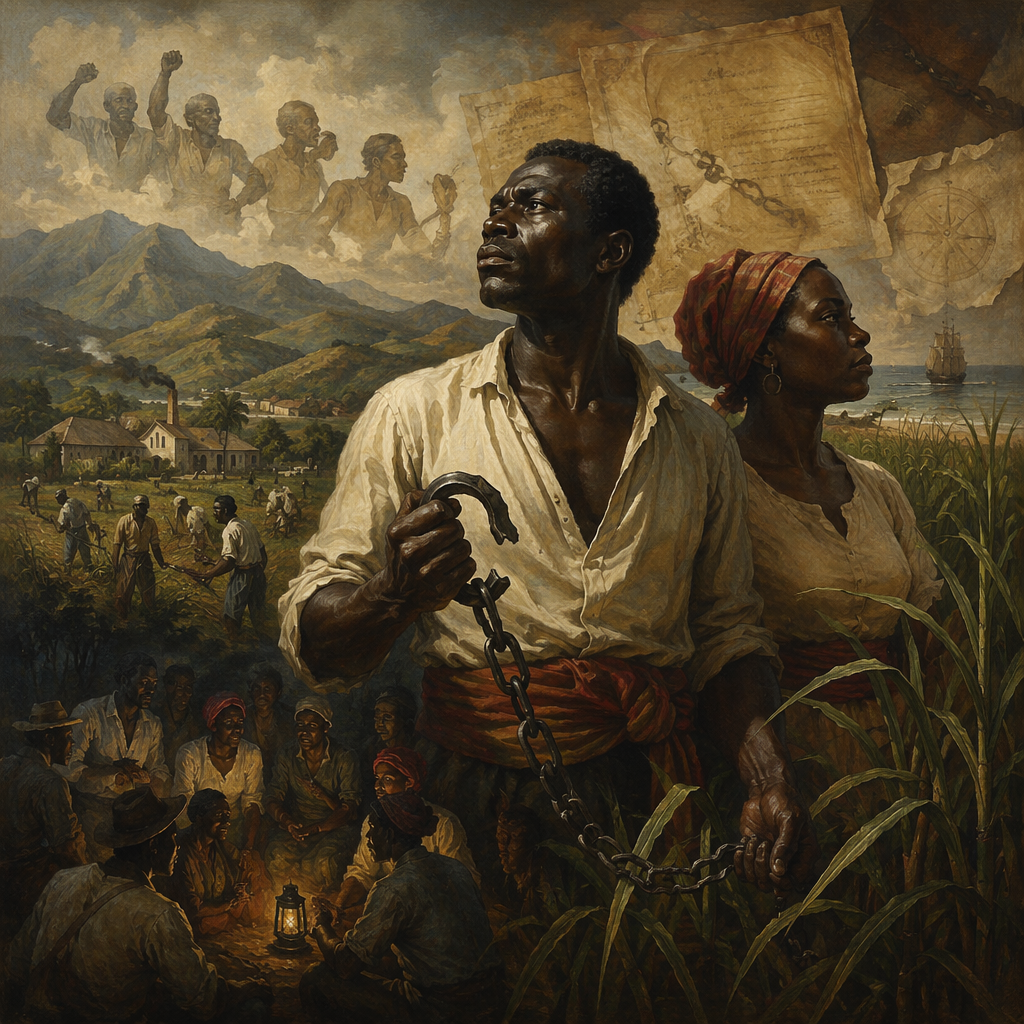
Saint-Domingue in the late eighteenth century was a place of extreme concentrations—of wealth, labor, and violence. The colony’s economy fed European demand for sugar and coffee through a plantation system that relied on the mass enslavement of Africans and their descendants. Social hierarchy there was rigid and racialized: enslaved people formed the majority, free people of color occupied an uneasy middle status, and white planters controlled land, trade, and local institutions. At the same time, the ideas and upheavals of the Atlantic world reached the colony’s ports and plantations.
News from the French metropole, debates about rights, and the logic of commercial empire all collided with local grievances: cruel labor regimes, family separations, legal discrimination, and the everyday tactics of resistance. Historians debate how far the revolt sprang from immediate, contingent choices by particular actors and how far it was driven by deeper structural pressures—demography, economic imperatives, and transatlantic political currents. This page does not resolve that debate; it presents the pressures and decisions that together made 1791 the opening of a revolutionary sequence. The Haitian Revolution needs enough room for Saint-Domingue before the uprising.
The colony was one of the richest and most brutal plantation societies in the Atlantic, built on sugar, coffee, racial hierarchy, French imperial competition, and the labor of enslaved Africans who carried memories, skills, languages, religious practices, and resistance strategies into plantation life. The revolt of 1791 was not only a reaction to the French Revolution, though revolutionary language mattered. Enslaved organizers, maroon networks, plantation intelligence, ritual gatherings, free people of color, white planters, Spanish and British intervention, and French policy shifts all shaped the struggle. The revolution becomes readable when local agency and Atlantic politics are kept together.
The Turning Point
The event that began in 1791 changed the colony’s political geography. What began as a series of coordinated uprisings by enslaved people quickly moved beyond episodic resistance to sustained challenges against plantation authority. Enslaved men and women attacked plantations, liberated communities, and disrupted the labor system that underpinned the colony’s wealth. Leadership emerged from within and around the insurgent ranks, and figures such as Toussaint Louverture and Jean-Jacques Dessalines would become central to the larger revolutionary process even if their prominence developed over years of conflict. Planters and colonial authorities faced a stark choice: attempt a brutal military repression to restore the old order, negotiate limited concessions, or seek metropolitan interventions.
Those choices fed back into the struggle: repression hardened insurgent resolve, while shifting alliances—among free people of color, enslaved fighters, and foreign powers—transformed a labor rebellion into a political revolution. The 1791 uprising thus marks a turning point not because it produced a single decisive battle, but because it initiated a sustained reordering of power in the colony, in which formerly enslaved people claimed political agency and redefined what emancipation and sovereignty could mean. The turning point was the transformation of an enslaved uprising into a revolutionary war over freedom, citizenship, empire, and sovereignty. Once abolition, military leadership, and international rivalry converged, Saint-Domingue became the center of a world-historical crisis.
Consequences
In the near term, the uprising produced widespread violence, social dislocation, and the collapse of large parts of the plantation economy: fields were abandoned, the labor system unraveled, and governability became contested. Over the following years, the struggle evolved through shifting coalitions, military campaigns, and diplomatic maneuvers. Ultimately the revolution destroyed slavery within the colony and led to Haitian independence—an outcome that unfolded through complex political and military processes rather than a single decisive moment. The longer-term consequences reached across the Atlantic: the revolution challenged the legitimacy of racial slavery, unsettling slaveholding societies from the Caribbean to North America. It altered European imperial calculations about colonies and contributed to changing debates over emancipation in the nineteenth century.
The presence of a sovereign, formerly enslaved republic also complicated international diplomacy and trade, provoking economic isolation and political hostility from many nations. Interpretations differ about how much to attribute to individual leadership, contingency, or structural forces; historians continue to weigh the roles of choices by commanders, mass agency, economic collapse, and the ripple effects of global revolutionary politics. What is clear is that the Haitian Revolution shifted the stakes of freedom and forced societies built on slavery to confront their foundations. The consequences reached far beyond Haiti.
The revolution destroyed slavery in the colony, led to Black independence, frightened slaveholding societies, challenged European racial ideology, and forced later movements to reckon with a freedom struggle led by enslaved people themselves. Its isolation and debt burdens also show how revolutionary victory could be punished by the world around it.
Interpretation Notes
Haitian Revolution Begins can look simple when reduced to one date, but the evidence usually points to a wider setting. The useful debate is which part mattered most: leadership, logistics, belief, social pressure, or the institutions that survived afterward.
Why Keep Reading
Explore the years that followed 1791 to see how the revolution moved from revolt to state-building: how leaders navigated alliances with France and other powers, how emancipatory politics became law, and how a new nation survived economic ostracism and diplomatic isolation. Follow Toussaint Louverture’s rise, Jean-Jacques Dessalines’s role in securing independence, and the broader Atlantic conversations about rights, labor, and empire. Reading the subsequent campaigns and diplomatic struggles reveals how a local uprising remade global debates about slavery and sovereignty—and why those reverberations still matter for how we understand revolution and human freedom today. Read Haiti with the French Revolution, Atlantic slavery, abolition, Toussaint Louverture, U. S. emancipation, and Latin American independence.
That path reveals why 1791 belongs at the center of modern freedom history.
Reading Path
Follow the story without losing the thread
Before This
- Haitian Revolution Begins1791 CE
- French Revolution Begins1789 CE
- Storming of the BastilleJuly 14, 1789
After This
- Execution of Louis XVIJanuary 21, 1793
- Smallpox Vaccine1796 CE
- Grito de Dolores1810
Same Period
- Declaration of IndependenceJuly 4, 1776
- French Revolution Begins1789 CE
- Storming of the BastilleJuly 14, 1789
Wider Timeline
Mind Map
How to think about Haitian Revolution Begins
Plantation slavery
The colony’s sugar- and coffee-based plantation system relied on coerced labor and harsh discipline, creating widespread grievances that fuelled mass revolt.
Map Layer
Where this event sits geographically
Gold pins mark the approximate locations of published event pages. This is a schematic locator map, not a historical border map.
Coordinates are approximate and are used to help readers orient themselves before opening a full event page.
References
Where to Check the Facts
- Library of Congress: U.S. History Primary Source TimelinePrimary-source timeline reference for Atlantic settlement, colonial expansion, reform, and later U.S. history paths.
- Encyclopaedia BritannicaBackground reference for chronology, names, and historical context.
- WikidataStructured reference for dates, places, alternate names, and entity links.