Central Question
Why do revolutions promise freedom but often create new conflicts over power?
Start With These Dates
- 1642 CEEnglish Civil War Begins
Conflict between King Charles I and Parliament broke into war after disputes over taxation, religion, military command, and royal authority.
- 1688 CEGlorious Revolution
James II was replaced by William and Mary after elite opposition invited Dutch intervention, recasting the relationship between crown and Parliament.
- July 4, 1776Declaration of Independence
The Continental Congress adopted a declaration that presented the American colonies as independent states and justified separation from Britain.
- 1789 CEFrench Revolution Begins
Fiscal crisis, social inequality, Enlightenment politics, and popular mobilization pushed France into revolution against the old regime.
- June 18, 1815Battle of Waterloo
Coalition forces defeated Napoleon near Waterloo, ending his brief return to power and closing the Napoleonic Wars.
- 1917 CERussian Revolution
War, hunger, strikes, and political collapse brought down the Romanov monarchy and opened the way for Bolshevik seizure of power.
- August 1947Indian Independence and Partition
British India became independent as India and Pakistan, while partition produced mass migration, communal violence, and unresolved border questions.
Sources Used Here
- Library of Congress: The American Revolution
Institutional reference for revolutionary ideas, independence, rights language, and new government design.
- Library of Congress: Declaration of the Rights of Man and of the Citizen
Primary-source reference for rights language in the French revolutionary tradition.
- Encyclopaedia Britannica: French Revolution
Reference for the causes, chronology, political crisis, and consequences of the French Revolution.
- Encyclopaedia Britannica: Russian Revolution
Reference for the 1917 revolutions, imperial collapse, Bolshevik power, and Soviet aftermath.
Revolutions, Rights, and Nationhood is designed as a route, not a folder. It gathers events that answer related reader questions about power, belief, conflict, exchange, institutions, and memory. The strongest way to read the page is to move from the earliest events toward the later ones, watching how one kind of pressure changes form across different places.
The route currently runs from July 4, 1776 to August 1947. That span lets readers compare immediate turning points with slower consequences: the founding of institutions, the spread of ideas, the shock of war or disease, and the way later societies reused earlier events as warnings, models, or symbols.
Start with Declaration of Independence, French Revolution Begins, Haitian Revolution Begins, English Civil War Begins, Glorious Revolution and then follow the internal links into people, timelines, years, maps, and source lists. The route structure stays visible when each event explains why it belongs with the others and where the next useful page is.
Compare the events by scale. Some are concentrated moments, such as a battle, proclamation, trial, or publication. Others are long processes, such as a reform movement, pandemic, trade route, or diplomatic order. Reading both types together helps prevent the page from becoming a list of dates.
A useful route keeps uncertainty visible. Historical change rarely has one cause or one clean ending, so the reader can separate background pressure, immediate trigger, turning point, result, and later memory. That pattern is what makes the atlas expandable without making the reader start over each time.
This route is also a comparison tool. After reading one event, compare it with a later event on the same page and ask what changed in scale, language, geography, technology, authority, or public memory. The comparison is often more useful than the individual summary because it reveals the pattern the topic page is built to expose. When a claim feels too neat, open the full event page and check whether the evidence supports one cause, several causes, or a contested interpretation before moving on.
This route is not a parade of heroic uprisings. It is a study of what happens when legitimacy breaks and people begin arguing that authority must be rebuilt around rights, representation, nationhood, class, race, citizenship, or sovereignty. The American, French, Haitian, Mexican, Russian, Chinese, and Indian examples do not answer the same question in the same way. That variety is the point: revolutions promise a new political language, but the struggle over who counts inside that language usually continues after the old regime falls.
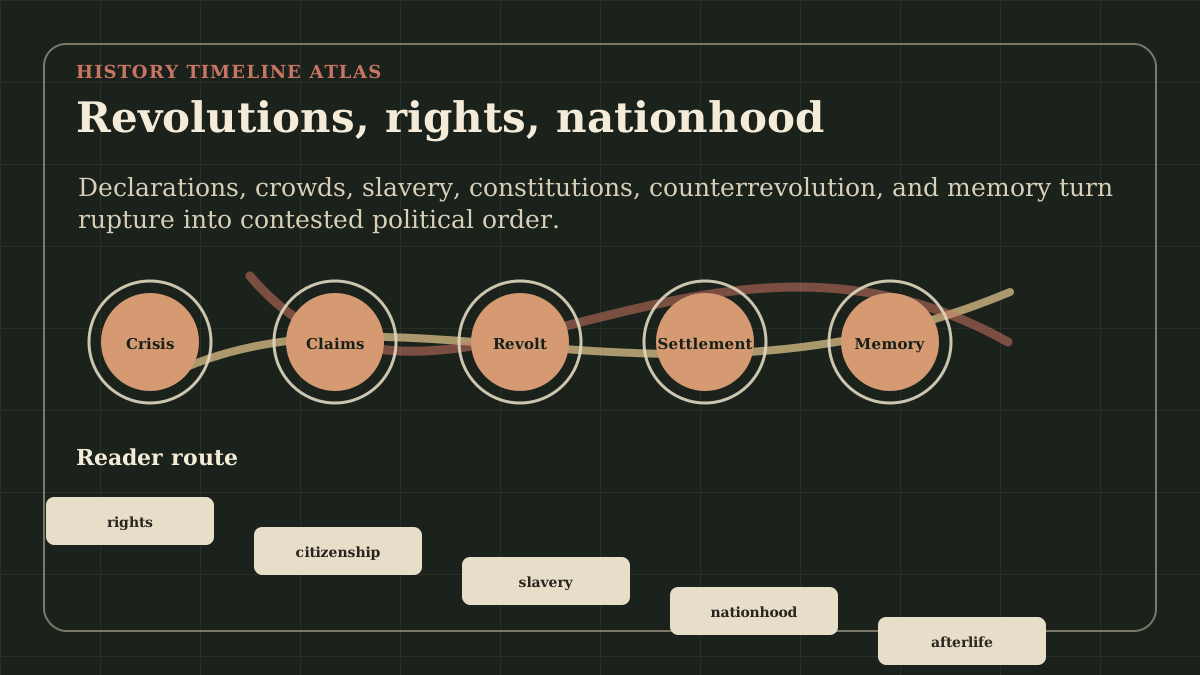
Read the hub by separating three layers. The first is pressure: taxes, imperial rule, social hierarchy, war debt, land, food prices, slavery, censorship, or failed reform. The second is rupture: a declaration, crowd action, military crisis, assembly, strike, or armed revolt makes compromise harder. The third is settlement: constitutions, republics, dictatorships, civil wars, independence states, party rule, or new exclusions reveal what the revolution could and could not deliver.
The route becomes more readable when Haiti stays beside the Atlantic and European cases. The Haitian Revolution forces the language of liberty to confront slavery, plantation violence, race, and colonial wealth. It also prevents the topic from becoming only a story of European political thought. Rights became world-historical because enslaved and colonized people tested whether universal language would actually include them.
The nineteenth- and twentieth-century pages add afterlife. Waterloo, 1848, the Paris Commune, the Mexican Revolution, Xinhai, Russia, and Indian independence show that revolution can become memory, export, fear, reform pressure, or state-building model. The hub therefore asks readers to follow promises and outcomes separately: a revolution may expand political imagination while also producing violence, exclusion, centralization, or a new ruling class.
The route begins with Atlantic rights because the language of liberty became global through contradiction. American independence made representation, taxation, imperial authority, and written constitutions visible, but it coexisted with slavery, Indigenous dispossession, gender exclusion, and property limits. The French Revolution widened the argument through citizenship, popular sovereignty, secular law, and mass mobilization. Haiti then made the contradiction impossible to hide by forcing liberty language to confront plantation slavery and racial empire.
Revolutionary geography matters. Boston, Paris, Saint-Domingue, Mexico City, Petrograd, Beijing, Delhi, and rural villages did not produce the same kind of rupture. Port cities carried news and commerce; capitals concentrated crowds, assemblies, soldiers, printers, and symbols; plantations exposed the violence behind Atlantic wealth; peasant regions raised land, tax, and food questions that urban manifestos could miss. A revolution route becomes richer when place explains why different actors entered the crisis.
Sources make revolutionary history vivid and dangerous at the same time. Declarations and constitutions preserve public ideals; court records preserve charges and punishments; newspapers spread rumor and argument; songs and images turn politics into memory; police files show surveillance; petitions show claims from below; memoirs defend or regret choices after the fact. No single revolutionary source is neutral. Each one fights for an audience.
The Haitian Revolution deserves extra weight because it changes the scale of the entire route. Enslaved people, free people of color, planters, French officials, Spanish and British forces, disease, plantation economics, and revolutionary law all interacted. The event forces readers to ask whether universal rights are universal only when the most excluded people can claim them. It also links this hub to Atlantic slavery, decolonization, and modern racial politics.
Waterloo and 1848 show revolution as fear and recurrence. Napoleon's defeat did not erase revolutionary memory; it made conservative rulers, liberals, nationalists, soldiers, and reformers argue over how much of the revolutionary age could be contained. The revolutions of 1848 spread because social pressure, food prices, nationalism, liberal reform, workers' demands, and printed ideas crossed borders. Failure did not mean disappearance. Many defeated claims returned in later constitutions, parties, and national projects.
Social revolution changes the hub's center of gravity. The Paris Commune, Mexican Revolution, Russian Revolution, and Chinese revolution routes ask about class, land, workers, peasants, party organization, army loyalty, and state coercion. Rights language remains important, but it sits beside food, wages, factories, villages, debt, and armed organization. The route becomes more useful when readers see that some revolutions ask who rules, while others ask who owns, works, eats, and commands.
Nationhood gives another pattern. Xinhai and Indian independence show revolution merging with sovereignty, anti-imperial struggle, constitutional imagination, and post-imperial state formation. A national revolution can create a new public language while leaving questions of region, minority protection, gender, class, and borders unresolved. The path from old regime to new nation is therefore never only celebratory. It is also administrative, violent, and contested.
Visual material has a clear role. A declaration image reveals public ideals; a crowd scene reveals mass politics; a map of Saint-Domingue or 1848 reveals spread; a portrait reveals memory-making; a barricade image reveals urban space; a constitution or newspaper reveals how language traveled. The route gains momentum when visuals show claims becoming public rather than when they merely decorate famous names.
The best next-click structure is comparative. Readers can start with causes, then move to turning points, then outcomes, then afterlives. American and French pages compare rights language; Haiti compares slavery and freedom; 1848 compares contagion and defeat; Mexico and Russia compare land and class; Xinhai and India compare nationhood and state-building. This keeps a broad search intent from splitting into thin duplicate pages.
The closing synthesis is that revolutions are promises under pressure. They can open rights language, expand participation, destroy old privileges, and inspire later movements. They can also centralize violence, narrow citizenship, create new elites, and disappoint the people who made them possible. The hub is compelling when readers follow both truths at once.
A people-first reading gives the route more texture. Taxpayers, enslaved workers, women market sellers, soldiers, printers, priests, lawyers, artisans, peasants, students, workers, Indigenous communities, and political prisoners all entered revolutionary politics differently. Some became celebrated citizens; others supplied labor, food, news, or bodies without gaining equal power. The route becomes more honest when participation and reward are kept separate.
Counterrevolution is not just reaction. Monarchs, slaveholders, colonial officials, landowners, clergy, army officers, foreign states, and frightened citizens often opposed revolution for different reasons. Some feared disorder; some defended privilege; some feared anti-religious violence; some feared slave revolt; some feared foreign invasion. Reading counterrevolution carefully helps explain why revolutionary change often becomes war, emergency law, censorship, or military rule.
Time scale also matters. A revolution can happen in days, but its consequences unfold across decades. July 1789, August 1791, February 1848, October 1917, 1911, 1910, or 1947 can mark rupture, but constitutions, land reform, citizenship rules, party systems, civil wars, and memories develop later. The route helps readers treat dates as entry points into long processes rather than as isolated endings.
The route also links to people and year pages. Washington, Robespierre, Toussaint Louverture, Hidalgo, Zapata, Lenin, Sun Yat-sen, Gandhi, and many less famous organizers reveal strategy, charisma, compromise, and coercion. Years such as 1776, 1789, 1791, 1848, 1910, 1911, 1917, and 1947 become anchors because they mark moments when claims over authority became publicly irreversible.
For search readers, the broad answer is that revolutions have causes, turning points, effects, and afterlives. Causes include fiscal pressure, war, empire, slavery, land, food, inequality, failed reform, and legitimacy crisis. Turning points include declarations, crowd action, military defection, armed revolt, and symbolic violence. Effects include new rights language, new states, civil war, repression, reform, and public memory. The hub holds those layers together.
The final comparison is between revolution as liberation and revolution as state formation. Liberation names the moment when old authority breaks. State formation names the harder work of courts, armies, taxes, schools, borders, parties, police, and public memory. Many disappointments appear in the gap between the two. That gap gives the route its depth.
Revolutionary violence also has to be compared by function, not only intensity. Some violence defends an old order; some destroys institutions; some enforces emergency rule; some becomes terror; some becomes civil war; some becomes later myth. The route asks what the violence did politically and who was made vulnerable by it.
The hub's strongest reading path moves from rights to exclusion, then from exclusion to organization, then from organization to settlement. A visitor can follow declarations, enslaved revolt, food protest, peasant mobilization, party discipline, anti-colonial sovereignty, and constitutional memory. That path turns a broad topic into a sequence of questions rather than a pile of revolts.
The final reason this topic matters is that modern political language still borrows from revolutionary history. Rights, nation, people, citizen, class, liberation, reaction, terror, reform, and counterrevolution are not neutral labels. They are words shaped by conflicts in which people argued over who had authority to remake the world.
The route also gives readers a way to compare scale. A local riot can expose legitimacy failure; a capital uprising can paralyze a regime; a colonial revolt can unsettle an empire; a social revolution can reorganize land and class; an anti-colonial revolution can create a new state. The same word, revolution, covers different scales of rupture.
A final source question keeps the route grounded. Revolutions produce too much rhetoric and too much silence at the same time. The loudest voices write manifestos and memoirs, while many laborers, women, enslaved people, rural communities, and defeated factions appear only indirectly. Reading revolution well means asking who got to speak, who was spoken for, and who paid the cost.
Read the events in order first; the page is built to reveal change over time.
Ask which pressures existed before the visible turning point and which actors had room to choose.
Follow what changed afterward in institutions, borders, law, belief, or everyday life.
Notice which events became symbols and why later generations kept returning to them.
Ask why the old order lost authority and which groups believed they had the right to rebuild it.
Read declarations beside slavery, gender limits, property rules, race, class, empire, and citizenship boundaries.
Track when violence destroys old institutions, when it creates new coercion, and when it becomes later memory.
Follow how later movements reused revolutionary language as model, warning, unfinished promise, or threat.
Compare land, wages, food, factories, peasant life, and party power beside declarations and constitutions.
Track how news, print, refugees, armies, empires, and later memory carried revolutionary language across borders.
Choose a Reading Path
Start With the Timeline
Use the related timeline first when you want a chronological route through the topic.
Start with 1642 CE: English Civil War BeginsOpen a Person Page
Use people pages when the topic is easier to understand through leadership, resistance, reform, or memory.
Start with 1688 CE: Glorious RevolutionUse Year Pages
Use year pages when you need a fast answer to what changed in a specific year.
Start with July 4, 1776: Declaration of IndependenceReturn to the Map
Use the map to keep geography visible while moving between events and regions.
Start with 1789 CE: French Revolution BeginsAtlantic Rights
Start with 1776, 1789, and Haiti to compare liberty language with slavery, empire, and citizenship.
Start with June 18, 1815: Battle of WaterlooEuropean Upheaval
Move through Waterloo, 1848, and the Paris Commune to see revolution as memory and recurring fear.
Start with 1917 CE: Russian RevolutionSocial Revolution
Use Mexico and Russia when the question is land, class, party power, peasant life, and state coercion.
Start with August 1947: Indian Independence and PartitionNationhood
Follow Xinhai and Indian independence to see revolution and sovereignty become state-building projects.
Read the Sources
Use declarations, petitions, newspapers, songs, court records, memoirs, and images to compare ideals with lived conflict.
How the Story Builds
Begin with Declaration of Independence. The opening event usually shows the pressure that made the route necessary: a crisis of authority, an expanding exchange system, a new technology, a contested idea, or a conflict that older institutions could no longer contain.
American Civil War Begins works as a checkpoint because it lets readers ask what had become irreversible, which actors still had choices, and how the route changed scale between the opening event and the later consequences.
The later edge of the route includes Xinhai Revolution, Russian Revolution, and Indian Independence and Partition. These pages help readers see what survived beyond the first shock: institutions, borders, laws, memories, technologies, movements, or arguments that kept shaping later history.
The route is easier to remember through people and places. Watch figures such as Thomas Jefferson, George Washington, John Adams, Louis XVI, Maximilien Robespierre, and Toussaint Louverture move through settings such as Philadelphia, Paris, Saint-Domingue, England, and London; that is where large structures become visible as choices, risks, costs, and memories.
Old regimes lose credibility when taxation, war, hierarchy, empire, or reform failure turns obedience into argument.
Declarations, assemblies, crowds, strikes, mutinies, and armed revolt make claims visible and compromise harder.
Every revolution creates opponents who fear disorder, loss of property, religious threat, foreign invasion, or social inversion.
The settlement reveals who actually gained rights, who was excluded, and which institutions replaced the old order.
Later movements reuse revolutionary language as warning, model, unfinished promise, or claim to legitimacy.
- Which event in Revolutions, Rights, and Nationhood feels like the true point of no return, and why might another reader choose a different event?
- What changes if the route is read from the perspective of ordinary people rather than rulers, armies, inventors, reformers, or institutions?
- Which consequence was immediate, and which consequence only became clear decades later?
- Where does the map change the interpretation by showing distance, borders, routes, ports, capitals, or frontiers?
- When does a reform crisis become a revolution rather than a negotiated settlement?
- Who is included in rights language, and who has to force that language to become real?
- Why do some revolutions build constitutional orders while others produce dictatorship, civil war, or party rule?
- How can revolutionary ideals be compared with the violence and exclusions that followed?
- What changes when Haiti, Mexico, Russia, China, and India stand beside the American and French cases?
- Which sources reveal the people who made revolutions but did not control the final settlement?
Interactive Timeline
Follow Revolutions, Rights, and Nationhood by sequence
English Civil War Begins
Conflict between King Charles I and Parliament broke into war after disputes over taxation, religion, military command, and royal authority.
Read the full event pageMap Layer
Revolutions, Rights, and Nationhood geography
Gold pins mark the approximate locations of published event pages. This is a schematic locator map, not a historical border map.
Coordinates are approximate and are used to help readers orient themselves before opening a full event page.
Route Events
Events in This Topic
English Civil War Begins
Conflict between King Charles I and Parliament broke into war after disputes over taxation, religion, military command, and royal authority.
Glorious Revolution
James II was replaced by William and Mary after elite opposition invited Dutch intervention, recasting the relationship between crown and Parliament.
Declaration of Independence
The Continental Congress adopted a declaration that presented the American colonies as independent states and justified separation from Britain.
French Revolution Begins
Fiscal crisis, social inequality, Enlightenment politics, and popular mobilization pushed France into revolution against the old regime.
Storming of the Bastille
Parisian crowds stormed the Bastille fortress during the French Revolution, turning political crisis into a visible attack on royal authority.
Haitian Revolution Begins
Enslaved people in Saint-Domingue rose against plantation slavery, turning the French colony into the center of the Atlantic world's most radical revolution.
Execution of Louis XVI
The French king Louis XVI was executed after trial by the revolutionary government, marking a decisive break with monarchy.
Battle of Waterloo
Coalition forces defeated Napoleon near Waterloo, ending his brief return to power and closing the Napoleonic Wars.
Revolutions of 1848
Revolutions broke out across Europe as liberals, nationalists, workers, and reformers challenged old regimes and social hierarchies.
American Civil War Begins
Confederate forces fired on Fort Sumter after secession, turning disputes over slavery, federal authority, and union into open war.
Paris Commune
Radicals and workers in Paris established the Commune after war and political collapse, governing the city before being violently suppressed.
Mexican Revolution Begins
Opposition to Porfirio Diaz opened a revolutionary period in Mexico shaped by demands for democracy, land reform, labor rights, and regional power.
Xinhai Revolution
The Xinhai Revolution overthrew the Qing dynasty and opened the way for the Republic of China after centuries of imperial rule.
Russian Revolution
War, hunger, strikes, and political collapse brought down the Romanov monarchy and opened the way for Bolshevik seizure of power.
Indian Independence and Partition
British India became independent as India and Pakistan, while partition produced mass migration, communal violence, and unresolved border questions.
References
Where to Check the Facts
- Library of Congress: The American RevolutionInstitutional reference for revolutionary ideas, independence, rights language, and new government design.
- Library of Congress: Declaration of the Rights of Man and of the CitizenPrimary-source reference for rights language in the French revolutionary tradition.
- Encyclopaedia Britannica: French RevolutionReference for the causes, chronology, political crisis, and consequences of the French Revolution.
- Encyclopaedia Britannica: Russian RevolutionReference for the 1917 revolutions, imperial collapse, Bolshevik power, and Soviet aftermath.