At a Glance
The shape of the event
- Date
- 1791 CE
- Place
- Saint-Domingue
- Type
- Revolution
The Haitian Revolution began as enslaved people and free people of color challenged plantation slavery, French colonial power, and racial hierarchy in Saint-Domingue.
1791 CE; place the event in Saint-Domingue before comparing causes or consequences.
Haiti gives the decolonization route an earlier Atlantic and anti-slavery foundation before the twentieth-century Global South wave.
Toussaint Louverture / Enslaved rebels are the first names or groups to compare before widening the story.
The uprising grew into a revolution that eventually created independent Haiti and destroyed slavery in the colony.
The uprising grew into a revolution that eventually created independent Haiti and destroyed slavery in the colony.
Haiti gives the decolonization route an earlier Atlantic and anti-slavery foundation before the twentieth-century Global South wave.
Follow the sequence of events that turned an uprising into a state to see how leaders, armies and diplomacy produced Haiti.
Background
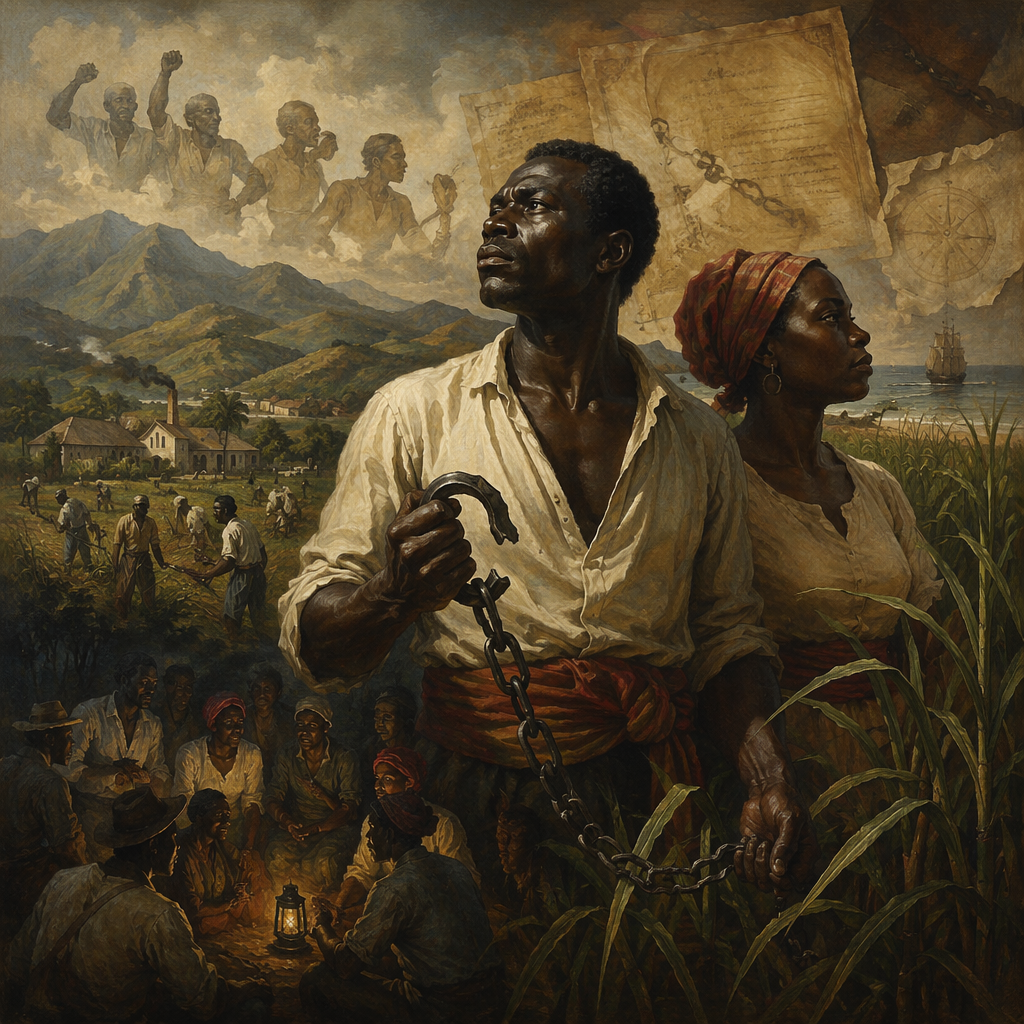
By 1791 Saint-Domingue was the richest colony in the Atlantic: sugar, coffee and indigo plantations produced enormous wealth for European owners and French investors. That wealth rested on a rigid racial order that legally divided people into enslaved Africans, free people of color, and white colonists—categories backed by violence, law and custom. The island’s enslaved majority endured brutal labor regimes, family separations, and everyday punishments that made life precarious and resistance persistent. At the same time, ideas circulating from the French Revolution—claims about liberty, equality and citizenship—provided new language and legal arguments that free people of color and some white reformers used to press for rights.
These pressures—economic extraction, legal inequality, everyday resistance, and revolutionary discussion—intersected without a single cause explaining everything. Local grievances, imperial politics, and the strategic choices of men and women on the island combined to make 1791 not a spontaneous accident but the moment when long-simmering crises found a new, explosive form. The Haitian Revolution began in Saint-Domingue, one of the most profitable and brutal plantation colonies in the Atlantic world. Sugar, coffee, enslaved labor, racial hierarchy, free people of color, French imperial law, and revolutionary language all collided there. The French Revolution opened debates over rights and citizenship, but the plantation system depended on denying those rights to the enslaved majority.
Free people of color pressed claims to equality; white planters fought over autonomy and privilege; enslaved people interpreted the language of liberty through their own experience of violence, labor, family separation, and spiritual community. That combustible structure made 1791 a moment when local grievances and Atlantic ideas became inseparable.
The Turning Point
The outbreak in 1791 changed the island’s trajectory by turning scattered acts of resistance into a coordinated rebellion against plantation slavery and colonial authority. Enslaved rebels and free people of color refused the legal and physical constraints placed upon them; they attacked plantations, destroyed records that enforced bondage, and seized arms. Those on the ground made immediate strategic choices—where to strike, which planters to confront, how to sustain momentum—that mattered far more than any single declaration in Paris. Command and leadership quickly became crucial. Figures associated with the island, including Toussaint Louverture, emerged into view as military and political actors who could organize troops, negotiate with rival factions, and navigate shifting loyalties between Spanish, British and French interests.
The turning point was not simply violence; it was a widening of participants’ aims. What began as rebellion against immediate abuses increasingly targeted the entire political order that made plantation slavery possible. In doing so the uprising turned a scene of revolt into the opening of a revolution that would remake sovereignty on the island. The uprising that began in the northern plain was organized through networks that colonial observers often underestimated. Night meetings, plantation communication, religious practice, trusted messengers, and military experience all mattered. The Bois Caiman ceremony occupies an important place in memory not because every detail is easy to verify, but because it captures a truth about collective commitment and spiritual-political resolve.
The early revolt targeted plantations, symbols of coercion, and the machinery of forced labor. It forced all other actors to respond: planters, French commissioners, free colored leaders, Spanish and British forces, and eventually Toussaint Louverture. The turning point was the moment enslaved people made themselves central political actors rather than objects in someone else's debate about rights.
Consequences
In the near term the 1791 uprising destabilized plantation production and forced European powers and colonial administrations to confront a crisis they had not anticipated. Militarized resistance, shifting alliances, and metropolitan turmoil prolonged conflict across the island through the 1790s. Politically, the rebellion pushed issues of citizenship and emancipation onto the metropolitan agenda; leaders on Saint-Domingue negotiated, fought, and at times struck deals with external powers as well as with rival internal groups. In the longer view, the uprising grew into a revolution that ultimately created independent Haiti and ended slavery in the colony—an outcome that reshaped Atlantic political possibilities.
The Haitian Revolution provided an earlier model of decolonization and anti-slavery struggle that complicated later histories which center twentieth-century movements as the starting point for global liberation. It also left a contested legacy: subsequent nation-builders, abolitionists, and colonial powers remembered and used the revolution in different ways. The immediate destruction of the old planter order and the long-term emergence of an independent Black republic made Saint-Domingue’s 1791 rupture a turning point with consequences that radiated far beyond the Caribbean. The consequences remade the Atlantic. The revolution led to emancipation, war against European powers, the rise of Black military and political leadership, and eventually Haitian independence in 1804.
It terrified slaveholding societies and inspired enslaved and free Black communities across the Americas. It also produced punitive isolation: France later imposed an indemnity, and many powers treated Haiti as a threat rather than a legitimate state. That afterlife matters because it shows how revolutionary success can be followed by economic punishment and diplomatic exclusion. Haiti's revolution was not an appendix to the French Revolution. It was one of the age's most radical transformations because it made universal rights confront plantation slavery directly.
Interpretation Notes
Haitian Revolution Begins is easy to flatten into one dramatic date. A stronger reading separates immediate action from deeper causes, affected communities, and the memory later states or movements built around the event.
Why Keep Reading
Follow the sequence of events that turned an uprising into a state to see how leaders, armies and diplomacy produced Haiti. Tracing the next years reveals how emancipation unfolded unevenly, how international powers reacted to a slave revolution, and how memory and myth shaped later political claims. If you want to understand how ideas from metropolitan revolutions met the hard choices of war and governance, the next entries—on military campaigns, legal emancipation, and Haitian independence—show the concrete steps by which a colony became a nation. Read next into Toussaint Louverture, Atlantic slavery, abolition, the French Revolution, and Latin American independence.
Haiti forces the reader to ask who was included when revolutionaries said liberty, and who had to fight to make the word real.
Reading Path
Follow the story without losing the thread
Before This
- Haitian Revolution Begins1791 CE
- French Revolution Begins1789 CE
- Storming of the BastilleJuly 14, 1789
After This
- Execution of Louis XVIJanuary 21, 1793
- Smallpox Vaccine1796 CE
- Zanzibar Clove Economy Expands1832 CE
Same Period
- Declaration of IndependenceJuly 4, 1776
- French Revolution Begins1789 CE
- Haitian Revolution Begins1791 CE
Wider Timeline
Mind Map
How to think about Haitian Revolution Begins
plantation economy
Sugar and coffee exports made Saint-Domingue economically critical and tied social order to forced labor.
Map Layer
Where this event sits geographically
Gold pins mark the approximate locations of published event pages. This is a schematic locator map, not a historical border map.
Coordinates are approximate and are used to help readers orient themselves before opening a full event page.
References
Where to Check the Facts
- The Haitian Revolution Timeline: Brown University Library ProjectUniversity-supported timeline reference for Haitian Revolution chronology, actors, and events.
- Primary Source Collection: John Carter Brown Library Haiti CollectionPrimary-source collection reference for Haiti, Saint-Domingue, and revolutionary-era materials.
- Library of Congress: A Lecture on the Haytien RevolutionsDigitized collection reference for an 1841 lecture on the Haitian Revolution and Toussaint Louverture.
- Encyclopaedia Britannica: Haitian RevolutionReference for the revolution, slavery, and independence in Haiti.
- Encyclopaedia Britannica: Toussaint LouvertureBiographical reference for Louverture and the Haitian Revolution.