Track the difference between independence as legal status, independence as control over institutions, and independence as lived political power.
Timeline
African Decolonization and Postcolonial States Timeline
A route through Pan-African organizing, Ghana, Mau Mau, Algeria, Congo, OAU, Biafra, Angola, Soweto, Rwanda, truth commissions, and postcolonial state-building.
Timeline Guide
How did African anticolonial movements turn empire into sovereignty, and why did freedom remain contested after independence?
Independence dates sit beside older African and diaspora histories, then widen into arguments over sovereignty, land, borders, one-party rule, Pan-Africanism, development, violence, and repair.
Independence maps show flags changing; the harder history follows how sovereignty, borders, land, parties, military power, race, development, memory, and everyday safety remained contested after the flag changed.
Great Zimbabwe belongs because African state capacity, stone cities, trade, cattle wealth, and political memory deserve their own place before colonial partitions. Haiti belongs as a Black anti-slavery revolution in the Atlantic world. Adwa and Maji Maji belong as anti-imperial struggles with their own stakes before they became later memory.
Haiti and India appear as comparison points, not replacements for African agency. Haiti showed a Black anti-slavery revolution overturning a plantation regime; India showed mass politics, partition, and negotiated imperial exit watched across empires. African activists, parties, unions, veterans, farmers, writers, and rulers adapted or rejected those examples in local struggles.
The comparison rule is simple: Haiti and India help explain vocabulary and strategy, but Accra, Conakry, Algiers, Dar es Salaam, Kinshasa, Luanda, Maputo, Soweto, Kigali, Asmara, and Johannesburg carry the route's main evidence. A Ghanaian organizer, a Guinean voter in 1958, a Mozambican FRELIMO fighter, a Soweto student, and a Rwandan survivor do not illustrate someone else's history; they are the history being followed.
Start With These Dates
- c. 1250 CEGreat Zimbabwe Flourishes
Great Zimbabwe reached a high point as a stone-built political and commercial center connected to cattle wealth, gold routes, regional authority, and Indian Ocean trade.
- 1791 CEHaitian Revolution Begins
The Haitian Revolution began as enslaved people and free people of color challenged plantation slavery, French colonial power, and racial hierarchy in Saint-Domingue.
- 1885 CEGerman East Africa Established
German East Africa emerged during the Scramble for Africa, turning coastal claims, chartered-company ambition, treaties, coercion, and inland conquest into colonial rule.
- March 1, 1896Battle of Adwa
Ethiopian forces defeated Italy at Adwa, preserving Ethiopian sovereignty during the age of European imperial partition.
- December 9, 1961Tanganyika Gains Independence
Tanganyika became independent from British rule, with Julius Nyerere and TANU turning nationalist organization into a new East African state.
- 1994Fall of Apartheid
South Africa held its first fully democratic elections, ending apartheid rule and bringing Nelson Mandela to the presidency.
- April-July 1994Rwandan Genocide
Extremist forces in Rwanda organized mass killing of Tutsi civilians and moderate Hutu during a rapid genocide that unfolded over roughly one hundred days.
- 1996 CESouth African Truth and Reconciliation Commission Hearings
South Africa's Truth and Reconciliation Commission held public hearings on apartheid-era abuses, linking testimony, amnesty, public memory, and democratic transition.
Sources Used Here
- Encyclopaedia Britannica: Algerian War
Reference for the 1954-1962 war for Algerian independence from France.
- Encyclopaedia Britannica: African Union
Reference for the Organization of African Unity, its 1963 founding, and the later African Union.
- Official African Union: OAU Charter
Official reference for the 1963 OAU Charter and the continental institution's founding framework.
- Official United Nations: Rwanda genocide historical background
Institutional reference for the 1994 genocide against the Tutsi in Rwanda and UN memory work.
- UNESCO: General History of Africa
African-history reference project for reading decolonization through African scholarship, regional diversity, culture, and postcolonial memory.
Francophone, Lusophone, Anglophone, and settler-colonial histories moved differently. Guinea's 1958 break with France, Ghana's negotiated independence, Algeria's settler war, Kenya's emergency, Mozambique's FRELIMO struggle, Angola's rival movements, Zimbabwe's liberation war, and South Africa's anti-apartheid transition do not fit one script.
Manchester delegates in 1945, crowds in Accra in 1957, Algerian villagers under counterinsurgency, MPLA and FRELIMO fighters in Lusophone wars, Soweto students in 1976, Rwandan survivors in 1994, and South African truth-commission witnesses each reveal a different path out of empire.
Regional differences are the point. West Africa includes Ghana's negotiated independence and Guinea's 1958 break with France; North Africa includes Algeria's settler war and Egyptian anti-imperial diplomacy; East Africa includes Tanganyika, Kenya, Ethiopia, and Eritrea; Central Africa includes Congo, Katanga, minerals, and Biafra's comparison point; Southern Africa includes Angola, Mozambique, Zimbabwe, Namibia, and apartheid South Africa. Nkrumah's call to seek political kingdom, Nyerere's self-reliance language, Cabral's culture-and-liberation arguments, and Fanon's violence debate show African voices disagreeing over freedom's route.
Flashpoints need local texture. Congo means Lumumba, Katanga, minerals, UN troops, and Cold War pressure; Biafra means federal power, oil, blockade, famine images, and civilian survival; Algeria means settler colonialism, torture, village war, exile, and memory on both sides of the Mediterranean.
Angola and Mozambique show Lusophone liberation through MPLA, UNITA, FNLA, FRELIMO, Portugal's Carnation Revolution, regional intervention, and socialist planning under fire. Rwanda is treated as genocide against the Tutsi, with moderate Hutu victims, propaganda, state organization, neighbors, survivor testimony, and international failure named directly.
Haiti matters here as an earlier Black revolution against slavery; India matters as a mass anti-colonial transfer watched across empires; the Universal Declaration gave rights language; Bandung gave newly independent states a diplomatic stage. These anchors explain vocabulary and strategy, not a substitute for African agency.
The non-African anchors are included for influence and comparison, not because they replace African history. Haiti showed enslaved people destroying a plantation regime and founding a Black republic; India showed mass politics, partition, and negotiated imperial exit; Bandung gave African and Asian leaders a shared stage. African movements then adapted, rejected, or reworked those examples in their own settings.
African and diaspora scholarship changes the route's center of gravity. Bethwell Ogot and the UNESCO General History of Africa make older African histories part of the frame; Terence Ranger helps readers think about memory and invention; Toyin Falola keeps social and cultural life visible; Mahmood Mamdani and Achille Mbembe push the page toward questions of citizenship, state violence, and postcolony. CODESRIA and South African History Online point readers toward African research communities rather than one outside institutional voice.
African debates were not uniform. Nkrumah pressed for rapid continental unity and socialist planning, while more gradualist and federal visions argued for sovereignty first, regional caution, or different balances between party, village, market, and state. Some movements defended inherited borders to avoid wider war; others criticized those borders as colonial traps. Land reform, one-party rule, labor rights, language policy, and Pan-Africanism divided leaders who all spoke the language of freedom.
Nkrumah, Nyerere, Amilcar Cabral, Frantz Fanon, trade unionists, women's organizers, church leaders, student activists, and rural communities make the route intellectual as well as political. Their arguments over culture, violence, socialism, land, language, and state power kept independence from becoming only a flag ceremony.
The page does not read freedom only through catastrophe. It also follows university debates, newspapers, trade unions, churches, women's organizing, rural development, public health, language policy, courts, music, and continental institutions where people tried to make sovereignty useful after the flag changed.
Violence stays sourced and specific: Rwanda means genocide against the Tutsi, killings of moderate Hutu and others, state power, propaganda, militia organization, neighbors, testimony, survivor memory, and international failure. Apartheid means pass laws, police, schools, labor, townships, prisons, armed and nonarmed struggle, and public truth-telling after formal transition.
This timeline narrows the broad Africa route around decolonization and postcolonial state-building. It begins with Pan-African organizing because independence did not appear from nowhere in the 1950s and 1960s. Diaspora activists, labor organizers, students, newspapers, churches, unions, parties, and returned veterans all helped turn empire into a problem that could be attacked in international language as well as local politics.
The first chapter follows nationalist breakthrough and colonial crisis. Ghanaian independence, Mau Mau, Algeria, Bandung, Congo, Tanganyika, and the OAU show that decolonization was not one peaceful handover. It included mass parties, rural insurgency, settler violence, Cold War pressure, diplomatic conferences, constitutional negotiations, and newly independent governments trying to define sovereignty inside borders drawn under empire.
The middle chapter shows how independence immediately produced hard questions. Arusha, Biafra, Angola, Soweto, and wider liberation struggles ask what a flag could do when land, resources, ethnic politics, party power, foreign intervention, apartheid, and development choices remained unsettled. The timeline keeps state formation and social cost together because postcolonial history is not only a victory story or a failure story.
The late chapter follows memory, justice, and repair. Mandela's release, apartheid's end, the Rwandan genocide, South Africa's truth commission, and later human-rights language show that the end of formal colonial rule did not end political violence or historical accountability. Some societies negotiated transitions; others faced catastrophic violence; many had to decide how law, testimony, elections, and public memory could carry grief without pretending it was solved.
The route also connects Africa to wider decolonization without making Africa a footnote to the Cold War. Haiti, India, Bangladesh, Vietnam, and Bandung appear as comparative links because anti-colonial movements learned from one another, international institutions created new forums, and imperial powers tried to manage retreat. Still, African actors remain central: Nkrumah, Nyerere, Lumumba, Mandela, Tutu, women organizers, rural communities, students, soldiers, workers, refugees, and survivors all changed the story.
A reader can use the page in three ways. For a timeline question, follow the sequence from organizing to independence to postcolonial crisis to memory. For a causes question, compare colonial coercion, nationalist mobilization, international pressure, and local political choices. For a significance question, ask how decolonization changed the United Nations, human-rights language, development debates, borders, education, and public memory.
Many African states became independent after 1945, but independence did not mean one simple ending. The story starts before the postwar wave without treating older African and diaspora histories as mere prelude. Great Zimbabwe is about African urban power, trade, cattle wealth, and political memory. Haiti is a Black anti-slavery revolution in the Atlantic world. Adwa is an Ethiopian victory over Italian invasion. Maji Maji is a rural war against German colonial coercion. Later movements remembered some of these moments, but each first deserves its own historical weight.
The post-1945 story then begins with movements, veterans, students, trade unions, churches, newspapers, village networks, and political parties using a changing international order to press claims that had local histories as well as global language.
The postwar opening is now clearer. The Fifth Pan-African Congress, Indian independence, the Universal Declaration of Human Rights, Mau Mau, Algeria, Bandung, and Ghana created a new language of legitimacy. Empire had to defend itself in a world of anticolonial organizing, veterans, labor movements, newspapers, churches, students, United Nations debates, and Asian-African diplomacy. Ghana's independence mattered because it turned possibility into a visible state example.
The first independence decade was not a simple parade of flags. Congo, Tanganyika, the OAU, Vietnam, Arusha, and Biafra show sovereignty under pressure from Cold War competition, resource politics, secession, development models, party institutions, and inherited borders. The timeline keeps external pressure and local decision-making together because postcolonial governments acted inside constraints rather than outside history.
African socialism and development debates deserve space. The Arusha Declaration belongs here because it asked how a postcolonial state could pursue self-reliance, rural development, education, and equality without simply copying capitalist or Soviet models. Its limits are part of the story, but so is the ambition. Decolonization did not end at independence ceremonies; it continued through policy choices about land, language, schools, villages, and state authority. Leaders and movements disagreed sharply over inherited borders, land reform, one-party rule, federalism, armed liberation, village development, private capital, and Pan-African unity; those disagreements are part of decolonization, not later noise.
The liberation-war and crisis section connects Africa to a wider Global South without losing African focus. Bangladesh and Vietnam serve as comparison points for partition, civil war, refugee movement, and the end of imperial war. Angola, Soweto, Mandela, apartheid, Rwanda, and the TRC keep African histories central through armed liberation, youth protest, negotiated transition, genocide, testimony, and memory.
The route also keeps affected groups visible. National leaders matter, but so do farmers under forced cultivation, detainees, guerrillas, women organizers, trade unionists, students, teachers, refugees, famine victims, survivors, clergy, lawyers, and families giving testimony. Decolonization changes meaning when read from the ground: a flag may change before land, school access, security, or public trust changes.
A serious source lens separates movement rhetoric from state policy and survivor record. Congress resolutions, independence speeches, UN declarations, colonial emergency files, military reports, refugee accounts, photographs, court records, and truth-commission testimony all carry different silences. The route becomes more trustworthy when readers can see why a genocide source is not used like a diplomatic treaty and why a nationalist speech is not the same as policy implementation.
The page's central question is not whether decolonization succeeded or failed. The better question is what kind of freedom each moment made possible, and what remained unresolved. Ghana opened a diplomatic and symbolic path. Congo exposed resource and Cold War fragility. Arusha tested development ideology. Biafra and Rwanda revealed catastrophic state violence. South Africa showed both negotiated transition and unfinished repair.
The story is strongest when read in layers. First, follow the dates from c. 1250 CE to 1996 CE. Then read across the event types: urban and political florescence, revolution, colonial rule, battle. The timeline becomes more than chronology when those dates reveal decisions, institutions, violence, reform, and memory.
Tanganyika Gains Independence sits near the middle of the sequence. Ask what had already become unavoidable by December 9, 1961, what actors still believed they could control, and which consequences were already beginning to move beyond the original setting.
The named events are Great Zimbabwe Flourishes, Haitian Revolution Begins, German East Africa Established, Battle of Adwa, Maji Maji Rebellion, Fifth Pan-African Congress. Each one pushes a more precise question: what changed, who benefited, who paid the cost, and what later page explains the aftermath more clearly?
Read the timeline against geography too. Places matter because power moves through corridors, borders, cities, ports, capitals, and frontiers. The map below keeps those distances visible while the event pages explain the human and institutional consequences.
A good timeline has a pulse: pressure, decision, expansion, resistance, and aftermath. When you move through Medieval Africa, Age of Revolutions, Scramble for Africa, African Anti-Colonial Resistance, and Colonial Africa, keep asking whether an event is creating a new problem, revealing a hidden weakness, or making an earlier choice harder to reverse.
The human layer matters because timelines can become too abstract. Figures such as Shona rulers, Gold traders, Toussaint Louverture, Enslaved rebels, Carl Peters, East African communities, and Menelik II help the sequence feel lived rather than mechanical. Their choices do not explain everything, but they show where institutions, ideas, military systems, social movements, and public fear entered real decisions.
The ending is not only the last date. With closing events such as Eritrea Becomes Independent, Fall of Apartheid, Rwandan Genocide, and South African Truth and Reconciliation Commission Hearings, the reader can ask what remained unsettled: which institutions survived, which arguments continued, which victims or opponents were left outside the official story, and which later crisis reused the same vocabulary.
Read this page once quickly for order, then read it again for contrast. Compare early confidence with later uncertainty, local decisions with global consequences, and visible turning points with slower changes in law, economy, belief, technology, borders, or memory. That second pass is where a timeline becomes an explanation.
Causation in this sequence is layered. One event may supply the trigger, another may reveal an older weakness, and a later event may show the consequence that people at the beginning did not expect. The useful habit is to separate background pressure, immediate decision, turning point, and aftermath before deciding which event matters most.
Consequences are uneven. A political settlement might look successful in one capital while creating resentment elsewhere; a military victory might end a campaign while deepening civilian trauma; a scientific or institutional breakthrough might solve one problem while creating new risks. The timeline is strongest when those mixed outcomes remain visible.
The final pass is comparative. After reading this sequence, open a neighboring topic or person page and ask whether the same pattern appears again. Repetition usually points to a structure; contrast usually points to a historical choice that could have gone another way.
Importance is not the same thing as drama. Some events are remembered because they were spectacular, while others matter because they changed rules, expectations, alliances, legal categories, technologies, or public language. Use the timeline to test both kinds of importance before deciding what belongs at the center of the story.
The page rewards moving outward. A timeline gives order, but the event pages give causes, maps, people, sources, and reading paths. When a date feels too compressed, open the full event page and then return here; the sequence becomes clearer with each pass instead of asking the reader to memorize a list.
Follow congresses, Bandung, the OAU, and liberation networks as routes that made African politics international.
Use Congo, Angola, Vietnam, and Bangladesh links to see how decolonization and superpower rivalry overlapped without becoming the same story.
Read Rwanda and the South African TRC as reminders that postcolonial history includes testimony, accountability, silence, and public grief.
Track the distance between international recognition and daily changes in land, policing, education, language, development, and public safety.
Use the OAU, liberation networks, and later truth processes to see African politics operating through regional and international forums.
For a fast route, follow Adwa, Maji Maji, Pan-African Congress, Ghana, Congo, OAU, Arusha, Soweto, Mandela, Rwanda, and the TRC.
Great Zimbabwe Flourishes gives the opening problem a date and place. Ask what was already unstable before it happened.
Tanganyika Gains Independence is a compression point: earlier causes are now crowded together with decisions that will shape the sequence's ending.
Follow the path through Great Zimbabwe, Saint-Domingue, Dar es Salaam, Adwa, German East Africa, and Manchester and ask how distance changed communication, logistics, fear, and control.
South African Truth and Reconciliation Commission Hearings works as both an ending and a beginning: it closes one sequence while opening later disputes, institutions, memories, or reforms.
Which conditions existed before the first event, and which later decision turned those conditions into visible historical change?
Who had the power to choose, who had fewer choices, and who is missing when the story is told only through leaders or institutions?
Which facts are date anchors, which are interpretations, and which claims need checking through the event sources before being repeated?
Which linked event, person, year, or topic page would change your interpretation if you read it next?
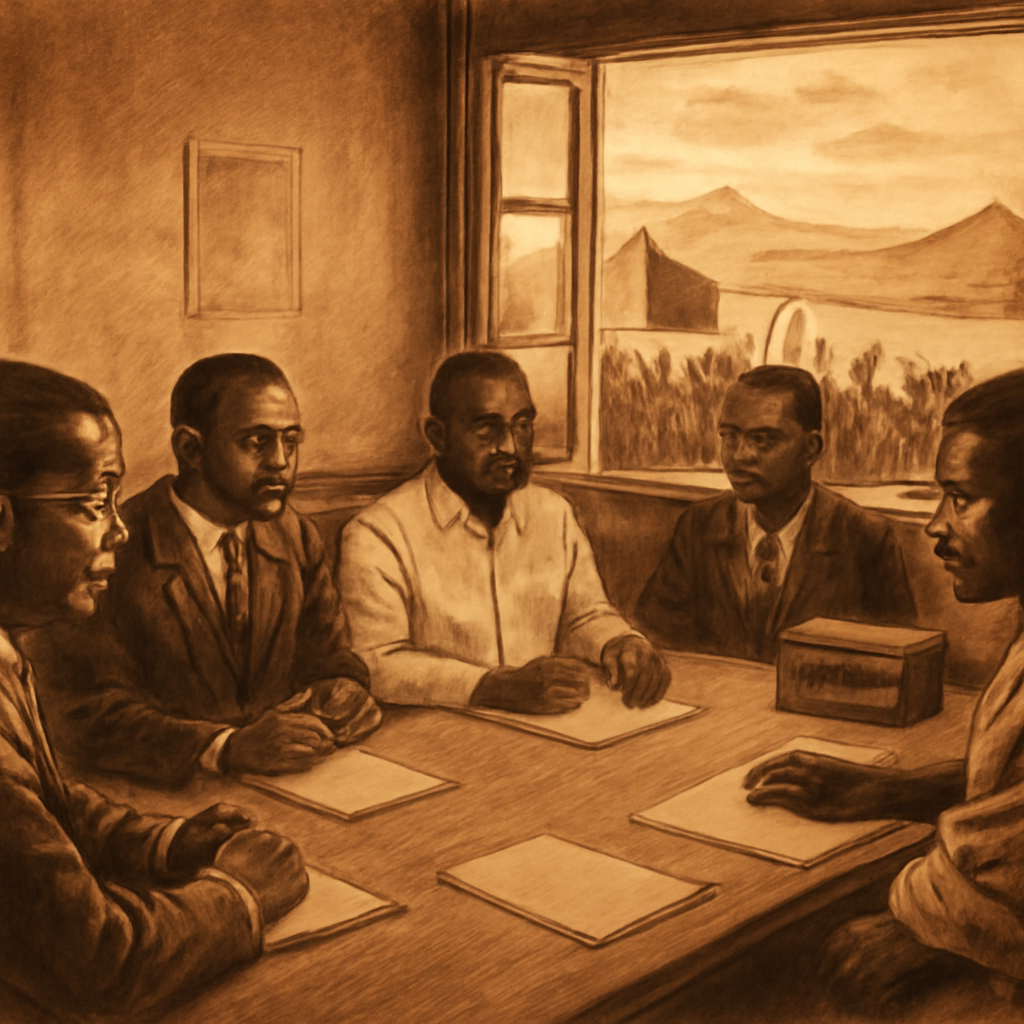
Interactive Timeline
Explore African Decolonization and Postcolonial States Timeline by sequence
Great Zimbabwe Flourishes
Great Zimbabwe reached a high point as a stone-built political and commercial center connected to cattle wealth, gold paths, regional authority, and Indian Ocean trade.
Read the full event pageNarrative Stages
Read this timeline in chapters
Older Roots of Anti-Colonial Politics
Precolonial statecraft, Haitian revolution, colonial conquest, Adwa, and Maji Maji show why African decolonization had roots before 1945.
- Great Zimbabwe Flourishesc. 1250 CE
- Haitian Revolution Begins1791 CE
- German East Africa Established1885 CE
- Battle of AdwaMarch 1, 1896
- Maji Maji Rebellion1905-1907 CE
Postwar Language and Asian-African Solidarity
Pan-African organizing, Indian independence, human-rights language, Mau Mau, Algeria, Bandung, and Ghana created new pressure on empire.
- Fifth Pan-African CongressOctober 1945
- Indian Independence and PartitionAugust 1947
- Universal Declaration of Human RightsDecember 10, 1948
- Mau Mau Uprising Begins1952 CE
- Algerian War BeginsNovember 1954
- Bandung ConferenceApril 1955
- Ghana IndependenceMarch 6, 1957
Sovereignty and Institution Building
Congo, Tanganyika, the OAU, Vietnam, Arusha, and Biafra show new states facing Cold War pressure, development choices, and internal fracture.
- Congo Independence and Crisis1960 CE
- Tanganyika Gains IndependenceDecember 9, 1961
- Organization of African Unity FoundedMay 25, 1963
- Vietnam War Escalation1965
- Arusha Declaration1967 CE
- Nigerian Civil War Begins1967 CE
Liberation Wars and Postcolonial Crisis
Bangladesh, Angola, Saigon, and Soweto connect decolonization to civil war, liberation movements, youth protest, and Cold War endings.
- Bangladesh Liberation War1971 CE
- Angola Gains IndependenceNovember 11, 1975
- Fall of SaigonApril 30, 1975
- Soweto UprisingJune 16, 1976
Apartheid, Genocide, and Public Memory
Mandela's release, apartheid's end, Rwanda, and the TRC keep transition, mass violence, testimony, and repair visible after independence.
- Nelson Mandela ReleasedFebruary 11, 1990
- Fall of Apartheid1994
- Rwandan GenocideApril-July 1994
- South African Truth and Reconciliation Commission Hearings1996 CE
Map Layer
African Decolonization and Postcolonial States Timeline geography
Gold pins mark the approximate locations of published event pages. This is a schematic locator map, not a historical border map.
Event location Simplified land areaClick a pin to open the event page
Coordinates are approximate and are used to help readers orient themselves before opening a full event page.
References
Where to Check the Facts
- Encyclopaedia Britannica: Algerian WarReference for the 1954-1962 war for Algerian independence from France.
- Encyclopaedia Britannica: African UnionReference for the Organization of African Unity, its 1963 founding, and the later African Union.
- Official African Union: OAU CharterOfficial reference for the 1963 OAU Charter and the continental institution's founding framework.
- Official United Nations: Rwanda genocide historical backgroundInstitutional reference for the 1994 genocide against the Tutsi in Rwanda and UN memory work.
- UNESCO: General History of AfricaAfrican-history reference project for reading decolonization through African scholarship, regional diversity, culture, and postcolonial memory.
- South African History Online: Liberation HistoryAfrican public-history reference for apartheid, liberation movements, township politics, memory, and South African transition.
- Encyclopaedia Britannica: ZanzibarReference for Zanzibar's Indian Ocean position, port economy, and later clove-export history.
- Official UNESCO World Heritage Centre: Stone Town of ZanzibarReference for Stone Town as an Indian Ocean Swahili trading center shaped by maritime commerce and cultural exchange.
- Encyclopaedia Britannica: Maji MajiReference for the 1905-1907 uprising against German colonial rule in East Africa.
- Encyclopaedia Britannica: German East AfricaReference for the colonial setting, geography, and German rule behind the Maji Maji rebellion.