At a Glance
The shape of the event
- Date
- 1965
- Place
- Vietnam
- Type
- War Escalation
The United States greatly expanded its military role in Vietnam, transforming a regional conflict into a major Cold War war.
1965; place the event in Vietnam before comparing causes or consequences.
Escalation reshaped U.S. politics, Southeast Asian history, antiwar movements, and Cold War ideas about intervention.
Lyndon B. Johnson / Ho Chi Minh are the first names or groups to compare before widening the story.
U.S. troops entered combat at scale while North Vietnam and the National Liberation Front continued resistance.
U.S. troops entered combat at scale while North Vietnam and the National Liberation Front continued resistance.
Escalation reshaped U.S. politics, Southeast Asian history, antiwar movements, and Cold War ideas about intervention.
If this moment compelled you to keep reading, follow the next steps in the story to see how escalation unfolded into broader political and military consequences.
Background
By the mid-1960s the conflict in Vietnam carried the marks of three larger pressures: a global contest between communist and non-communist states (the Cold War), the aftershocks of imperial withdrawal and national liberation across Asia and Africa (decolonization), and the internal political dynamics inside Vietnam itself. American policymakers saw events there through Cold War frames: fears that a communist victory would matter beyond Vietnam and that inaction might encourage further advances elsewhere. Vietnamese leaders and movements—ranging from the government in the North to the National Liberation Front in the South—drew on nationalist as well as ideological arguments to press for independence and reunification.
At the same time, domestic politics in the United States—presidential priorities, public opinion, and institutional momentum inside the military and civilian bureaucracy—shaped how leaders perceived options. Historians still debate how much of what happened in 1965 was the result of individual choices by figures like Lyndon B. Johnson and how much was the inevitable product of deeper structural forces. This page preserves that uncertainty: it explains pressures and decisions without collapsing them into a single cause. The 1965 escalation should be read as a change in the war's operating system, not only as a rise in troop numbers.
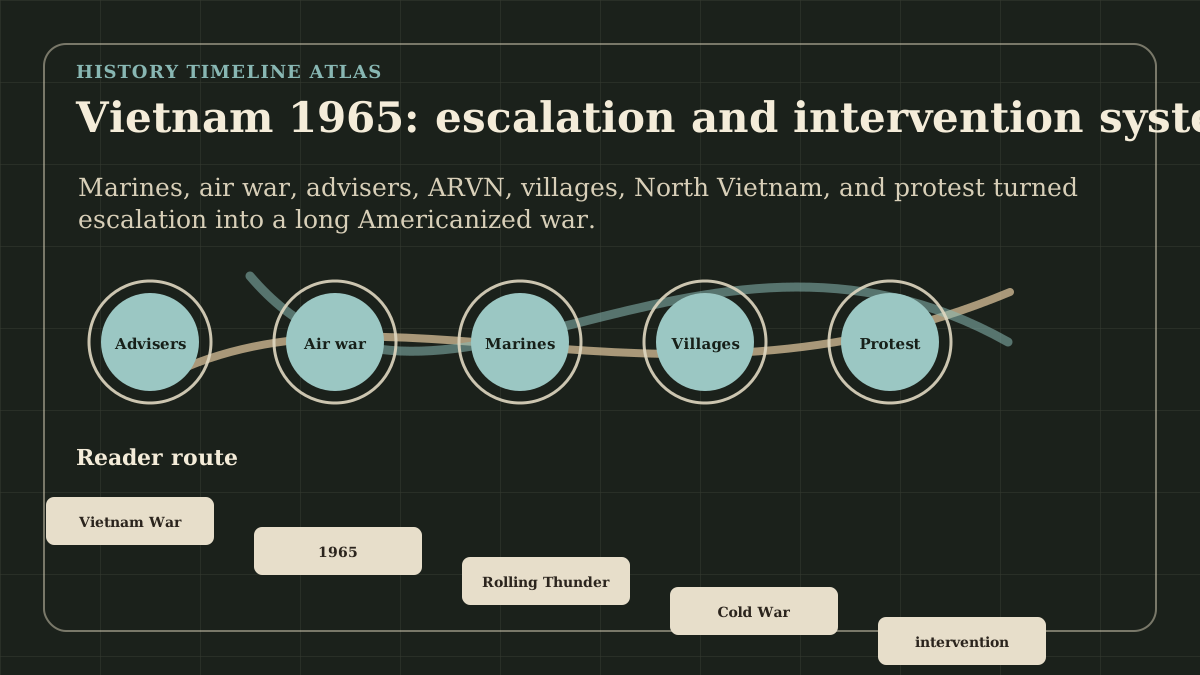
The United States moved from advising and supporting South Vietnam toward sustained direct combat, air war, base construction, search-and-destroy operations, and a much larger political commitment. That shift made withdrawal harder because credibility, alliance politics, and domestic authority became tied to battlefield outcomes. Vietnamese actors must remain central. North Vietnam, the National Liberation Front, the Army of the Republic of Vietnam, village communities, Buddhist activists, refugees, local officials, and families all shaped the war's texture. U. S. policy did not act on an empty map; it entered a society already marked by colonial war, partition, state weakness, revolutionary organization, and competing visions of legitimacy. The evidence and media layer also matters.
Body counts, bombing reports, official briefings, television coverage, soldier testimony, and antiwar organizing created different ways of knowing the war. Escalation produced a conflict over interpretation as well as territory.
The Turning Point
The decisive change in 1965 was not a single battle but a strategic shift: the United States moved from advisory and limited-support roles to deploying combat forces at scale. President Lyndon B. Johnson and his civilian and military advisers chose to authorize large, sustained U. S. combat operations; those decisions made American troops central actors on the battlefield. At the same time, North Vietnam, led politically by Ho Chi Minh and materially supported by its own institutions and allies, persisted in its campaign and continued to coordinate with the National Liberation Front in the South. The result was a transformation of a regional civil conflict into an expanded Cold War confrontation with foreign armies fighting in Vietnamese terrain.
Crucially, this change emerged from a mix of calculated policy choices—about troop deployments, rules of engagement, and political signaling—and enduring structural constraints: alliance commitments, Cold War doctrine about communist expansion, and the realities of nationalist resistance inside Vietnam. The 1965 escalation therefore reflects both intentional decisions by named leaders and pressures that limited the range of plausible alternatives. The turning point was the conversion of a limited advisory war into an Americanized war. Rolling Thunder, Marine landings, expanding troop deployments, and Johnson administration decisions made U. S. power more visible and more exposed. Each measure was meant to prevent defeat, but together they widened the war's scale. Escalation also changed the home front. Once large numbers of U. S.
troops fought in Vietnam, casualties, conscription, budget pressures, civil-rights politics, campus organizing, and trust in official statements became part of the war's history.
Consequences
In the near term the 1965 escalation increased the scale, intensity, and international visibility of the Vietnam fighting: U. S. troops entered sustained combat while North Vietnamese and National Liberation Front forces continued their resistance. That dynamic lengthened the war and deepened its costs for combatants and civilians alike. Politically, the escalation reshaped American domestic life—altering debates about presidential power, conscription, and the legitimacy of military intervention—and it energized and broadened antiwar movements. In Southeast Asia, the presence of large foreign forces changed local politics, shifted wartime calculations, and contributed to longer-term instability in neighboring countries.
Over the longer term the episode forced a reexamination of Cold War ideas about intervention: policymakers, scholars, and publics asked whether the strategy of containing communism through direct military involvement was prudent or sustainable. Interpretations remain contested. Some emphasize how individual decisions by leaders such as Lyndon B. Johnson made the escalation possible; others point to deeper structural forces—international alignments, decolonization pressures, and institutional momentum—that made escalation likely. Both lines of argument help explain why 1965 produced consequences that lasted decades. The immediate consequence was deeper U. S. military involvement without a clean path to victory.
Bombing and troop deployments inflicted enormous damage, but they did not solve the political problem of legitimacy in South Vietnam or the resilience of North Vietnamese and NLF strategy. The longer consequence was a crisis of confidence in American politics and Cold War intervention. The escalation of 1965 helps explain later antiwar mobilization, congressional skepticism, veterans' testimony, the Paris peace process, and the shock of 1975. It also belongs to Southeast Asian history, where civilians experienced the war through displacement, violence, and survival.
Interpretation Notes
The hardest question around Vietnam War Escalation is causation. The event had immediate actors, but its meaning also came from institutions, geography, resources, and expectations already present in Southeast Asia.
Why Keep Reading
If this moment compelled you to keep reading, follow the next steps in the story to see how escalation unfolded into broader political and military consequences. Look next at the domestic aftermath in the United States—how public opinion, elections, and protest evolved as American combat troops remained engaged—and at developments inside North and South Vietnam that prolonged resistance. Tracing those threads clarifies how a single year of policy choices extended into years of fighting, diplomatic strain, and social upheaval. The continuing debates between interpretations—about leaders’ responsibility versus structural inevitability—also reshape how we judge later decisions and why the war came to an end on its own terms.
Read 1965 after Dien Bien Phu, Geneva, and the Cold War timeline, then continue to 1968, the Paris talks, and the fall of Saigon. That route keeps decolonization, Vietnamese politics, U. S. decision-making, and public trust in the same frame.
Reading Path
Follow the story without losing the thread
Before This
- Organization of African Unity FoundedMay 25, 1963
- Partial Nuclear Test Ban TreatyAugust 5, 1963
- Cuban Missile CrisisOctober 1962
After This
- ASEAN FoundedAugust 8, 1967
- Prague Spring1968
- Apollo 11 Moon LandingJuly 20, 1969
Same Period
- Cuban Missile CrisisOctober 1962
- Apollo 11 Moon LandingJuly 20, 1969
- Fall of the Berlin WallNovember 9, 1989
Wider Timeline
Mind Map
How to think about Vietnam War Escalation
Cold War fear
U.S. leaders framed Vietnam through a containment logic that treated local outcomes as part of a global struggle
Map Layer
Where this event sits geographically
Gold pins mark the approximate locations of published event pages. This is a schematic locator map, not a historical border map.
Coordinates are approximate and are used to help readers orient themselves before opening a full event page.
References
Where to Check the Facts
- U.S. National Archives: The Cold WarArchive reference hub for Cold War records, federal documentation, and research guidance.
- Office of the Historian: The Early Cold War, 1945-1952Official diplomatic history reference for early Cold War foreign-policy context.