At a Glance
The shape of the event
- Date
- July 20, 1969
- Place
- Mare Tranquillitatis
- Type
- Space Exploration
Apollo 11 landed humans on the Moon, fulfilling a U.S. Cold War space goal and creating a global symbol of technological ambition.
July 20, 1969; place the event in Mare Tranquillitatis before comparing causes or consequences.
The landing changed public ideas about science, exploration, engineering, and the political uses of space achievement.
Neil Armstrong / Buzz Aldrin / Michael Collins are the first names or groups to compare before widening the story.
Neil Armstrong and Buzz Aldrin walked on the lunar surface while Michael Collins orbited above.
Neil Armstrong and Buzz Aldrin walked on the lunar surface while Michael Collins orbited above.
The landing changed public ideas about science, exploration, engineering, and the political uses of space achievement.
If this event hooked you, follow the surrounding timelines to see how governments, engineers, and publics responded afterward.
Background
The Apollo 11 mission unfolded against a dense tangle of pressures: geopolitical rivalry, scientific curiosity, and an accelerating expectation that engineering could deliver decisive symbols of national standing. During the 1950s and 1960s the so-called Space Race framed spaceflight as one arena in which rival powers measured technical capacity and political credibility. Governments invested attention, personnel, and prestige into programs that promised visible, demonstrable results. At the same time, NASA and its contractors had to blend research, industrial production, and high-stakes testing into a schedule that left little room for failure without political consequences.
This convergence—strategic competition on one side, a complex new technological enterprise on the other—produced both the mandate to attempt a lunar landing and the institutional means to carry it out. Historians continue to debate how far the decisive causes were the choices of particular leaders and engineers versus deeper structural forces such as Cold War politics, industrial mobilization, and the rise of big science and big engineering. This page keeps those disputes visible: the landing is described here as the outcome of individual actions embedded in larger currents, not as the result of a single cause. Apollo 11 is more than a triumphal image of astronauts on the Moon.
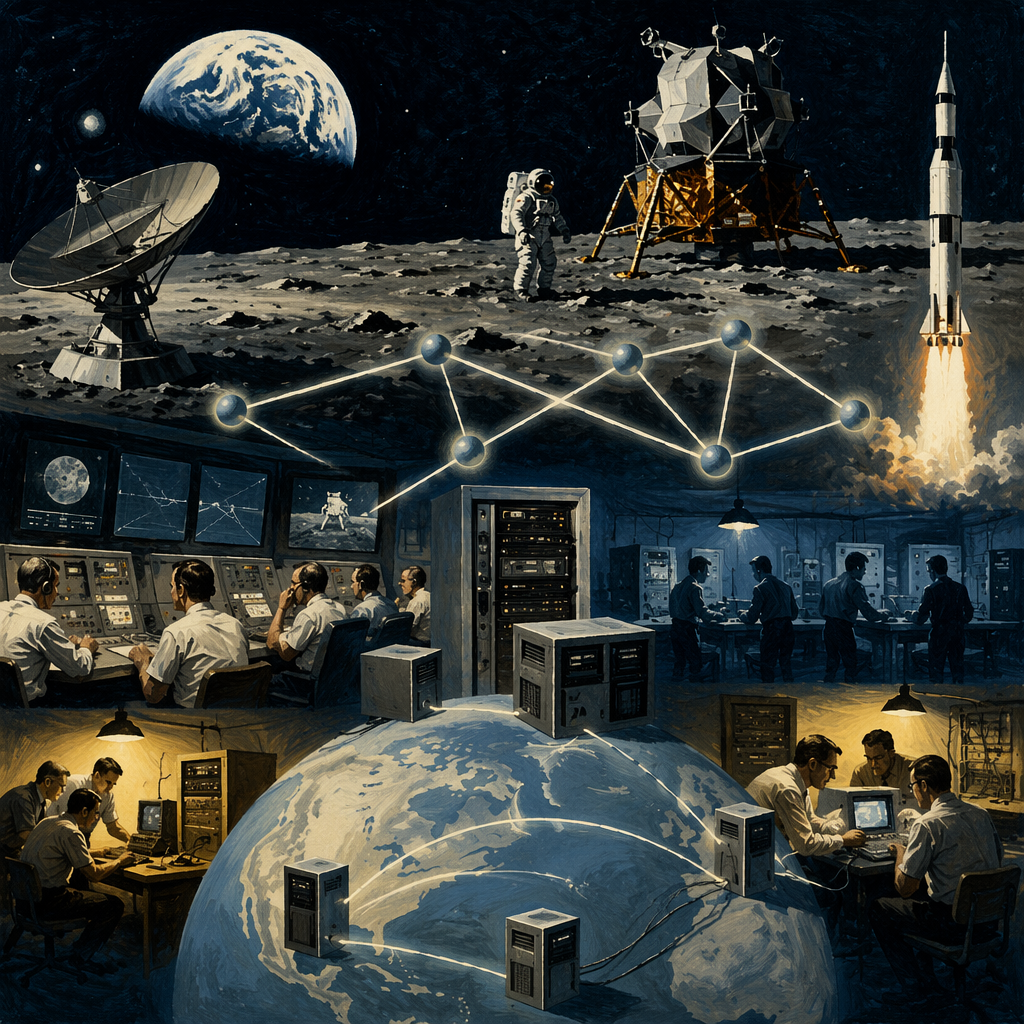
It grew from Cold War competition, rockets, computers, engineers, test pilots, budgets, accidents, television, industrial supply chains, and public arguments over whether exploration justified its cost. The mission also belongs to a year of technological contrast. ARPANET quietly connected computers while Apollo turned spaceflight into a shared global broadcast. Together they show how the late 1960s made technology both spectacular and infrastructural.
The Turning Point
The decisive change on 20 July 1969 was concrete and immediate: a piloted spacecraft descended, two crewmen stepped onto lunar soil, and a human presence moved from aspiration to proof. Within that day three roles were sharply delineated. Neil Armstrong and Buzz Aldrin moved from spacecraft operators to explorers on another world, conducting the first human extravehicular activity on the Moon. Michael Collins remained in lunar orbit aboard the command module, managing systems and waiting for the return link that would reunite the crew. Those arrangements were more than choreography; they embodied choices about risk allocation, mission design, and human agency.
The success of the landing converted programmatic aims into an observable fact, shifting the debate from whether humans could reach the Moon to what such achievement might mean culturally and politically. The event also exposed how dependent such moments are on countless technical decisions and on the people who execute them: engineers tuning guidance systems, pilots executing descent profiles, and a support network on Earth handling telemetry and contingency planning. In short, the turning point was both an isolated human act on the lunar surface and the culmination of distributed expertise and institutional will. The turning point was the successful landing and safe return.
The achievement proved that the United States could coordinate science, engineering, state funding, and risk at a scale unmatched in earlier exploration.
Consequences
In the near term the landing delivered a clear, dramatic demonstration of capability: two Americans had walked on the Moon while a third orbited above, and that fact was judged at once technological, political, and symbolic. The achievement reinforced public faith in large-scale engineering projects and became a reference point for what coordinated scientific effort could accomplish. In the longer term the mission reshaped public ideas about science, exploration, and engineering. For many people the Moon landing became a shorthand for modern technical possibility and a spur to careers in science and aerospace. Politically, it illustrated how state-backed scientific endeavors could be used to project national aims abroad.
At the same time, the episode did not settle deeper questions about priorities, costs, and institutional direction; debates over the balance between individual initiative and structural forces continued. The landing also left legacies in how the story was told: certain personal narratives and images came to dominate public memory even as historians note the indispensable contributions of teams, contractors, and ground personnel. The result is a layered legacy in which a specific moment of human action sits atop a broader architecture of decisions, investments, and contingent choices. The afterlife includes lunar science, national prestige, space policy, environmental imagery of Earth, later debates over human spaceflight, and the memory of a moment watched across borders.
Apollo mattered because it made technology feel like political imagination.
Interpretation Notes
Apollo 11 Moon Landing raises a debate about scale: did the decisive change come from the visible space exploration, or from older pressures around Space Race and Science that had already narrowed what people could do?
Why Keep Reading
If this event hooked you, follow the surrounding timelines to see how governments, engineers, and publics responded afterward. Later Apollo missions tested different objectives and pushed scientific return, while domestic and international debates over funding and direction evolved in new ways. Tracing those threads helps explain whether the Moon landing inaugurated a sustained era of human spaceflight or instead remained a concentrated moment of symbolic power. You might also explore biographies of the three crew members to see how individual careers intersected with institutional pressure, or surveys of cultural response that show how the image of the Moon landing circulated globally. Understanding the aftermath offers clearer sightlines into how technological feats become historical turning points rather than isolated triumphs.
Read Apollo 11 with Sputnik, the Space Race, ARPANET, Cold War science, and environmental history to follow how technology reshaped public time.
Reading Path
Follow the story without losing the thread
Before This
- ARPANET Connection1969 CE
- Prague Spring1968
- Vietnam War Escalation1965
After This
- SALT I and Detente1972
- Fall of SaigonApril 30, 1975
- Helsinki Final ActAugust 1, 1975
Same Period
- Cuban Missile CrisisOctober 1962
- Fall of the Berlin WallNovember 9, 1989
- Truman DoctrineMarch 1947
Wider Timeline
Mind Map
How to think about Apollo 11 Moon Landing
Cold War rivalry
U.S. political competition with other powers created an imperative to demonstrate technological leadership through a lunar landing
Map Layer
Where this event sits geographically
Gold pins mark the approximate locations of published event pages. This is a schematic locator map, not a historical border map.
Coordinates are approximate and are used to help readers orient themselves before opening a full event page.
References
Where to Check the Facts
- U.S. National Archives: The Cold WarArchive reference hub for Cold War records, federal documentation, and research guidance.
- Office of the Historian: The Early Cold War, 1945-1952Official diplomatic history reference for early Cold War foreign-policy context.
- Science Museum: Objects and StoriesMuseum reference hub for science, technology, medicine, invention, and public understanding.
- NASA: Apollo 11Official NASA reference for Apollo 11, the lunar landing objective, crewed mission, and space-race context.
- Library of Congress: U.S. History Primary Source TimelinePrimary-source timeline reference for Atlantic settlement, colonial expansion, reform, and later U.S. history paths.