At a Glance
The shape of the event
- Date
- October 1962
- Place
- Cuba
- Type
- Diplomatic Crisis
The United States and Soviet Union confronted each other over Soviet nuclear missiles in Cuba, bringing the Cold War close to nuclear war.
October 1962; place the event in Cuba before comparing causes or consequences.
The crisis led to new communication channels and arms-control thinking while showing the danger of nuclear brinkmanship.
John F. Kennedy / Nikita Khrushchev / Fidel Castro are the first names or groups to compare before widening the story.
A negotiated withdrawal ended the immediate crisis, with public and private concessions on missiles.
A negotiated withdrawal ended the immediate crisis, with public and private concessions on missiles.
The crisis led to new communication channels and arms-control thinking while showing the danger of nuclear brinkmanship.
Follow the next pages to see how this crisis altered diplomacy, intelligence, and public memory.
Background
The Cuban Missile Crisis did not spring from a single cause; it rose from layered pressures in a bipolar world where nuclear weapons reshaped politics. For a decade the United States and the Soviet Union had regarded each other as existential rivals, and both nations treated military presence and alliance politics as instruments of survival. Cuba, an independent island in the Caribbean led by Fidel Castro, became entangled in that rivalry. The presence of Soviet missiles in Cuba was interpreted as an escalation by the United States and as a projection of Soviet power and security by Moscow. At the same time, leaders in Washington and Moscow faced domestic and international expectations that constrained their choices.
The situation combined state rivalry, regional fears, and the novel danger posed by strategic nuclear arms concentrated close to enemy territory. Historians still debate how much came from long-term structural dynamics—balance of power, deterrence theory—and how much turned on the judgements of particular leaders. This account keeps those tensions visible rather than treating one explanation as definitive. The Cuban Missile Crisis should not be visualized as a generic space-age Cold War image. It was a Caribbean, nuclear, and diplomatic crisis created by the Cuban Revolution, U. S. hostility to Castro, Soviet security calculations, missile deployments, aerial reconnaissance, and fears about credibility. Cuba was not scenery; it was an actor whose security concerns shaped the crisis.
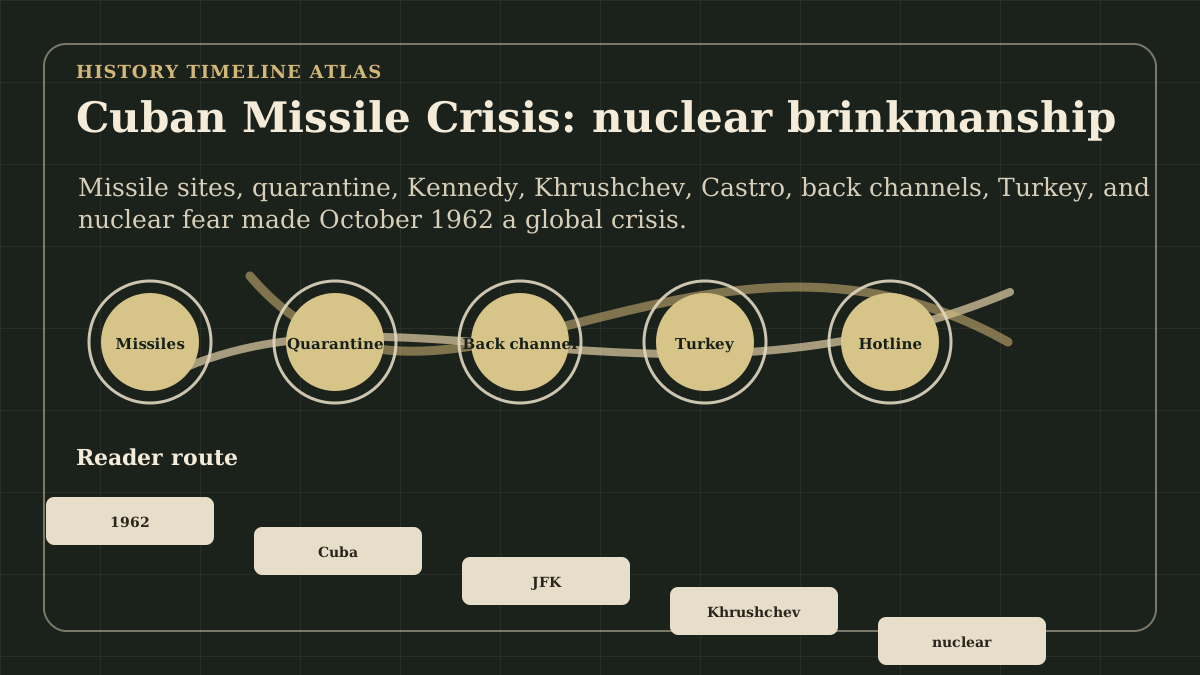
The crisis becomes more readable when public performance and private bargaining are separated. Kennedy announced a naval quarantine and demanded missile removal, while secret channels explored terms that included U. S. pledges about Cuba and the later removal of Jupiter missiles from Turkey. The public story of firmness and the private story of compromise worked together. Nuclear danger depended on friction as well as intention. Ships, submarines, pilots, field commanders, alert levels, communication delays, and incomplete information made escalation possible even when leaders wanted control. That uncertainty is why the crisis remains one of the clearest lessons in brinkmanship.
The Turning Point
What changed in October 1962 was the confrontation’s shift from suspicion to direct, public crisis: Soviet nuclear missiles in Cuba moved from secret placements to an urgent diplomatic problem that demanded a response. The United States confronted the reality that Soviet capabilities now threatened its doorstep; John F. Kennedy and his advisors faced choices between military action, blockade, or negotiation. Nikita Khrushchev responded to perceived vulnerabilities by committing Soviet resources to Cuba, while Fidel Castro watched as his island became the focal point of superpower rivalry. The decisive moments were not inevitable; they were produced by a series of choices. Leaders on both sides chose to avoid immediate escalation to full-scale war and instead to negotiate.
That negotiation involved public positions and private exchanges, trade-offs visible to contemporaries and invisible to the wider public. The crisis crystallised a fundamental question about nuclear politics: could brinkmanship be managed without catastrophe? In October 1962 the answer was a narrow, precarious yes—because leaders elected to step back from the threshold rather than cross it. The turning point was the discovery of Soviet missile sites and the decision to use quarantine rather than immediate air strikes. That choice kept pressure high but preserved time for negotiation. It was dangerous restraint: a military signal designed to avoid immediate war. A second turning point was the exchange of messages between Khrushchev and Kennedy, combined with back-channel diplomacy.
The settlement depended on public and private promises, which means the end of the crisis was negotiated, not simply won.
Consequences
The immediate outcome was a negotiated withdrawal that ended the acute confrontation: Soviet missiles left Cuba and the immediate likelihood of nuclear exchange receded. That result rested on public and private concessions about missiles, demonstrating that diplomacy could produce urgent de-escalation even amid bitter rivalry. In the near term the crisis left political wounds: leaders had come close to irreversible catastrophe, and trust between Washington and Moscow was deeply shaken. In the longer view the episode reshaped how states thought about nuclear peril. It prompted new communication channels and more systematic arms-control thinking, as policymakers sought mechanisms to prevent future mishaps and misreads.
The crisis also embedded a cautionary lesson about the costs of brinkmanship—how competitive posturing with nuclear weapons can produce unintended escalation. Yet historians continue to disagree about whether these changes flowed mainly from the structural logic of the Cold War or from the decisions of particular individuals. The Cuban Missile Crisis therefore remains both a case study in leadership under duress and a moment that exposed the systemic dangers of nuclear competition. The immediate consequence was the removal of Soviet missiles from Cuba and a U. S. pledge not to invade the island, paired with the quieter removal of U. S. Jupiter missiles from Turkey.
The longer consequence was a new urgency around crisis communication, arms control, and nuclear risk management. The crisis also changed how leaders imagined credibility. It showed that appearing tough could create danger, but that compromise could be hidden, delayed, or reframed. For readers, the event is a warning that survival in nuclear politics often depends on ambiguity, patience, and channels that publics may not see.
Interpretation Notes
Cuban Missile Crisis can look simple when reduced to one date, but the evidence usually points to a wider setting. The useful debate is which part mattered most: leadership, logistics, belief, social pressure, or the institutions that survived afterward.
Why Keep Reading
Follow the next pages to see how this crisis altered diplomacy, intelligence, and public memory. Read on to trace the development of direct crisis communications, the later arms-control debates that shaped treaties and taboo, and Cuba’s ongoing strategic role in Cold War history. If you want to understand how close the world came to nuclear war—and why leaders nevertheless found a path back from the brink—explore the timelines of October 1962, the biographies of the decision-makers, and the subsequent policy shifts that tried to ensure such a moment would not be repeated. Read the Cuban Missile Crisis after the Bay of Pigs and Berlin Wall Built pages, then continue to the Partial Nuclear Test Ban Treaty and detente.
That route shows how revolutionary Cuba, Berlin, nuclear fear, and arms control became one connected Cold War story.
Reading Path
Follow the story without losing the thread
Before This
- Berlin Wall BuiltAugust 1961
- Bay of Pigs InvasionApril 17-20, 1961
- Congo Independence and Crisis1960 CE
After This
- Partial Nuclear Test Ban TreatyAugust 5, 1963
- Vietnam War Escalation1965
- ASEAN FoundedAugust 8, 1967
Same Period
- Apollo 11 Moon LandingJuly 20, 1969
- Fall of the Berlin WallNovember 9, 1989
- Truman DoctrineMarch 1947
Wider Timeline
Mind Map
How to think about Cuban Missile Crisis
strategic rivalry
Bipolar Cold War competition set the stage for superpower confrontation over influence and security
Map Layer
Where this event sits geographically
Gold pins mark the approximate locations of published event pages. This is a schematic locator map, not a historical border map.
Coordinates are approximate and are used to help readers orient themselves before opening a full event page.
References
Where to Check the Facts
- U.S. National Archives: The Cold WarArchive reference hub for Cold War records, federal documentation, and research guidance.
- Office of the Historian: The Early Cold War, 1945-1952Official diplomatic history reference for early Cold War foreign-policy context.