At a Glance
The shape of the event
- Date
- November 9, 1989
- Place
- Berlin
- Type
- Political Collapse
East German authorities opened border crossings in Berlin after months of protest and pressure, allowing people to cross the wall freely.
November 9, 1989; place the event in Berlin before comparing causes or consequences.
The event became the strongest visual symbol of the Cold War's end in Europe.
East German citizens are the first names or groups to compare before widening the story.
The wall lost its function almost overnight, and German reunification became possible.
The wall lost its function almost overnight, and German reunification became possible.
The event became the strongest visual symbol of the Cold War's end in Europe.
If this night changed what was possible in Germany, the next chapters explain how possibility became policy.
Background
Berlin’s division had been both a physical barrier and a political shorthand for the Cold War. For decades the wall separated families, restricted travel, and made one city the stage for conflicting ideologies. By late 1989, those visible divisions encountered sustained public pressure: months of demonstrations, persistent calls to travel freely, and growing impatience among East German citizens. These internal pressures met wider changes across Europe—the political landscape of the continent was shifting—but no single cause explains what happened on that November night. The East German state still retained institutions meant to enforce the border; the decision to open crossings was a choice made within a constrained and volatile environment.
Historians and eyewitnesses continue to debate the balance between street-level protest and deeper structural shifts. This page keeps such disputes visible rather than presenting a single, definitive explanation. The fall of the Berlin Wall is easy to remember as a single night, but the event becomes richer when pressure is visible before the checkpoints opened. East German emigration through Hungary and Czechoslovakia, Monday demonstrations, church networks, reform debates, Soviet restraint, and a tired ruling party all narrowed the regime's room to govern by fear. Berlin mattered because the wall had made Cold War division physical. Concrete, guards, permits, watchtowers, families, work routes, and forbidden crossings turned ideology into daily geography. When the border opened, the scene was not only symbolic.
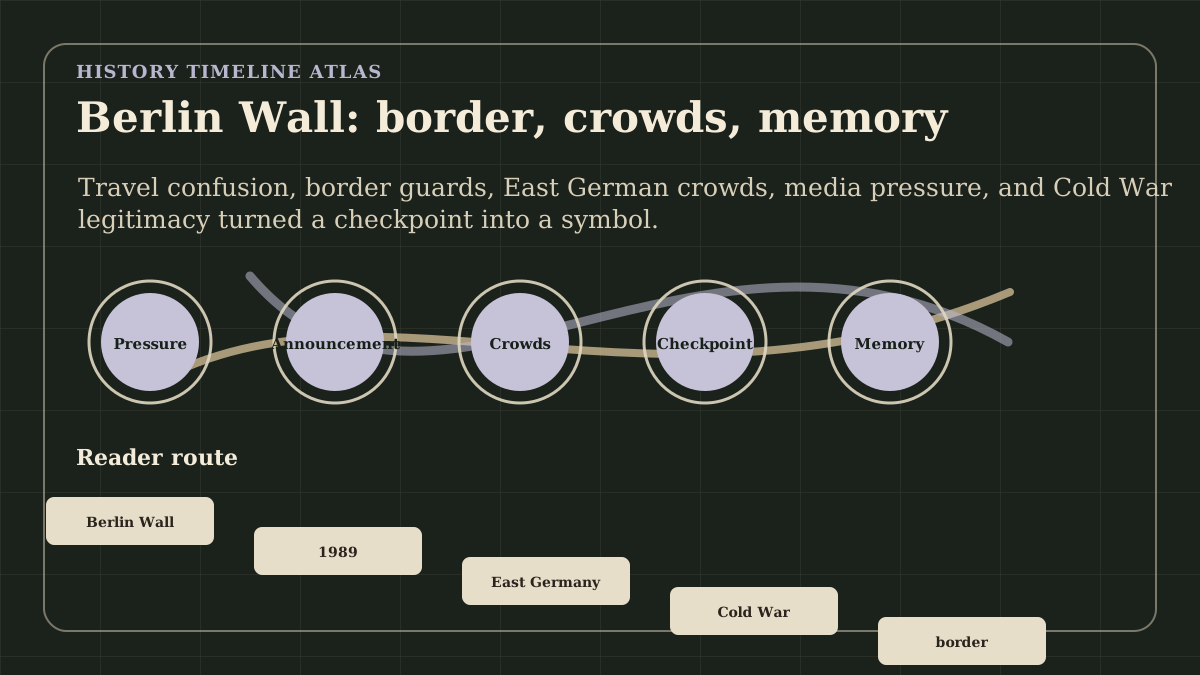
People moved through a structure that had organized ordinary life for decades. The news conference confusion gives the event its human texture. An unclear announcement about travel rules collided with live media, public expectation, border guards without workable instructions, and crowds willing to test the opening. A bureaucratic sentence became a political fact because people acted on it.
The Turning Point
What changed on 9 November was both administrative and existential. East German authorities, responding to sustained protest and political pressure, authorized the opening of border crossings in Berlin. That bureaucratic act—explicit, implemented at checkpoints—converted a fortified frontier into a series of permeable gateways. For citizens who had lived with permits, checkpoints, and separation, the openings transformed a regulated space of denial into one of choice: people who had queued, petitioned, or simply endured decades of separation were now able to cross freely. The decision-makers who loosened the controls acted in a context of uncertainty; their choice did not instantly erase the wall, but it removed its practical function almost overnight.
The moment combined administrative error, political calculation, and public insistence: an official change in policy intersected with citizens ready to move, producing a rapid collapse in the wall’s authority and an image of rupture that radiated far beyond Berlin. The turning point was the loss of command at the border. The East German state still existed, but the wall's authority depended on guards, orders, fear, and compliance. Once crowds gathered and officials hesitated, the barrier stopped functioning as a credible instrument of control. The event also changed the pace of European politics. Reform, protest, and emigration had already weakened the regime, but the open checkpoints made German reunification and the end of Europe's postwar division feel suddenly imaginable.
Consequences
In the immediate aftermath the wall ceased to operate as a meaningful barrier: crossings became passages, and the carefully maintained choreography of border control unraveled. For East German citizens the opening meant new mobility and the immediate possibility of reunions, travel, and political expression. Politically, the event made German reunification a feasible project rather than a distant prospect; within months the legal and diplomatic work of reunification gathered speed. Culturally and symbolically, the fall of the wall became the strongest single visual signifier of the Cold War’s end in Europe, shaping how the period is remembered across generations. Yet consequences were uneven and contested: economic integration posed difficult adjustments, and social memory divided local experiences into celebration, loss, and critique.
Interpretations continue to differ over how much the outcome owed to the actions of individual citizens on the streets versus deeper geopolitical and institutional shifts; acknowledging that dispute is essential to understanding both the moment’s drama and its complex aftermath. The wall's fall did not end every problem it revealed. Reunification brought economic, legal, social, and memory conflicts, while Eastern Europe continued to negotiate sovereignty, NATO, markets, archives, and communist-era accountability. The night of celebration opened a difficult transition rather than a tidy ending. Its afterlife remains powerful because a border became a teaching image for legitimacy.
The wall had claimed to protect socialism; by 1989 it showed the cost of a state that could keep people in only through coercion. Its fall gives readers a concrete route into Cold War collapse, civic pressure, and the fragility of regimes that lose public belief.
Interpretation Notes
The memory of Fall of the Berlin Wall often depends on who tells the story. A court, army, religious community, merchant network, or later nation can emphasize different causes and make Berlin stand for different lessons.
Why Keep Reading
If this night changed what was possible in Germany, the next chapters explain how possibility became policy. Follow the timelines that track the legal steps toward reunification, the political debates in both East and West, and the local stories of neighborhoods transformed by the sudden end of the border. Readers will find that the fall of the wall is not a single, closed event but a hinge: it opens questions about how societies knit together after enforced separation, how memory is shaped by images, and how ordinary people navigate the consequences of rapid political change. Read this page beside Solidarity in Poland, the Helsinki Final Act, the INF Treaty, German reunification, and the dissolution of the Soviet Union.
The path shows how protest, diplomacy, economic strain, and changing Soviet choices interacted.
Reading Path
Follow the story without losing the thread
Before This
- INF Treaty SignedDecember 8, 1987
- Chernobyl DisasterApril 26, 1986
- Solidarity Movement in Poland1980
After This
- German ReunificationOctober 3, 1990
- Dissolution of the Soviet UnionDecember 1991
Same Period
- Cuban Missile CrisisOctober 1962
- Apollo 11 Moon LandingJuly 20, 1969
- Truman DoctrineMarch 1947
Wider Timeline
Mind Map
How to think about Fall of the Berlin Wall
sustained protests
months of public demonstrations and pressure that increased the political cost of maintaining closed borders
Map Layer
Where this event sits geographically
Gold pins mark the approximate locations of published event pages. This is a schematic locator map, not a historical border map.
Coordinates are approximate and are used to help readers orient themselves before opening a full event page.
References
Where to Check the Facts
- U.S. National Archives: The Cold WarArchive reference hub for Cold War records, federal documentation, and research guidance.
- Office of the Historian: The Early Cold War, 1945-1952Official diplomatic history reference for early Cold War foreign-policy context.