At a Glance
The shape of the event
- Date
- 1980
- Place
- Gdansk
- Type
- Labor Movement
Polish workers formed Solidarity, an independent labor movement that challenged communist authority through organization, strikes, and civil society.
1980; place the event in Gdansk before comparing causes or consequences.
Solidarity helped weaken communist rule in Poland and contributed to the broader transformation of eastern Europe.
Lech Walesa are the first names or groups to compare before widening the story.
The movement faced repression but remained a powerful symbol and force for political change.
The movement faced repression but remained a powerful symbol and force for political change.
Solidarity helped weaken communist rule in Poland and contributed to the broader transformation of eastern Europe.
Follow this thread to see how a labour movement in one port city connected to a sequence of events that reconfigured eastern Europe.
Background
Poland in 1980 was part of the Cold War order where a single party claimed political monopoly while economic and social pressures accumulated. Workers across the country experienced persistent dissatisfaction with wages, workplace conditions, and the lack of independent representation. State-run institutions left little room for autonomous associations, and civic life was tightly regulated. At the same time, ideas about political rights and democratic participation circulated among intellectuals, activists, and workers, creating expectations that authority struggled to meet. External geopolitics—the wider rivalry between East and West—gave the Polish situation added weight, because any major disturbance risked international attention and domestic crackdown.
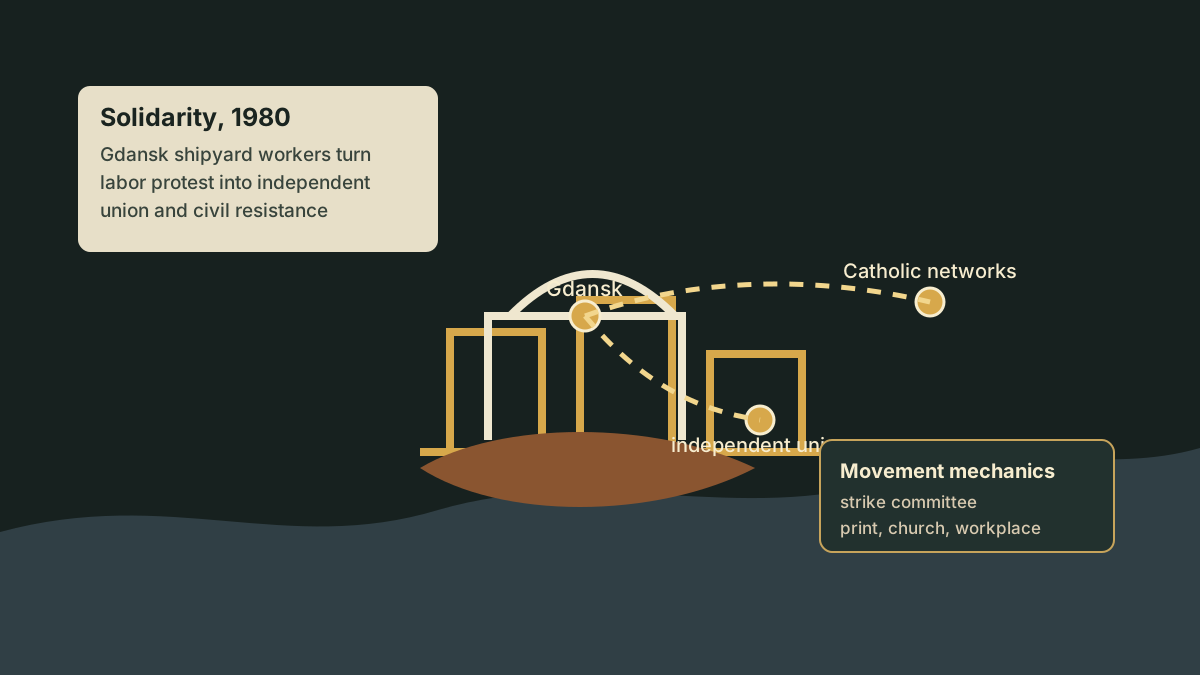
Historians debate how much of what followed was shaped by immediate choices of leaders and rank-and-file activists, and how much flowed from deeper structural strains in the Polish state and economy. This account keeps that tension visible: it describes concrete actors and decisions without insisting that a single explanation accounts for everything. Solidarity began in a Poland shaped by state socialism, food shortages, censorship, Catholic networks, worker memory, and earlier protest waves. The Lenin Shipyard in Gdansk gave labor politics a concrete place: gates, workshops, strike committees, demands, and negotiations. Workers did not only ask for wages. They demanded independent representation, dignity, public truth, and rights inside a system that claimed to rule on behalf of workers.
The Turning Point
The turning point came when isolated workplace grievances transformed into an organized, independent labour movement. Workers in Gdansk moved from individual complaints to coordinated action: they formed a structure that could present unified demands, sustain strike pressure, and create channels of communication across workplaces and communities. Lech Walesa emerged as a visible leader, not because he alone carried the movement, but because he became a focal point for collective action and negotiation. The movement’s tactics combined organized strikes with the building of civic forms—committees, lists of demands, and public statements—that made dissent legible to the wider public and to authorities. That shift—from quiet Grievance to deliberate, organized challenge—changed the stakes.
It forced authorities to respond to a coherent social force rather than isolated disruptions. The choices made by rank-and-file activists to sustain strikes, by organizers to insist on independent representation, and by leaders to negotiate publicly were decisive in converting labour unrest into a political movement with national significance. Those choices also exposed the limits of the existing system, and set up a confrontation whose outcomes were not predetermined. The Gdansk Agreement was decisive because it recognized an independent trade union in a Soviet-aligned state. That recognition created a legal and symbolic breach in the monopoly of official organizations. Lech Walesa became a visible figure, but Solidarity's strength came from networks of workers, intellectuals, printers, priests, families, and local committees.
The movement made civil society visible where the state had tried to control public life.
Consequences
In the near term, the movement confronted state repression and restraints on its activities; it did not eliminate the risks or instantly change the political system. Yet Solidarity endured as a visible and resilient presence: a symbolic and practical alternative to state-run organizations. It created networks of people experienced in independent organization, negotiation, and public mobilization. Over the longer term, those networks, that experience, and the memory of sustained collective action helped erode the legitimacy of one-party rule in Poland. Solidarity’s existence and resilience contributed to wider processes of political change across eastern Europe by demonstrating that organized, nonviolent civic resistance could challenge communist authority and by inspiring other movements.
Interpretations differ about how much credit to assign to specific decisions, individual leaders, or the structural strains of the Cold War system; what is clear is that Solidarity shifted the political conversation inside Poland and added to the pressures that would, over time, reshape the region. The movement became a reference point for later democratic transitions and a lasting reminder that civic organization can alter political possibilities. The consequences included hope, repression, martial law, underground organizing, and eventually renewed negotiations in the late 1980s. Solidarity did not bring immediate freedom, but it changed what seemed possible.
It also influenced other Eastern European opposition movements by showing that workplace organization, moral language, and national memory could challenge communist authority without becoming a conventional army. Its workplace base also mattered because factories gave people meeting points, shared grievances, and practical leverage that private dissent alone could not create.
Interpretation Notes
Solidarity Movement in Poland can look simple when reduced to one date, but the evidence usually points to a wider setting. The useful debate is which part mattered most: leadership, logistics, belief, social pressure, or the institutions that survived afterward.
Why Keep Reading
Follow this thread to see how a labour movement in one port city connected to a sequence of events that reconfigured eastern Europe. Reading the later trajectories of Solidarity, the choices its leaders and members made under repression, and the responses of the Polish state illuminates how social movements translate local grievances into political change. For readers who want to understand how individual leadership and collective practice interacted with broader geopolitical pressures, the next pages trace timelines, key episodes of negotiation and repression, and the movement’s role in the wider Cold War transformations. Read next into the Cold War, Pope John Paul II, martial law in Poland, the fall of the Berlin Wall, and 1989 revolutions.
Solidarity explains how organized civic pressure weakened an authoritarian system from inside. The same route also links labor history to media history, because illegal printing, recorded sermons, and foreign broadcasts helped sustain a public language of opposition.
Reading Path
Follow the story without losing the thread
Before This
- Soviet-Afghan War BeginsDecember 1979
- Iranian Revolution1978-1979 CE
- Sandinista Revolution1979
After This
- Chernobyl DisasterApril 26, 1986
- INF Treaty SignedDecember 8, 1987
- Brazil's Democratic Constitution1988
Same Period
- Cuban Missile CrisisOctober 1962
- Apollo 11 Moon LandingJuly 20, 1969
- Fall of the Berlin WallNovember 9, 1989
Wider Timeline
Mind Map
How to think about Solidarity Movement in Poland
structural pressures
Economic stagnation and the political monopoly of the communist state created widespread worker dissatisfaction that made independent organization possible
Map Layer
Where this event sits geographically
Gold pins mark the approximate locations of published event pages. This is a schematic locator map, not a historical border map.
Coordinates are approximate and are used to help readers orient themselves before opening a full event page.
References
Where to Check the Facts
- U.S. National Archives: The Cold WarArchive reference hub for Cold War records, federal documentation, and research guidance.
- Office of the Historian: The Early Cold War, 1945-1952Official diplomatic history reference for early Cold War foreign-policy context.