At a Glance
The shape of the event
- Date
- December 1979
- Place
- Afghanistan
- Type
- Invasion
The Soviet Union sent troops into Afghanistan to support a friendly government, beginning a long war against armed resistance.
December 1979; place the event in Afghanistan before comparing causes or consequences.
The war weakened Soviet legitimacy, altered regional politics, and left consequences that continued after the Cold War.
Soviet leadership / Afghan mujahideen are the first names or groups to compare before widening the story.
The conflict became costly for the Soviet Union and drew international support for Afghan resistance groups.
The conflict became costly for the Soviet Union and drew international support for Afghan resistance groups.
The war weakened Soviet legitimacy, altered regional politics, and left consequences that continued after the Cold War.
Follow the timelines and related events to see how this initial intervention unfolded into a protracted campaign and how local and international actors adapted.
Background
Afghanistan in the late 1970s was a country at the crossroads of tribal loyalties, reformist zeal and geopolitical tension. A government in Kabul claimed authority and sought allies; the Soviet Union, anxious about influence on its southern frontier and the stability of a friendly regime, faced decisions about intervention. At the same time, Afghan opposition — later known collectively as mujahideen — mobilised in armed resistance against what many saw as an imposed order. Internationally, the Cold War provided a backdrop: both superpowers and regional actors watched how control over Afghanistan might shift balances of influence.
Structural forces mattered — ideological rivalry, security concerns, and the limits of state capacity in Afghanistan — and so did specific choices: the calculations of Soviet leadership about timing and commitment, and the decisions of Afghan fighters to resist. Historians continue to debate whether deeper systemic pressures or the judgments of a few leaders were decisive; this page keeps both possibilities in view rather than collapsing them into a single cause. The Soviet-Afghan War should not begin with superpower rivalry alone. Afghanistan had its own political crisis after the Saur Revolution, with party factionalism, land and social reforms, repression, rural resistance, religious opposition, ethnic and regional diversity, and instability inside the new state.
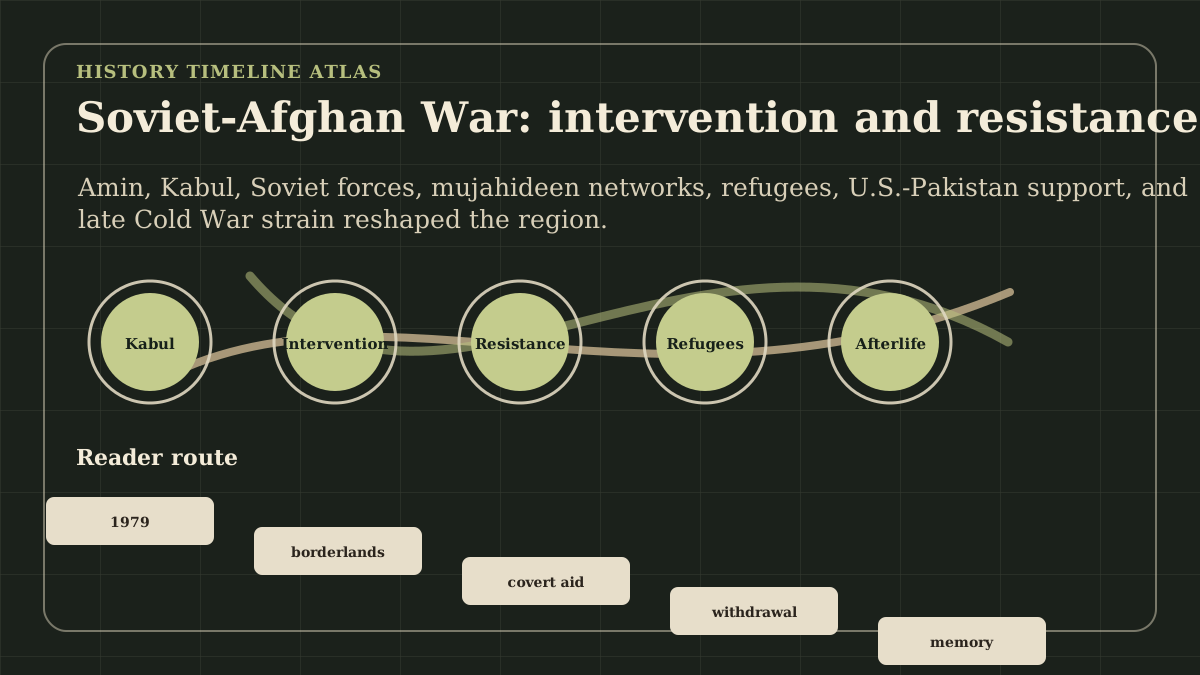
Soviet leaders watched those problems through Cold War assumptions, but the crisis was not simply imported from outside. Geography made intervention difficult from the first day. Kabul, mountain valleys, borderlands with Pakistan and Iran, rural networks, supply routes, and local commanders shaped the war more than any single capital could. The map helps readers see why a quick stabilizing operation turned into a long conflict of occupation, insurgency, refugees, and external support. The page also needs the human layer. Afghan civilians, conscripts, mujahideen groups, party officials, refugees, Soviet soldiers, Pakistani intelligence networks, U. S. and Saudi support, and neighboring states all belonged to the conflict's structure. A generic Cold War space image cannot carry those Afghan and regional specifics.
The Turning Point
The entry of Soviet troops in December 1979 crystallised a new phase of the Afghan conflict. Until then, tensions involved political turmoil, opposition groups and intermittent violence. The intervention converted those pressures into sustained conventional and irregular warfare. A concrete choice by Soviet leadership to deploy forces shifted the calculus on the ground: it meant a major external power had committed to uphold a friendly government, and it signalled to Afghan opponents that their struggle would now include confronting an occupying force. For the mujahideen, the presence of Soviet troops hardened resistance, encouraged wider mobilisation and altered tactics from localized insurgency to protracted guerrilla warfare.
The intervention also changed international perceptions: the war was no longer an internal Afghan contest but a theatre in the global confrontation of the Cold War. Command decisions, the logistics of an occupying force, and the adaptive responses of Afghan fighters combined to escalate a conflict that, from this point, would prove long and costly for all sides involved. The turning point was the Soviet decision to send forces into Afghanistan and install a more controllable leadership in Kabul. That decision changed an internal revolutionary crisis into an internationalized war. It gave the Afghan conflict a Cold War frame while also deepening resistance to a foreign military presence. The intervention also transformed time expectations.
What might have been imagined as a short move to preserve a friendly state became a war of attrition. Insurgency, difficult terrain, external aid, refugee flows, and the limits of state legitimacy made withdrawal harder than entry.
Consequences
In the near term, the invasion produced years of sustained conflict across Afghanistan, where an externally backed government faced determined armed resistance. The result imposed heavy material and political costs. For the Soviet Union, the war eroded domestic and international legitimacy, strained military resources and became a source of political controversy at home. Regionally, the conflict altered alliances and heightened instability in Central Asia, contributing to flows of refugees and the spread of arms and fighters across borders. Internationally, the war drew varying degrees of support for Afghan resistance groups, with outside actors seeing an opportunity to counter Soviet influence.
Over the longer term, the conflict left legacies that outlived the Cold War: weakened institutions within Afghanistan, altered patterns of regional politics, and a landscape of armed actors whose presence shaped subsequent decades. Caution is necessary when tracing direct lines of causality; the war’s outcomes emerged from complex interactions between foreign intervention, Afghan social dynamics and shifting international priorities, and scholars continue to debate how much weight to assign to each factor. The immediate consequence was war across Afghan society: displacement, militarization, rural destruction, urban fear, and the hardening of armed opposition. The conflict also strained Soviet resources and legitimacy, intensified U. S. -Pakistan security cooperation, and helped make Afghanistan a major late Cold War battlefield.
The longer consequence reached beyond 1989. Refugee communities, armed networks, state collapse, civil war, and later international interventions all carried traces of the conflict. A strong page helps readers avoid treating Afghanistan as only a setting for other powers; Afghan society and politics were central to both cause and afterlife.
Interpretation Notes
The hardest question around Soviet-Afghan War Begins is causation. The event had immediate actors, but its meaning also came from institutions, geography, resources, and expectations already present in Central Asia.
Why Keep Reading
Follow the timelines and related events to see how this initial intervention unfolded into a protracted campaign and how local and international actors adapted. Read on to track key phases: the escalation of ground operations, the networks of resistance that formed across rural regions, and the diplomatic responses that reshaped global alignments. Each subsequent episode reveals how decisions made in December 1979 set constraints and opportunities for actors on all sides, and why the consequences of that winter still matter for understanding Afghanistan and the end of the Cold War. Read the Soviet-Afghan War beside the Iranian Revolution, 1979 in history, the Cold War timeline, decolonization routes, and the dissolution of the Soviet Union.
That sequence shows how late Cold War crisis linked ideology, religion, state weakness, intervention, and regional displacement.
Reading Path
Follow the story without losing the thread
Before This
- Iranian Revolution1978-1979 CE
- Sandinista Revolution1979
- Fall of SaigonApril 30, 1975
After This
- Solidarity Movement in Poland1980
- Chernobyl DisasterApril 26, 1986
- INF Treaty SignedDecember 8, 1987
Same Period
- Cuban Missile CrisisOctober 1962
- Apollo 11 Moon LandingJuly 20, 1969
- Fall of the Berlin WallNovember 9, 1989
Wider Timeline
Mind Map
How to think about Soviet-Afghan War Begins
Soviet decision
Soviet leadership chose to send troops to uphold a friendly Afghan government, shifting a political crisis into a military occupation.
Map Layer
Where this event sits geographically
Gold pins mark the approximate locations of published event pages. This is a schematic locator map, not a historical border map.
Coordinates are approximate and are used to help readers orient themselves before opening a full event page.
References
Where to Check the Facts
- U.S. National Archives: The Cold WarArchive reference hub for Cold War records, federal documentation, and research guidance.
- Office of the Historian: The Early Cold War, 1945-1952Official diplomatic history reference for early Cold War foreign-policy context.