At a Glance
The shape of the event
- Date
- 1978-1979 CE
- Place
- Tehran
- Type
- Revolution
Iran's revolution overthrew the Pahlavi monarchy and created an Islamic Republic, combining mass protest, clerical leadership, anti-authoritarian anger, and anti-imperial politics.
1978-1979 CE; place the event in Tehran before comparing causes or consequences.
The revolution changed Middle Eastern geopolitics, U.S.-Iran relations, political Islam, oil politics, and Cold War alignments.
Ruhollah Khomeini / Mohammad Reza Shah Pahlavi are the first names or groups to compare before widening the story.
The shah left Iran, Khomeini returned, and a new revolutionary state reshaped regional and global politics.
The shah left Iran, Khomeini returned, and a new revolutionary state reshaped regional and global politics.
The revolution changed Middle Eastern geopolitics, U.S.-Iran relations, political Islam, oil politics, and Cold War alignments.
Follow related events and timelines to see how a revolutionary turning point unfolds into lasting institutions and regional realignments.
Background
By the late 1970s Iran was governed by Mohammad Reza Shah Pahlavi, a monarch who pursued rapid modernization, centralization, and close ties with the United States. Those policies produced visible economic growth and infrastructural change, but also widened social divides, concentrated power in the palace and security services, and eroded traditional political spaces. Clerical networks, bazaari merchants, students, and leftist groups had long-standing grievances that ranged from religious and cultural concerns to demands for political participation and economic justice. Internationally, Iran occupied a strategic position during the Cold War: its oil reserves and alliances made it a focal point of superpower attention and regional influence.
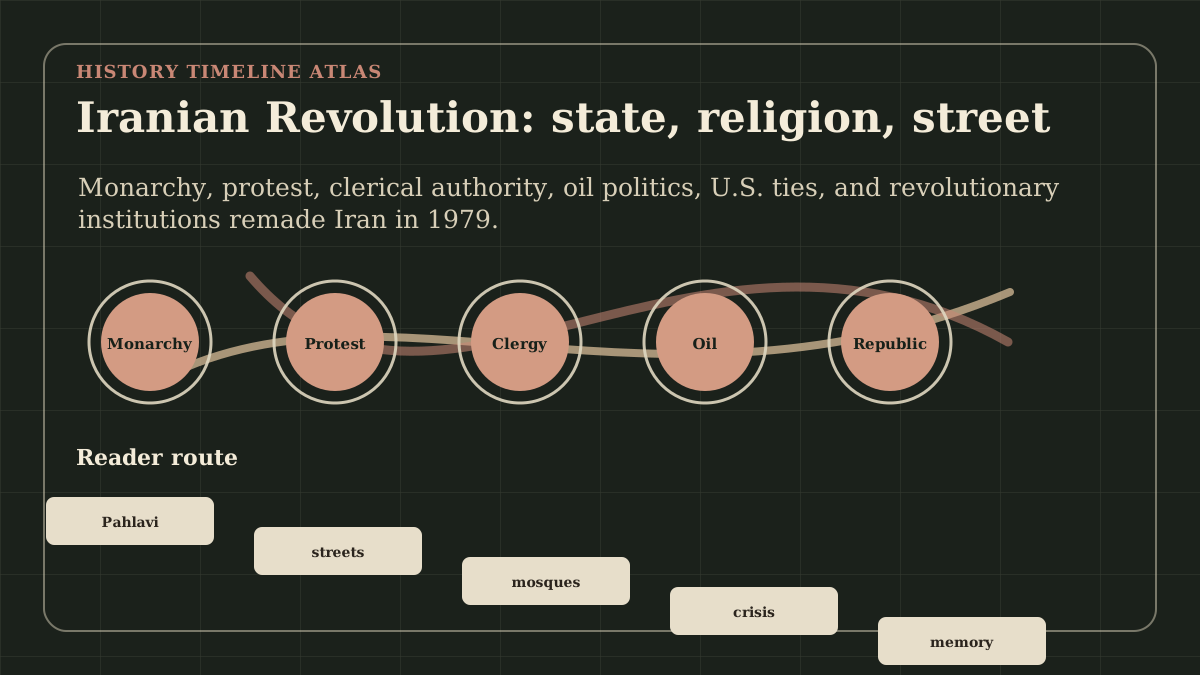
Into this mix entered Ruhollah Khomeini, a clerical figure in exile whose critique of the shah fused religious legitimacy with a critique of imperial interference. The result was a complex field of competing pressures—economic dislocation, political repression, religious mobilization, and foreign entanglement—none of which alone explains the revolution but which together set the scene for upheaval. The Iranian Revolution becomes more readable when the page refuses a one-cause explanation. The Pahlavi monarchy had pursued rapid modernization, centralized state power, close U. S. ties, oil-based development, and security surveillance.
Those projects created supporters and beneficiaries, but they also fed anger among religious networks, bazaar interests, students, leftists, liberals, workers, nationalists, and people who saw the monarchy as authoritarian, unequal, or culturally intrusive. A strong page keeps the street and the institution in the same frame. Demonstrations, mourning cycles, strikes, mosques, cassette sermons, exile communication, university activism, oil workers, and urban crowds all mattered. So did state hesitation, repression, elite calculation, and the collapse of confidence inside the old order. Revolution was not only ideology; it was a sequence of coordination problems that made authority look less inevitable. The Cold War setting should be present without flattening Iranian agency.
The United States mattered because of support for the Shah, memory of foreign intervention, oil politics, and regional strategy. Yet Iranians were not puppets in someone else's story. The revolution drew power from local grievances, religious legitimacy, social networks, and competing visions of what post-monarchical sovereignty should become.
The Turning Point
What changed, decisively, was the collapse of the shah’s political authority amid an expanding popular mobilization and the emergence of clerical leadership able to channel disparate grievances into a sustained movement. From 1978 into 1979, strikes, demonstrations, and religiously framed public rituals multiplied in Tehran and across Iran. Key actors made consequential choices: security forces and the monarchy struggled to contain unrest through repression and emergency measures, while many Iranians from different social backgrounds chose public protest over accommodation. Ruhollah Khomeini, long in exile, became the symbolic and organizational focal point for those refusing the shah’s rule; his return to Iran after the shah’s departure crystallized momentum.
The shah’s exit removed the central pillar of the old order, but it did not mechanically produce a single outcome. Instead, political and institutional contests followed: clerical leaders, revolutionary councils, leftist activists, and returning exiles all vied to shape the new state. That period turned a long list of grievances into a new political reality—an Islamic Republic built under clerical guidance—and redefined who could claim legitimate authority in Iran. The turning point was the monarchy's loss of credible control. As protest, strikes, and defections widened, the state could no longer make fear, reform promises, and royal authority work together. The Shah's departure and Khomeini's return made that collapse visible to people inside Iran and to observers abroad.
The second turning point came after the monarchy fell, when revolutionary coalition gave way to institution-building and political struggle. Revolutionary committees, clerical authority, constitutional design, elections, repression of rivals, and the hostage crisis shaped what the revolution would become. The event was therefore both an overthrow and a contested remaking of the state.
Consequences
In the near term, the shah left Iran and Khomeini returned; institutions of the Pahlavi state were dismantled, reconfigured, or repurposed, and a revolutionary government consolidated power by combining clerical leadership with new political structures. The immediate consequence was the creation of an Islamic Republic that placed religion at the center of state legitimacy and governance. In the medium and long term, the revolution altered regional geopolitics and the architecture of international relations: it ruptured longstanding U. S. -Iran ties, reshaped alliances in the Middle East, and injected political Islam into global conversations about statecraft and ideology. Oil politics were affected as states, corporations, and consumers recalibrated assumptions about supply, access, and influence.
The revolution also affected Cold War calculations, as Western and Soviet policymakers reassessed strategies in a region where a revolutionary theocracy now exercised significant influence. Domestically, Iranian society experienced profound legal, social, and institutional transformation as revolutionary rhetoric translated into policy. Memory and interpretation of the events that produced this state have themselves become political resources: subsequent governments, opposition movements, and international observers draw on different readings of 1978–79 to justify policies, demands, and alliances. The revolution’s consequences are thus multiple—political, social, diplomatic—and they continue to be contested. The immediate consequence was the creation of the Islamic Republic and a dramatic rupture in Iran's relationship with the United States.
The revolution changed law, gender politics, education, media, foreign policy, clerical authority, and the place of revolutionary memory in public life. It also helped reorder Middle Eastern politics just before the Iran-Iraq War. The longer consequence is interpretive. Some readers approach 1979 through anti-imperial sovereignty, others through clerical power, repression, gender restrictions, or regional conflict. A useful page does not force one moral slogan to carry the whole event. It shows how a broad revolution can open political possibility and then close possibilities for some of its own participants.
Interpretation Notes
Iranian Revolution is easy to flatten into one dramatic date. A stronger reading separates immediate action from deeper causes, affected communities, and the memory later states or movements built around the event.
Why Keep Reading
Follow related events and timelines to see how a revolutionary turning point unfolds into lasting institutions and regional realignments. Tracing the immediate months after the shah’s departure clarifies how contested authority hardened into constitutional change. Examining U. S. -Iran interactions in the 1980s and the spread of political Islam illuminates how local upheaval had global reverberations. For readers curious about cause, consequence, and memory, the sequences that connect protest, exile, return, and state-building reveal why this revolution remains a reference point for politics across the Middle East and beyond. Read the Iranian Revolution beside the 1979 year page, the Iran-Iraq War, Soviet-Afghan War, oil crisis, and Cold War globalization routes.
That sequence shows how one year connected revolution, energy, religion, intervention, and regional state power.
Reading Path
Follow the story without losing the thread
Before This
- Soviet-Afghan War BeginsDecember 1979
- Sandinista Revolution1979
- Fall of SaigonApril 30, 1975
After This
- Solidarity Movement in Poland1980
- Iran-Iraq War BeginsSeptember 1980
- Chernobyl DisasterApril 26, 1986
Same Period
- Arab Oil Embargo1973-1974 CE
- Iran-Iraq War BeginsSeptember 1980
- Mongol Sack of BaghdadFebruary 1258
Wider Timeline
Mind Map
How to think about Iranian Revolution
Economic discontent
Uneven modernization and inflation heightened grievances among workers and merchants
Map Layer
Where this event sits geographically
Gold pins mark the approximate locations of published event pages. This is a schematic locator map, not a historical border map.
Coordinates are approximate and are used to help readers orient themselves before opening a full event page.
References
Where to Check the Facts
- Encyclopaedia Britannica: Iranian RevolutionReference for the 1978-1979 revolution and establishment of the Islamic Republic.
- Encyclopaedia Britannica: Arab oil embargoReference for the 1973-1974 embargo and its energy, diplomatic, and economic consequences.
- Official United Nations Peacekeeping: First United Nations Emergency ForceOfficial UN reference for the Suez Crisis, UNEF, ceasefire, withdrawal, and international peacekeeping frame.
- Official UN Peacemaker: Oslo AccordsOfficial UN-hosted reference for the 1993 Declaration of Principles and interim self-government framework.
- U.S. National Archives: The Cold WarArchive reference hub for Cold War records, federal documentation, and research guidance.
- Office of the Historian: The Early Cold War, 1945-1952Official diplomatic history reference for early Cold War foreign-policy context.