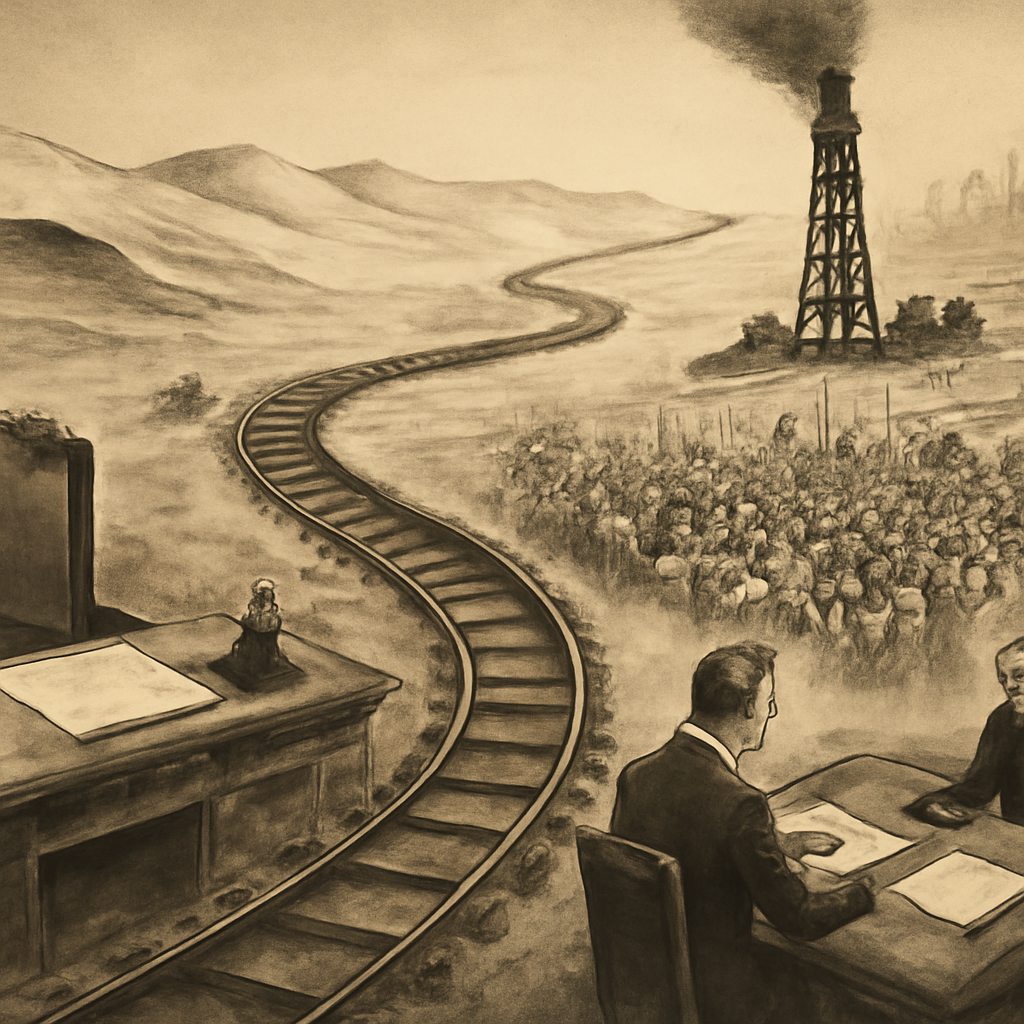
Central Question
How did imperial legacies, oil, revolution, nationalism, war, diplomacy, and state violence shape the modern Middle East and North Africa?
Start With These Dates
- 1839 CETanzimat Reforms Begin
The Tanzimat reforms began with an imperial reform program that aimed to reorganize Ottoman law, administration, taxation, military service, and subjecthood.
- July 1908Young Turk Revolution
The Young Turk Revolution restored the Ottoman constitution and parliament, challenging Abdulhamid II's autocracy while intensifying debates over empire and nationalism.
- 1915 CEArmenian Genocide Begins, 1915: Deportation, Violence, and Evidence
The Armenian Genocide began in 1915 as Ottoman authorities moved from wartime suspicion to arrests, deportations, and mass violence against Armenian communities. April 24 marks one remembered start, but the destruction unfolded through a wider system of removal, killing, starvation, exile, and evidence.
- 1956 CESuez Crisis
The Suez Crisis followed Egypt's nationalization of the canal and a British, French, and Israeli attack that exposed the limits of old imperial power.
- September 1980Iran-Iraq War Begins
Iraq invaded Iran in 1980, beginning an eight-year war shaped by revolutionary upheaval, border disputes, oil regions, regional rivalry, and outside support.
- December 2010Arab Spring Begins
Protests in Tunisia spread into a wider regional wave against authoritarian rule, corruption, unemployment, and police abuse.
- 2011 CESyrian Civil War Begins
Protests in Syria escalated into a civil war involving state repression, armed opposition, regional powers, global intervention, refugees, and humanitarian catastrophe.
Sources Used Here
- Encyclopaedia Britannica: Ottoman Empire
Reference for Ottoman imperial chronology, institutions, reform, war, and decline.
- Encyclopaedia Britannica: Tanzimat
Reference for the nineteenth-century Ottoman reform program and its administrative setting.
- Encyclopaedia Britannica: Iranian Revolution
Reference for the 1978-1979 revolution and establishment of the Islamic Republic.
- Encyclopaedia Britannica: Arab oil embargo
Reference for the 1973-1974 embargo and its energy, diplomatic, and economic consequences.
- Official United Nations Peacekeeping: First United Nations Emergency Force
Official UN reference for the Suez Crisis, UNEF, ceasefire, withdrawal, and international peacekeeping frame.
Modern Middle East and North Africa is designed as a route, not a folder. It gathers events that answer related reader questions about power, belief, conflict, exchange, institutions, and memory. The strongest way to read the page is to move from the earliest events toward the later ones, watching how one kind of pressure changes form across different places.
The route currently runs from 1839 CE to 2011 CE. That span lets readers compare immediate turning points with slower consequences: the founding of institutions, the spread of ideas, the shock of war or disease, and the way later societies reused earlier events as warnings, models, or symbols.
Start with Tanzimat Reforms Begin, Young Turk Revolution, Armenian Genocide Begins, 1915: Deportation, Violence, and Evidence, Suez Crisis, Arab Oil Embargo and then follow the internal links into people, timelines, years, maps, and source lists. The route structure stays visible when each event explains why it belongs with the others and where the next useful page is.
Compare the events by scale. Some are concentrated moments, such as a battle, proclamation, trial, or publication. Others are long processes, such as a reform movement, pandemic, trade route, or diplomatic order. Reading both types together helps prevent the page from becoming a list of dates.
A useful route keeps uncertainty visible. Historical change rarely has one cause or one clean ending, so the reader can separate background pressure, immediate trigger, turning point, result, and later memory. That pattern is what makes the atlas expandable without making the reader start over each time.
This route is also a comparison tool. After reading one event, compare it with a later event on the same page and ask what changed in scale, language, geography, technology, authority, or public memory. The comparison is often more useful than the individual summary because it reveals the pattern the topic page is built to expose. When a claim feels too neat, open the full event page and check whether the evidence supports one cause, several causes, or a contested interpretation before moving on.
Modern Middle East and North Africa connects late Ottoman reform, imperial collapse, oil, revolution, war, diplomacy, terrorism, protest, and civil war. The page deliberately starts before the twentieth century's familiar headlines because Tanzimat and 1908 show state reform, constitutionalism, and imperial crisis already reshaping the region before post-1945 politics.
Oil and revolution provide the route's global hinge. The Arab oil embargo shows that resource control could alter inflation, diplomacy, energy policy, and everyday life far beyond the region. The Iranian Revolution shows that monarchy, religion, anti-authoritarian protest, anti-imperial language, and Cold War alignment could combine into a new political order with consequences across the Gulf and the wider world.
The later nodes ask why peace and state order proved so difficult. The Iran-Iraq War, Oslo, September 11, Iraq War, Arab Spring, and Syrian Civil War show sovereignty, occupation, sectarian politics, authoritarian rule, protest, intervention, refugees, and humanitarian crisis interacting. The hub is therefore not a list of crises; it is a route through the institutions and pressures that made crisis durable.
The route begins with late Ottoman reform because modern politics in the region cannot be explained only by post-1945 states or Cold War alliances. Tanzimat reform raised questions about citizenship, law, minority protection, centralization, provincial authority, and European diplomatic pressure. The Young Turk Revolution added constitutional hope and military-political conflict. Those earlier nodes help readers see that modernity arrived as a contested state project before the empire collapsed.
The Armenian Genocide sits at the edge between imperial crisis and modern memory. It belongs here because the violence of World War I, deportation, mass death, survivor testimony, denial, and national memory shaped how later communities understood state power and minority vulnerability. A useful MENA route does not turn the genocide into background. It treats it as a central warning about what can happen when war, nationalism, bureaucracy, and dehumanization converge.
Suez in 1956 gives the route a postwar hinge. Egypt, Britain, France, Israel, the United States, the Soviet Union, the United Nations, canal ownership, Arab nationalism, and decolonization all appeared in one crisis. It was not only a regional war. It was a test of old imperial power in a world where formal empire had weakened but strategic infrastructure still mattered.
Oil makes the route global without making the region reducible to petroleum. The 1973 embargo shows that energy markets could turn diplomatic conflict into inflation, household cost, industrial planning, and foreign policy far away. But oil also affected domestic politics: states, companies, subsidies, armies, infrastructure, inequality, and patronage all became part of the story. Resource power created leverage and dependence at the same time.
The Iranian Revolution gives the route a second political language. It was anti-monarchical, religious, anti-imperial, popular, ideological, and institutional. The revolution changed U.S.-Iran relations, Gulf politics, Islamic political movements, and debates over sovereignty and legitimacy. It also reminds readers that revolution is not one moment of crowd victory; it becomes a new state order with its own coercion, institutions, memory, and opponents.
The Iran-Iraq War shows how revolution and state rivalry could become mass destruction. Borders, oil fields, revolutionary fear, authoritarian rule, chemical weapons, soldiers, cities, and international arms flows all shaped the war's endurance. The event matters because it makes clear that regional wars are not only diplomatic episodes. They reorganize generations through conscription, grief, debt, trauma, and state propaganda.
Oslo gives the route a diplomacy lens. The accords are useful because they show negotiation, recognition, territory, security, hope, asymmetry, and disappointment in one frame. Diplomacy can create institutions and new language without resolving settlement, occupation, sovereignty, refugees, violence, or political trust. Readers need that complexity to avoid treating peace processes as simple successes or failures.
September 11 and the Iraq War connect the region to U.S. security policy, terrorism, invasion, occupation, insurgency, sectarian violence, intelligence claims, and global protest. These nodes are often searched as world events, but in this hub they become part of a longer regional sequence. Intervention changed Iraqi society and regional politics, while also changing how outside publics imagined the Middle East and North Africa.
The Arab Spring and Syrian Civil War give the route its contemporary crisis. Protest began with demands around dignity, corruption, police violence, food prices, and accountable government, but outcomes diverged sharply across states. Syria shows the catastrophic edge: repression, militarization, foreign intervention, refugees, cities under siege, humanitarian crisis, and contested memory. The route keeps local actors visible inside larger regional and international pressures.
The MENA hub becomes more readable when it separates three scales. The first is local: families, workers, students, religious communities, soldiers, refugees, and activists living through state power. The second is regional: Arab nationalism, Iran, Israel-Palestine, Gulf politics, water, oil, borders, and sectarian language. The third is global: empire, Cold War rivalry, the United Nations, energy markets, terrorism policy, and migration. The route works by moving between those scales without letting one erase the others.
This structure also guards against crisis fatigue. A visitor can arrive through oil, Iran, Suez, September 11, Iraq, the Arab Spring, or Syria and still find a coherent path. The central question is not why the region is always in crisis. The better question is how states, borders, resources, interventions, social movements, and memories interacted to make some conflicts durable and some reforms difficult.
Borders are one of the route's recurring problems. Ottoman provinces, postwar mandates, colonial agreements, new republics, monarchies, occupation zones, refugee camps, and contested territories all shaped how people understood sovereignty. A border on a map could become a checkpoint, a family separation, a military front, a diplomatic claim, or a legal category. The route becomes more human when borders are read as lived institutions.
Authoritarianism also requires historical explanation rather than stereotype. Some regimes built legitimacy through anti-colonial language, military rule, development projects, monarchy, party institutions, security services, oil revenues, or religious authority. Protest movements challenged those arrangements with different tools: street demonstrations, unions, mosques, social media, parties, armed resistance, and international advocacy. The route lets readers ask why some challenges opened reform while others triggered repression or war.
Water, food, and urban life belong inside modern MENA history too. Cities grew rapidly; rural livelihoods changed; migration linked villages to Gulf labor markets, European cities, and refugee diasporas; water scarcity and infrastructure shaped daily politics. These pressures often sit behind headline events. They explain why people protest, migrate, support strong states, fear disorder, or distrust promises that never reach housing, wages, bread, electricity, or safety.
The region's religious diversity also needs careful handling. Sunni and Shi'i Islam, Christianity, Judaism, Druze, Yazidi, and other communities appear in different local histories, legal statuses, memories, and vulnerabilities. Religion can shape law, identity, alliance, and protest, but it cannot explain every conflict by itself. The hub keeps religion in the analysis while also tracking class, state power, empire, oil, borders, and intervention.
External power recurs because the region has often been treated as strategically indispensable by outsiders. Britain, France, Russia, the United States, the Soviet Union, the United Nations, oil companies, financial institutions, and regional powers all shaped events. But outside influence never removes local agency. Leaders, activists, workers, soldiers, religious authorities, families, and refugees made choices inside constraints that outsiders often misunderstood.
The source trail for this route also teaches caution. Official diplomatic texts show what states wanted recorded; news footage captures public drama; memoirs and testimony reveal experience; human-rights reports document violence; maps show claims and displacement; energy data shows dependency. No single source family explains the region. A careful reader moves among them and asks what each can and cannot show.
For SEO and reader usefulness, this hub answers several searches without creating duplicate pages. A visitor asking about modern Middle East history gets the route. A visitor asking about the Iranian Revolution, Arab oil embargo, Suez Crisis, Arab Spring, Iraq War, or Syrian Civil War gets a focused event page. The hub owns the synthesis: how those entries connect across state power, resources, diplomacy, protest, war, and memory.
The route also helps readers avoid two weak habits. One habit treats the region as a set of ancient rivalries that never change. The other treats every event as the result of outside intervention alone. The better reading is historical: local societies, state institutions, external powers, resource politics, religious language, class pressure, and memory interact differently in each episode.
A final way through the hub is by affected group. Armenians, Egyptians, Palestinians, Israelis, Iranians, Iraqis, Syrians, Kurds, Gulf workers, protesters, refugees, soldiers, oil workers, diplomats, and families each enter the route from different places. Naming that range makes the region harder to flatten and gives readers more reasons to keep clicking into specific pages.
That range also makes the hub safer for search readers. It does not promise one master cause for modern MENA history. It offers a disciplined route: identify the institution, locate the affected communities, follow the source trail, and then compare the event with its nearest timeline and topic neighbors.
The final synthesis is therefore practical. Late Ottoman reform explains state inheritance, Suez explains decolonizing sovereignty, oil explains global leverage, Iran explains revolutionary state-building, Oslo explains diplomacy under asymmetry, and Syria explains the cost of authoritarian collapse and intervention. Readers can enter anywhere and still find the wider structure.
Modern Middle East and North Africa history becomes clearer when late Ottoman reform, European intervention, oil, nationalism, revolution, war, diplomacy, and protest stay connected. The route is not a straight line from empire to nation-state. It is a sequence of reforms, mandates, military institutions, borders, monarchies, republics, resource politics, and public movements that repeatedly changed the meaning of sovereignty.
Oil is part of the story, but oil alone explains too little. Railways, armies, land law, constitutionalism, Suez, Palestine, Algeria, Iran, Iraq, Gulf monarchies, labor migration, debt, and superpower rivalry all shaped modern politics. A reader gets a better route by asking which institution carried power in each place: army, party, palace, mosque, company, union, militia, foreign base, or protest square.
The Arab Spring and Syrian civil war belong in the same hub because they show both the possibility and the danger of public rupture. Protest, repression, media, economic frustration, sectarian politics, foreign intervention, displacement, and civil war do not collapse into one cause. The hub invites readers to compare Egypt, Tunisia, Syria, Iran, Iraq, Palestine, and North Africa without pretending the region has one story.
Read the events in order first; the page is built to reveal change over time.
Ask which pressures existed before the visible turning point and which actors had room to choose.
Follow what changed afterward in institutions, borders, law, belief, or everyday life.
Notice which events became symbols and why later generations kept returning to them.
Use Ottoman reform and collapse to see how borders, minorities, law, and state institutions shaped later politics.
Ask how energy markets turned regional war and diplomacy into household prices, inflation, and strategic planning worldwide.
Compare Iran, the Arab Spring, Iraq, and Syria as different routes through protest, repression, intervention, and memory.
Read Suez and Oslo as moments where negotiation, infrastructure, sovereignty, and unequal power met in public.
Keep refugees, conscripts, civilians, minorities, protesters, and families visible beside state strategy.
Move between constitutions, armies, oil companies, foreign diplomacy, and public squares to see how formal power met social pressure.
Choose a Reading Path
Start With the Timeline
Use the related timeline first when you want a chronological route through the topic.
Start with 1839 CE: Tanzimat Reforms BeginOpen a Person Page
Use people pages when the topic is easier to understand through leadership, resistance, reform, or memory.
Start with July 1908: Young Turk RevolutionUse Year Pages
Use year pages when you need a fast answer to what changed in a specific year.
Start with 1915 CE: Armenian Genocide Begins, 1915: Deportation, Violence, and EvidenceReturn to the Map
Use the map to keep geography visible while moving between events and regions.
Start with 1956 CE: Suez CrisisNeed the Ottoman Opening
Start with Tanzimat, 1908, and Armenian Genocide to see reform, constitutionalism, minority vulnerability, and imperial collapse.
Start with September 1980: Iran-Iraq War BeginsNeed Oil and Diplomacy
Move through Suez and the 1973 embargo to connect canals, decolonization, energy markets, and global strategy.
Start with December 2010: Arab Spring BeginsNeed Revolution
Use Iran 1979 and the Arab Spring to compare monarchy, protest, religion, authoritarianism, and new state power.
Start with 2011 CE: Syrian Civil War BeginsNeed War and Intervention
Read Iran-Iraq, September 11, Iraq War, and Syria as linked but distinct histories of violence, policy, and memory.
How the Story Builds
Begin with Tanzimat Reforms Begin. The opening event usually shows the pressure that made the route necessary: a crisis of authority, an expanding exchange system, a new technology, a contested idea, or a conflict that older institutions could no longer contain.
Iran-Iraq War Begins works as a checkpoint because it lets readers ask what had become irreversible, which actors still had choices, and how the route changed scale between the opening event and the later consequences.
The later edge of the route includes Iraq War Begins, Arab Spring Begins, and Syrian Civil War Begins. These pages help readers see what survived beyond the first shock: institutions, borders, laws, memories, technologies, movements, or arguments that kept shaping later history.
The route is easier to remember through people and places. Watch figures such as Abdulmecid I, Ottoman reformers, Abdulhamid II, Committee of Union and Progress, and Armenian civilians move through settings such as Istanbul, Ottoman Empire, Ottoman Anatolia, Suez Canal, and Middle East and global oil markets; that is where large structures become visible as choices, risks, costs, and memories.
Tanzimat and 1908 introduce citizenship, law, centralization, constitutional hopes, military politics, and minority questions.
The Armenian Genocide marks mass violence, deportation, survivor memory, denial, and the human cost of wartime state power.
Suez and oil politics show decolonization, canals, nationalism, resource leverage, and global dependence.
Iran, Iran-Iraq, and Oslo connect revolution, borders, diplomacy, recognition, and the difficulty of durable settlement.
September 11, Iraq, Arab Spring, and Syria reveal intervention, protest, repression, refugees, and contested futures.
- Which event in Modern Middle East and North Africa feels like the true point of no return, and why might another reader choose a different event?
- What changes if the route is read from the perspective of ordinary people rather than rulers, armies, inventors, reformers, or institutions?
- Which consequence was immediate, and which consequence only became clear decades later?
- Where does the map change the interpretation by showing distance, borders, routes, ports, capitals, or frontiers?
- How far back does a useful modern Middle East timeline need to begin?
- Why did oil make regional politics globally consequential?
- What changed after the Iranian Revolution, and what older structures remained?
- How can readers discuss intervention and civil war without erasing local actors?
- Which scale explains the most in a given event: local society, regional rivalry, or global power?
- When did reform strengthen states, and when did it expose deeper legitimacy problems?
- How does the history change when oil is read beside borders, labor, armies, and protest?
Interactive Timeline
Follow Modern Middle East and North Africa by sequence
Tanzimat Reforms Begin
The Tanzimat reforms began with an imperial reform program that aimed to reorganize Ottoman law, administration, taxation, military service, and subjecthood.
Read the full event pageMap Layer
Modern Middle East and North Africa geography
Gold pins mark the approximate locations of published event pages. This is a schematic locator map, not a historical border map.
Coordinates are approximate and are used to help readers orient themselves before opening a full event page.
Route Events
Events in This Topic
Tanzimat Reforms Begin
The Tanzimat reforms began with an imperial reform program that aimed to reorganize Ottoman law, administration, taxation, military service, and subjecthood.
Young Turk Revolution
The Young Turk Revolution restored the Ottoman constitution and parliament, challenging Abdulhamid II's autocracy while intensifying debates over empire and nationalism.
Armenian Genocide Begins, 1915: Deportation, Violence, and Evidence
The Armenian Genocide began in 1915 as Ottoman authorities moved from wartime suspicion to arrests, deportations, and mass violence against Armenian communities. April 24 marks one remembered start, but the destruction unfolded through a wider system of removal, killing, starvation, exile, and evidence.
Suez Crisis
The Suez Crisis followed Egypt's nationalization of the canal and a British, French, and Israeli attack that exposed the limits of old imperial power.
Arab Oil Embargo
Arab oil producers restricted shipments during the 1973 Arab-Israeli war, turning energy supply into a global diplomatic and economic crisis.
Iranian Revolution
Iran's revolution overthrew the Pahlavi monarchy and created an Islamic Republic, combining mass protest, clerical leadership, anti-authoritarian anger, and anti-imperial politics.
Iran-Iraq War Begins
Iraq invaded Iran in 1980, beginning an eight-year war shaped by revolutionary upheaval, border disputes, oil regions, regional rivalry, and outside support.
Oslo Accords
The Oslo Accords created a formal peace process between Israel and the Palestine Liberation Organization after mutual recognition and secret negotiations.
September 11 Attacks
Al-Qaeda hijackers attacked targets in the United States, destroying the World Trade Center towers and striking the Pentagon.
Iraq War Begins
A U.S.-led coalition invaded Iraq in 2003, toppling Saddam Hussein and opening a long conflict over occupation, insurgency, sectarian politics, and state collapse.
Arab Spring Begins
Protests in Tunisia spread into a wider regional wave against authoritarian rule, corruption, unemployment, and police abuse.
Syrian Civil War Begins
Protests in Syria escalated into a civil war involving state repression, armed opposition, regional powers, global intervention, refugees, and humanitarian catastrophe.
References
Where to Check the Facts
- Encyclopaedia Britannica: Ottoman EmpireReference for Ottoman imperial chronology, institutions, reform, war, and decline.
- Encyclopaedia Britannica: TanzimatReference for the nineteenth-century Ottoman reform program and its administrative setting.
- Encyclopaedia Britannica: Iranian RevolutionReference for the 1978-1979 revolution and establishment of the Islamic Republic.
- Encyclopaedia Britannica: Arab oil embargoReference for the 1973-1974 embargo and its energy, diplomatic, and economic consequences.
- Official United Nations Peacekeeping: First United Nations Emergency ForceOfficial UN reference for the Suez Crisis, UNEF, ceasefire, withdrawal, and international peacekeeping frame.
- Official UN Peacemaker: Oslo AccordsOfficial UN-hosted reference for the 1993 Declaration of Principles and interim self-government framework.