At a Glance
The shape of the event
- Date
- September 11, 2001
- Place
- New York, Washington, D.C., and Pennsylvania
- Type
- Terrorist Attack
Al-Qaeda hijackers attacked targets in the United States, destroying the World Trade Center towers and striking the Pentagon.
September 11, 2001; place the event in New York, Washington, D.C., and Pennsylvania before comparing causes or consequences.
September 11 reshaped security policy, surveillance, foreign intervention, and public memory in the twenty-first century.
Victims and first responders are the first names or groups to compare before widening the story.
The attacks killed thousands and prompted U.S.-led military action in Afghanistan.
The attacks killed thousands and prompted U.S.-led military action in Afghanistan.
September 11 reshaped security policy, surveillance, foreign intervention, and public memory in the twenty-first century.
Follow-up reading will show how a single day translated into policy and cultural change over decades: how airport security and intelligence-sharing were restructured, how the United States and its allies pursued milit...
Background
The attacks on September 11, 2001 did not spring from a single cause that can be summed up briefly. They emerged at the intersection of long-term political grievances, the rise of transnational militant networks, and a pattern of U. S. engagement overseas that many critics had already debated in the 1990s. Al-Qaeda had built an international cell structure and an ideology that justified violence against civilian and military targets; at the same time, global travel, commercial aviation, and porous intelligence networks created opportunities for a small group to turn airliners into weapons.
Domestic factors mattered as well: immigration and visa systems, airport security protocols, and the capacity of law-enforcement and intelligence agencies to share information were tested in ways they had not been before. Scholars and commentators continue to dispute how much weight to give to individual decisions—terrorists’ operational choices, pilots’ actions, rescuers’ split-second responses—versus deeper structural forces such as geopolitics, post-Cold War American power, and the legal and bureaucratic frameworks that govern surveillance and border security. This page aims to keep those debates visible while laying out what happened and why it mattered. September 11 needs a page that slows down before it generalizes.
The attacks were a coordinated act of mass violence by al-Qaeda, but the human center is specific: office workers, airline crews, passengers, firefighters, police officers, emergency medical workers, families waiting for calls, and communities who later carried grief, illness, testimony, and commemoration. A responsible page keeps those lives visible while explaining the systems that failed and changed. The event also belongs to a longer history of U. S. foreign policy, militant networks, intelligence work, immigration and aviation systems, and public fear after the Cold War. That does not make the attacks inevitable. It helps readers understand why a small number of hijackers could use ordinary commercial infrastructure to create a national emergency.
The aftermath should not be treated as one automatic response. The Authorization for Use of Military Force, the war in Afghanistan, the creation of the Department of Homeland Security, the USA PATRIOT Act, airport security changes, surveillance debates, anti-Muslim backlash, health consequences for responders, and memorial work all formed different branches of the same historical shock.
The Turning Point
Between the first alarms and the collapse of the towers, ordinary routines became crisis management. Hijackers took control of passenger aircraft and turned them toward highly symbolic targets: two commercial airliners were flown into New York’s World Trade Center towers, causing catastrophic structural damage and fires that led to both towers’ eventual collapse; another plane struck the Pentagon in Washington, D. C. ; the crisis extended into Pennsylvania when a fourth aircraft was brought down outside the initial target area. The choices of actors on that morning—air traffic controllers rerouting flights, military officials tracking unidentified aircraft, police and firefighters entering burning buildings, pilots and passengers confronting hijackers—shaped the course of the day.
First responders faced impossible trade-offs in an environment of incomplete information and rapidly changing risk. Political leaders in Washington transferred authority and began emergency decision-making while the nation watched. The visible violence of smashed buildings and flames created an immediate imperative: rescue, account for the missing, and secure other potential targets. In hours the event moved from a sequence of violent acts to a national crisis that demanded political and military responses, and it made plain the limits of existing security systems. The turning point was the movement from unfolding attack to national mobilization within hours.
Grounded flights, emergency command decisions, rescue operations, media coverage, and the search for missing people turned a morning of violence into a crisis of state capacity and public trust. Another turning point came when grief and security policy fused. Preventing another attack became the organizing claim behind new agencies, military action, intelligence sharing, detention policies, and domestic surveillance. The page should help readers ask which changes protected people, which created new harms, and which became permanent.
Consequences
The immediate human cost was vast: thousands were killed, many more injured, and countless families and communities were disrupted. First responders and recovery teams faced long-term physical and psychological consequences as they worked at the attack sites. Politically, the attacks propelled a swift national focus on prevention and retaliation: U. S. -led military action in Afghanistan followed as a direct response to the group that planned the attacks, and a broad set of domestic measures expanded surveillance powers, border controls, and intelligence coordination. These policy changes were often rapid and contested—some lawmakers and officials argued for sweeping new authorities to prevent future attacks, while civil libertarians and others warned about the risks to rights and oversight.
Over the longer term, September 11 reshaped how the United States engaged abroad, accelerating counterterrorism partnerships, military deployments, and nation-building efforts in parts of the Muslim-majority world. It also left a profound mark on public memory: monuments, survivor testimony, official rituals, and continuing debates about sacrifice, culpability and commemoration. Historians and policymakers continue to argue about which decisions mattered most, how unintended consequences unfolded, and how the balance between security and liberty should be maintained—questions that remain central to twenty-first-century governance. The immediate consequences were death, injury, rescue, recovery, mourning, and a changed sense of vulnerability in public space.
The longer consequences reshaped global politics: the war in Afghanistan, later links to the Iraq War debate, counterterror partnerships, drone warfare, border control, emergency law, and arguments over civil liberties. Memory is also a consequence. Names, photographs, oral histories, museum exhibits, annual ceremonies, survivor testimony, and health advocacy for responders keep the event from becoming only a policy origin story. A strong page preserves that moral scale while still explaining institutions and geopolitics.
Interpretation Notes
September 11 Attacks can look simple when reduced to one date, but the evidence usually points to a wider setting. The useful debate is which part mattered most: leadership, logistics, belief, social pressure, or the institutions that survived afterward.
Why Keep Reading
Follow-up reading will show how a single day translated into policy and cultural change over decades: how airport security and intelligence-sharing were restructured, how the United States and its allies pursued military and diplomatic strategies labeled the War on Terror, and how local communities coped with loss and recovery. Tracing those threads connects the boots-on-the-ground response to long-term shifts in law, foreign policy and public memory. If you want to understand current debates about surveillance, counterterrorism, or memorialization, the next entries—on immediate rescue operations, the authorization for use of force, and the rebuilding of lower Manhattan—clarify the steps taken after September 11 and the dilemmas they produced.
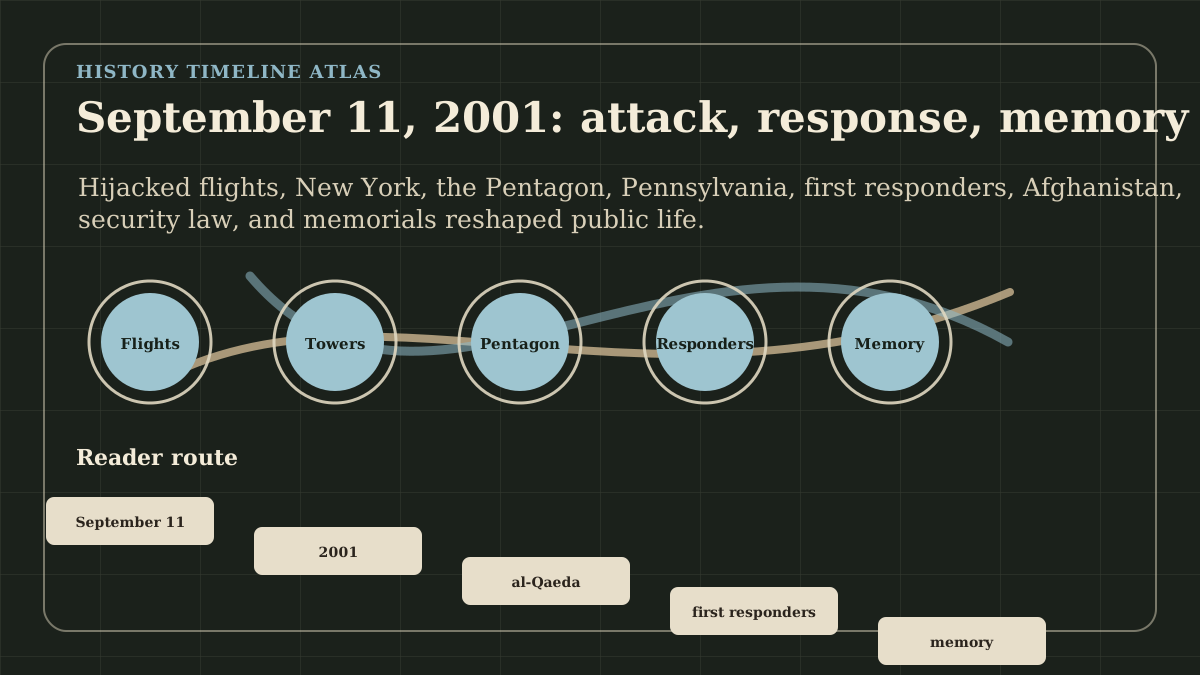
Read September 11 before the Iraq War, Afghanistan, civil liberties, contemporary Middle East pages, and twenty-first-century security debates. That route shows how one attack became a long structure of war, law, memory, and identity.
Reading Path
Follow the story without losing the thread
Before This
- Civil Rights Act of 1964July 2, 1964
- March on WashingtonAugust 28, 1963
- Bay of Pigs InvasionApril 17-20, 1961
After This
- Iraq War BeginsMarch 2003
- Human Genome Project Completed2003 CE
- Arab Spring BeginsDecember 2010
Same Period
- Arab Spring BeginsDecember 2010
- COVID-19 Pandemic DeclaredMarch 11, 2020
- Human Genome Project Completed2003 CE
Wider Timeline
Mind Map
How to think about September 11 Attacks
Al-Qaeda network
An organized transnational group that planned and directed the hijackings
Map Layer
Where this event sits geographically
Gold pins mark the approximate locations of published event pages. This is a schematic locator map, not a historical border map.
Coordinates are approximate and are used to help readers orient themselves before opening a full event page.
References
Where to Check the Facts
- National September 11 Memorial and Museum: ExhibitionsMuseum reference for the events of September 11, historical context, aftermath, artifacts, and public memory.
- Encyclopaedia BritannicaBackground reference for chronology, names, and historical context.
- WikidataStructured reference for dates, places, alternate names, and entity links.