At a Glance
The shape of the event
- Date
- March 2003
- Place
- Iraq
- Type
- War outbreak
A U.S.-led coalition invaded Iraq in 2003, toppling Saddam Hussein and opening a long conflict over occupation, insurgency, sectarian politics, and state collapse.
March 2003; place the event in Iraq before comparing causes or consequences.
The Iraq War is central to understanding post-9/11 geopolitics, intervention debates, Iraqi society, and regional insecurity.
George W. Bush / Saddam Hussein / Iraqi civilians are the first names or groups to compare before widening the story.
The Ba'athist regime fell, but the war produced prolonged instability and major regional consequences.
The Ba'athist regime fell, but the war produced prolonged instability and major regional consequences.
The Iraq War is central to understanding post-9/11 geopolitics, intervention debates, Iraqi society, and regional insecurity.
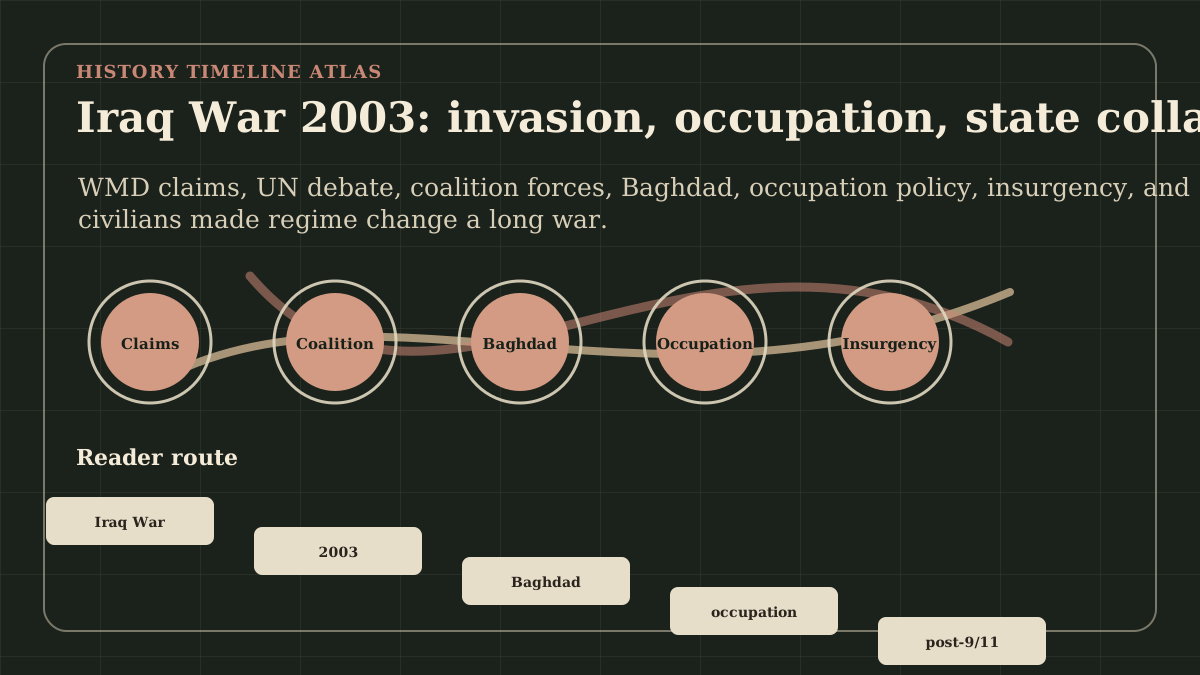
Follow the timelines and you will see how a single military decision unfolded into years of occupation, insurgency and political transformation.
Background
The decision to invade Iraq in March 2003 did not arise from a single cause but from overlapping pressures. In the years after the September 2001 attacks, U. S. foreign policy priorities shifted toward perceived threats from the Middle East, making military options more prominent in political debate. Saddam Hussein’s Ba'athist regime had ruled Iraq for decades with a centralized, authoritarian apparatus that shaped daily life, governance and political grievances. International diplomacy, regional rivalries and the politics of security in Washington converged with Iraqi social fault lines to create a volatile prelude.
At the same time, ordinary Iraqis lived under the long shadow of centralized state control and economic and social disruptions that affected their capacity to absorb sudden political shock. Historians separate the immediate outbreak of war from these deeper currents—structural pressures, contested narratives of threat, and the lives of people governed by an entrenched regime—because understanding the invasion means reading both the decision-makers’ calculations and the communities that endured the consequences. The beginning of the Iraq War should not read as a clean operation that ended with regime collapse.
It began inside the post-9/11 security climate, weapons of mass destruction claims, debates over United Nations authority, memories of the 1991 Gulf War, sanctions, Iraqi state repression, regional rivalry, and arguments about whether force could remake politics. The Iraqi social layer is essential. Baghdad, Basra, Mosul, Najaf, Fallujah, Kurdish regions, Shi'a communities, Sunni Arab communities, Christians, minorities, soldiers, civil servants, families, exiles, and displaced people did not experience the invasion as one uniform event. The war changed everyday security, electricity, employment, policing, archives, prisons, and trust. Occupation policy belongs in the same story as the invasion.
The fall of Saddam Hussein's regime created an immediate question: what institutions would remain, who would administer security, how would former Ba'ath Party members and soldiers be treated, and who could claim legitimacy in a state suddenly opened to foreign authority and domestic competition?
The Turning Point
The invasion itself marks a clear change of course: coalition forces entered Iraq in March 2003 and within weeks the Ba'athist regime’s visible structures of power had been removed. That shift was as much political and administrative as it was military. The removal of Saddam Hussein from power transformed Iraq from an authoritarian state under a single dominant party into a territory under foreign occupation, with competing Iraqi political actors attempting to claim authority. Key choices during and immediately after the invasion—how to administer security, how to organize transitional governance, which institutions to preserve or disband—shaped the next phase.
On one side, coalition leaders faced the task of imposing order and planning reconstruction; on the other, Iraqi civilians and local leaders confronted a rapidly changing landscape of authority, public services and security. The moment of regime collapse did not end politics; it reset the conditions under which insurgency, sectarian competition and struggles over state institutions took root. Those early decisions and the immediate human experience of invasion set trajectories that would not be easily reversed. The turning point was the rapid fall of visible Ba'athist state power without an equally rapid replacement of order.
Coalition military success removed the regime, but looting, institutional breakdown, contested authority, and uncertain security made clear that victory over a government was not the same as building a stable political order. Decisions about occupation, de-Ba'athification, the Iraqi army, transitional governance, and reconstruction shaped the next phase. Those choices helped determine whether armed resistance, sectarian competition, local militias, and regional influence would grow inside the political vacuum.
Consequences
In the near term the most visible consequence was the fall of the Ba'athist regime and the beginning of foreign occupation. The removal of a central authority opened spaces for armed resistance, political competition and new local power structures to emerge. Iraqi civilians experienced displacement, insecurity and the disruption of public services as different forces contested control. Over the longer term the Iraq War has been a central reference point for debates about intervention, intelligence and the limits of military power in achieving political transformation. Regionally, the invasion altered alignments and heightened instability in a way that many observers link to broader insecurity across the Middle East.
For Iraq itself the years that followed were marked by contested reconstruction, contested memories of occupation and violence, and by political and social processes that reshaped communities and institutions. The event therefore has dual legacies: it is the moment that ended one regime, and also the starting point for prolonged instability and political realignment whose effects continue to be debated and felt by Iraqi civilians and neighboring states. The immediate consequence was regime change and foreign occupation. The longer consequence was a war over the meaning of the state itself: constitution-making, elections, insurgency, sectarian violence, militia power, counterinsurgency, displacement, and arguments over sovereignty.
The Iraq War also reshaped global debate about intelligence, preventive war, international law, civilian harm, veterans, media evidence, and the limits of military power. A careful page should not reduce those debates to slogans; it should keep Iraqi civilians and institutions at the center of the costs.
Interpretation Notes
Iraq War Begins is easy to flatten into one dramatic date. A stronger reading separates immediate action from deeper causes, affected communities, and the memory later states or movements built around the event.
Why Keep Reading
Follow the timelines and you will see how a single military decision unfolded into years of occupation, insurgency and political transformation. Explore the sequence of occupation policies, the emergence of armed resistance, the processes of state rebuilding and the public debates in capitals across the world. Read the stories of Iraqi civilians to understand the human cost and the varieties of local response. If you want to grasp how post-9/11 priorities reshaped international action, or how societies rebuild after authoritarian collapse, the events that begin in March 2003 provide a necessary, if contested, starting point. Read Iraq 2003 beside September 11, the Cold War Middle East, the Iranian Revolution, the Iran-Iraq War, the Arab Spring, and Syrian civil war pages.
That path shows how intervention, state weakness, sectarian politics, and regional power interacted over decades.
Reading Path
Follow the story without losing the thread
Before This
- Human Genome Project Completed2003 CE
- September 11 AttacksSeptember 11, 2001
- Iran-Iraq War BeginsSeptember 1980
After This
- Arab Spring BeginsDecember 2010
- Syrian Civil War Begins2011 CE
- COVID-19 Pandemic DeclaredMarch 11, 2020
Same Period
- September 11 AttacksSeptember 11, 2001
- Arab Spring BeginsDecember 2010
- COVID-19 Pandemic DeclaredMarch 11, 2020
Wider Timeline
Mind Map
How to think about Iraq War Begins
Post-9/11 security climate
Shifts in U.S. and allied strategic priorities after 2001 increased political willingness to use military force in the Middle East.
Map Layer
Where this event sits geographically
Gold pins mark the approximate locations of published event pages. This is a schematic locator map, not a historical border map.
Coordinates are approximate and are used to help readers orient themselves before opening a full event page.
References
Where to Check the Facts
- Encyclopaedia Britannica: Iraq WarReference for the 2003 invasion and later conflict.
- Encyclopaedia Britannica: Iraq, the Iraq WarReference for Iraq War context and consequences.