At a Glance
The shape of the event
- Date
- 2003 CE
- Place
- International
- Type
- Scientific Milestone
The Human Genome Project completed a reference sequence of the human genome, creating a major resource for biology and medicine.
2003 CE; place the event in International before comparing causes or consequences.
The project accelerated genomic medicine, bioethics debates, data-intensive science, and public understanding of heredity.
Human Genome Project researchers are the first names or groups to compare before widening the story.
Researchers gained a shared map for studying genes, disease, inheritance, and biological variation.
Researchers gained a shared map for studying genes, disease, inheritance, and biological variation.
The project accelerated genomic medicine, bioethics debates, data-intensive science, and public understanding of heredity.
Follow this moment to track the paths that flowed from a single scientific decision to build a shared map.
Background
The Human Genome Project emerged from decades of molecular biology and genetics, carried forward by many laboratories and funded through a mix of public support and institutional commitments across countries. By the turn of the twenty-first century, experimental methods, computing power and collaborative norms had reached a point where assembling a reference sequence became feasible and urgent. Scientists and policymakers saw a practical promise: a single, shared map would speed research into gene function, heredity and disease. At the same time, the undertaking met ethical unease about how such information could be used, who would control it, and what it might mean for individuals and communities.
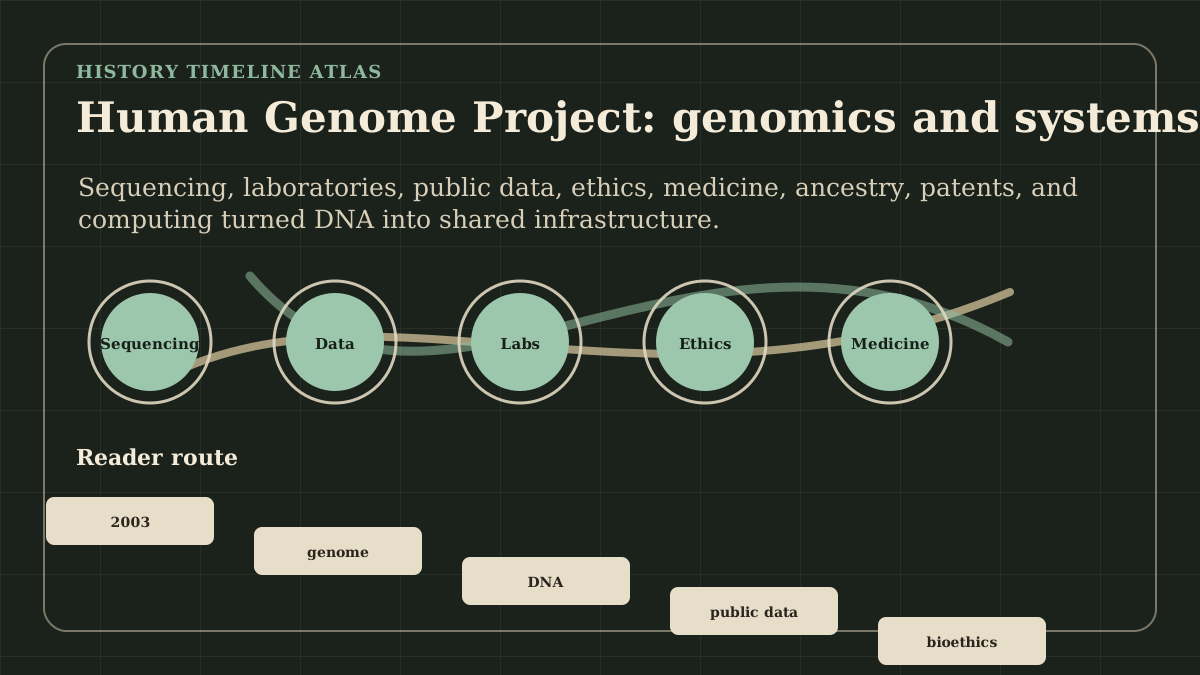
Interpretations of the project’s causes and consequences differ; historians and commentators continue to debate how much resulted from individual choices by scientists and funders versus broader structural forces — technological momentum, institutional incentives and public demands for medical progress. This page keeps those disputed perspectives visible rather than settling on a single narrative. The Human Genome Project is richer when it is read as infrastructure, not just a scientific finish line. Sequencing the reference human genome required laboratories, automation, computing, public databases, funding, standards, and international coordination. The result was not a single book of life that explained everything. It was a shared reference that made new questions easier to ask.
The public-private rivalry matters because it shaped how genomic knowledge would circulate. Public project leaders argued for rapid data release, while private sequencing efforts raised questions about patents, commercial value, access, and the speed of discovery. Those choices affected later research culture as much as the final announcement did. The human layer includes patients, families, Indigenous and minority communities, genetic counselors, clinicians, privacy advocates, and people worried about discrimination. A good page should connect DNA to medicine without promising simple certainty. Genes influence risk, but environment, inequality, ancestry categories, health systems, and interpretation all shape what genomic information means.
The Turning Point
What changed in 2003 was both practical and conceptual. Practically, Human Genome Project researchers coordinated internationally to assemble and release a reference sequence — a standardized map of human DNA that other researchers could use without redoing foundational measurements. That choice to create and share a common resource altered everyday practice in laboratories: experiments could be designed with a stable reference, data could be compared across teams, and follow-up studies could build cumulatively. Conceptually, completing the reference sequence shifted the field’s center of gravity. Genetics moved from fragmentary gene hunts toward genome-scale questions about variation, regulation and networks.
The actors were many: laboratory teams generating raw data, institutional leaders setting standards for data-sharing, and technicians and informaticians who turned sequences into searchable archives. Their combined decisions — to pool data, to release results publicly, and to treat a reference genome as a scientific tool — turned an ambitious scientific program into an infrastructural resource. That infrastructural turn made subsequent discoveries faster, but it also reframed debates about ownership, consent and medical application because one shared map became the platform for many different downstream uses. The turning point was the move from heroic sequencing to usable genomic infrastructure. Completion in 2003 signaled that researchers had a reference map reliable enough to support comparison, annotation, disease studies, and new tools.
It changed the scale at which biology could be searched. Another turning point was cultural: the project made genetics a public conversation about identity, medicine, privacy, and ownership. The achievement became a way to talk about future cures, but also about who benefits from data-intensive science.
Consequences
In the near term, the completed reference sequence gave researchers a dependable scaffold for locating genes, comparing genetic differences and designing experiments. Laboratories could pursue disease-related hypotheses more quickly, and clinical researchers obtained new starting points for understanding genetic contributions to illness. In the longer term, the project reshaped research culture: it accelerated the move toward data-intensive biology, normalized large-scale collaboration, and prompted new forms of public engagement with heredity. The completion also amplified ethical and policy questions. With a publicly available reference came urgent conversations about privacy, the potential for discrimination, and who benefits from genomic knowledge.
Those debates persist because interpretations vary — some emphasize choices made by clinicians, patients and consumers, others point to structural forces such as funding priorities, technology costs and regulatory frameworks. Caution is appropriate: the reference sequence was neither a final answer about human biology nor an automatic route to cures. Instead, it was a durable resource that opened possibilities and dilemmas, changing how science is done and how societies reckon with biological information. The immediate consequence was an acceleration of genomics research, biomedical databases, comparative sequencing, and disease association studies. The longer consequence was the normalization of DNA as part of medicine, ancestry services, forensic work, agriculture, evolutionary research, and public debate. The project also left unresolved questions.
Reference genomes can underrepresent human diversity, genetic prediction can be oversold, and data can travel farther than people expect. The page should help readers see the Human Genome Project as both a landmark and a starting point for ethical, clinical, and social debates.
Interpretation Notes
Human Genome Project Completed can look simple when reduced to one date, but the evidence usually points to a wider setting. The useful debate is which part mattered most: leadership, logistics, belief, social pressure, or the institutions that survived afterward.
Why Keep Reading
Follow this moment to track the paths that flowed from a single scientific decision to build a shared map. The reference sequence is the hinge between classical genetics and later chapters in genomic medicine, data ethics, and personalized research. Reading onward will show how laboratory practices, hospitals and regulators adapted, how public conversations about heredity evolved, and how different societies balanced potential benefits against concerns about privacy and equity. If you want to understand contemporary debates over genetic testing, data governance, or biomedical priorities, the completion of the Human Genome Project is a starting point that explains both tools and tensions. Read the Human Genome Project after Darwin and before COVID-19.
That route shows how life science moved from evolutionary theory to molecular infrastructure to public-health systems and data politics.
Reading Path
Follow the story without losing the thread
Before This
- Iraq War BeginsMarch 2003
- September 11 AttacksSeptember 11, 2001
- Apollo 11 Moon LandingJuly 20, 1969
After This
- Arab Spring BeginsDecember 2010
- COVID-19 Pandemic DeclaredMarch 11, 2020
Same Period
- September 11 AttacksSeptember 11, 2001
- Arab Spring BeginsDecember 2010
- COVID-19 Pandemic DeclaredMarch 11, 2020
Wider Timeline
Mind Map
How to think about Human Genome Project Completed
Technological readiness
Advances in sequencing and computation made assembling a reference sequence technically possible and timely.
Map Layer
Where this event sits geographically
Gold pins mark the approximate locations of published event pages. This is a schematic locator map, not a historical border map.
Coordinates are approximate and are used to help readers orient themselves before opening a full event page.
References
Where to Check the Facts
- Science Museum: Objects and StoriesMuseum reference hub for science, technology, medicine, invention, and public understanding.
- Encyclopaedia BritannicaBackground reference for chronology, names, and historical context.
- WikidataStructured reference for dates, places, alternate names, and entity links.