Follow courts, workshops, museums, universities, laboratories, companies, militaries, public-health agencies, and networks that make knowledge durable.
Timeline
Science, Technology, and Discovery Timeline
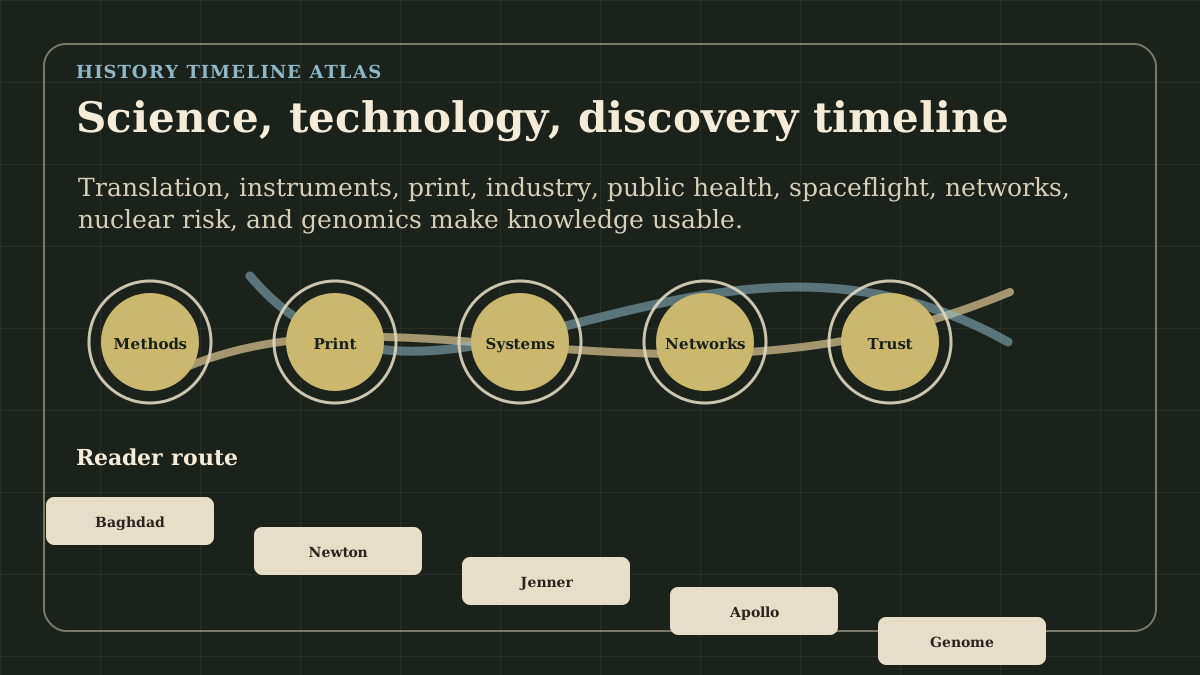
A route through scientific publishing, vaccination, evolution, infrastructure, communication, space technology, computing, and genomics.
Timeline Guide
How did knowledge move from translation and navigation into laboratories, machines, spaceflight, networks, and public health?
Read this edited guide as a path through dates, places, affected lives, source limits, and contested memory rather than as an exhaustive database.
This timeline treats science and technology as systems of knowledge, infrastructure, trust, and power. It does not begin with one European laboratory because discovery has always moved through translation, navigation, craft, observation, instrument-making, patronage, and long-distance exchange. The House of Wisdom, Polynesian navigation, and circumnavigation make the opening broader: knowledge is made by people who measure, sail, translate, repair, classify, and test.
The House of Wisdom gives the route an urban and multilingual starting point. Translation in Baghdad moved Greek, Persian, Indian, and Arabic knowledge through court patronage, scholars, scribes, paper, mathematics, astronomy, medicine, and philosophy. That does not mean every later scientific change comes from one city. It means readers can expect knowledge to travel through institutions before it becomes a famous discovery.
Names and tools make that opening less abstract. Al-Khwarizmi helps connect calculation, algebra, astronomy, and administration; Hunayn ibn Ishaq points toward translation, medicine, and scholarly language; astronomical tables, paper, libraries, patrons, and instruments show how knowledge became portable. The House of Wisdom works best here as a knowledge network, not as a magic origin point.
Concrete scenes keep the route human. Picture a Baghdad scribe copying an astronomical table, a Pacific navigator reading stars and swell, a printer carrying diagrams between European readers, a mill mechanic testing a part that must survive heat and pressure, a vaccination worker asking a family to trust a risky new practice, and an Apollo engineer checking a system that cannot be repaired once it leaves Earth.
Start With These Dates
- c. 830 CEHouse of Wisdom Flourishes
The Abbasid court's Bayt al-Hikmah, or House of Wisdom, became a symbol of translation, scholarship, and mathematical and scientific work in Baghdad.
- c. 900 CEHawaiian Settlement Expands
Polynesian settlement expanded in Hawaii through ocean navigation, voyaging knowledge, agriculture, kinship, and island adaptation.
- c. 1000 CEEastern Polynesia Settlement Expands
Polynesian voyagers expanded settlement across distant eastern Pacific islands, using navigation, canoe technology, ecological knowledge, and social networks.
- 1522 CEMagellan Expedition Circumnavigates the Globe
The surviving ship of Magellan's expedition returned to Spain after the first circumnavigation of the globe, proving the scale of oceanic connection.
- November 17, 1869Opening of the Suez Canal
The Suez Canal opened a direct water route between the Mediterranean and Red Sea, shortening sea travel between Europe and Asia.
- April 26, 1986Chernobyl Disaster
A reactor explosion at Chernobyl released radioactive material and exposed failures in technology, secrecy, emergency response, and public trust.
- 2003 CEHuman Genome Project Completed
The Human Genome Project completed a reference sequence of the human genome, creating a major resource for biology and medicine.
- March 11, 2020COVID-19 Pandemic Declared
The World Health Organization characterized COVID-19 as a pandemic after the virus spread across continents and strained public-health systems.
Sources Used Here
- Encyclopaedia Britannica: Bayt al-Hikmah
Reference for the House of Wisdom, Abbasid Baghdad, translation, and early Islamic knowledge networks.
- Polynesian Voyaging Society: Polynesian Wayfinding
Institutional reference for Polynesian wayfinding, stars, swells, and the modern teaching lineage through Mau Piailug and Nainoa Thompson.
- Encyclopaedia Britannica: Scientific Revolution
Reference for scientific revolution periodization, method, astronomy, mechanics, instruments, and print culture.
- National Human Genome Research Institute: Human Genome Project Timeline
Official source for Human Genome Project milestones, sequencing, data infrastructure, and completion.
- NASA: Apollo 11 Mission
Official mission reference for Apollo 11, space technology, and the 1969 lunar landing.
Hawaiian settlement, eastern Polynesian voyaging, and Magellan's circumnavigation make navigation a knowledge system. Oceanic travel required astronomy, winds, currents, memory, boats, social organization, and risk. European circumnavigation later changed maps, imperial ambition, and global exchange, but the route keeps Pacific knowledge visible so discovery does not become a story of Europeans finding empty space.
Modern Polynesian wayfinding also gives readers an evidence bridge. Mau Piailug and Nainoa Thompson belong to a modern revival rather than to the medieval voyages themselves, but their work shows how stars, swells, birds, clouds, training, memory, and embodied judgment can operate as serious navigational knowledge without modern instruments.
The scientific revolution and Newton's Principia mark a shift in method, argument, and authority. Mathematics, observation, instruments, print, astronomy, mechanics, and learned correspondence changed how claims about nature could be tested and circulated. The point is not that everyone suddenly became modern. It is that new habits of proof and publication gave some knowledge claims unusual mobility.
The dated spine is simple enough for a student to follow: Abbasid Baghdad in the 800s; Pacific settlement and navigation across centuries; Copernicus in 1543; Newton in 1687; steam, factories, and railways from the eighteenth and nineteenth centuries; smallpox vaccination in 1796; Darwin in 1859; Suez and transcontinental rail in 1869; telephone communication in 1876; Sputnik in 1957; Apollo in 1969; Chernobyl in 1986; the Human Genome Project by 2003; and COVID-19 in 2020.
Industrialization turns knowledge into machinery and systems. Steam, factories, metallurgy, canals, railways, telephones, and standardized parts made technology part of daily life, labor discipline, state capacity, and empire. The Industrial Revolution belongs on a science timeline because practical invention and scientific culture increasingly reinforced one another through workshops, universities, patents, companies, and state projects.
Medicine changes the route's human stakes. The smallpox vaccine shows observation, experiment, public trust, risk, and state policy meeting in one public-health problem. Darwin's Origin of Species then shows scientific explanation becoming a cultural and religious argument as well as a biological one. Both events remind readers that discovery is not accepted simply because evidence exists. It enters institutions, classrooms, churches, newspapers, and family decisions.
The smallpox story is especially useful because it turns discovery into a social test. A medical idea had to move through doctors, families, governments, fear, religious language, rumor, record keeping, and public-health logistics. The science did not matter only in the moment of experiment. It mattered when communities decided whether to trust a practice enough to let it touch their bodies.
Darwin gives the route a different kind of conflict. The Origin of Species did not only alter biology; it changed how evidence, time, species, religion, education, and public argument interacted. Some readers accepted the explanatory power, some resisted its implications, and many institutions had to decide how to teach it. That makes the node a study of how knowledge enters culture.
Infrastructure nodes such as Suez, the transcontinental railroad, and the telephone show technology at scale. A canal changes shipping and empire; a railroad changes land, settlement, violence, labor, and markets; a telephone changes presence and communication. These technologies matter because they reorganize distance. They let states, companies, and households act as if far places had become closer, while also creating new dependencies and inequalities.
The railroad section also needs people on the ground. Surveyors, immigrant laborers, Indigenous nations, investors, soldiers, telegraph operators, settlers, and displaced communities all lived inside the same technical project from different positions. A track was an engineering achievement, but it was also land seizure, wage labor, military reach, market expansion, and environmental change.
The Cold War gives the timeline a high-risk systems layer. Suez, Sputnik, Apollo, and ARPANET show technology as prestige, military anxiety, systems engineering, public spectacle, and network design. Spaceflight did not float above politics. It moved through rockets, defense budgets, education policy, laboratories, television, national pride, and fear. The early internet likewise emerged from institutions that cared about resilience, communication, and computation.
Apollo works here because it is both awe and administration. The Moon landing required astronauts, mathematicians, machinists, test pilots, programmers, contractors, launch crews, radio networks, budgets, and public performance. The event looks like a single televised step, but the historical explanation is a system of thousands of coordinated tasks.
Chernobyl changes the emotional key. Modern technology can produce expertise and catastrophe at the same time. Nuclear power required engineering, bureaucracy, secrecy, public communication, and emergency response. When trust failed, the disaster became more than a reactor event. It became a story about systems, truth, state legitimacy, risk, and the public's right to know.
COVID-19 closes the route with an uncomfortable lesson about speed. Genomic sequencing, vaccine platforms, dashboards, laboratories, hospitals, borders, misinformation, and public trust moved together. The science was faster than many earlier public-health systems, but social trust and political coordination were uneven. That tension keeps the timeline from ending in simple progress.
The Human Genome Project and COVID-19 bring the route into data and global biology. Sequencing, databases, laboratories, public health, vaccine platforms, misinformation, surveillance, and international coordination all show modern knowledge moving through networks. The timeline's final question is not whether science is good or bad. It is how societies build enough trust, transparency, and judgment to use powerful knowledge without hiding its costs.
The page also works as a map of who gets counted as a knowledge maker. Scholars, sailors, translators, instrument makers, nurses, mechanics, Indigenous navigators, programmers, patients, factory workers, and public officials all appear in different chapters. That breadth matters because scientific change is often remembered through a few famous names, while the actual route depends on many people making knowledge usable, repeatable, trusted, regulated, or resisted.
The route is also a warning against hero-only discovery stories. Individuals matter, but discoveries survive through instruments, notebooks, peer communities, printers, observatories, ships, factories, agencies, funders, patents, standards, and public arguments. A page about technology becomes richer when it asks not only who invented something, but who made it repeatable, who paid for it, who resisted it, and who lived with its unintended effects.
For students, the best essay structure is not a parade of inventions. It is a comparison between knowledge, infrastructure, and trust. Knowledge asks what people believed they had learned. Infrastructure asks what they could now build or coordinate. Trust asks whether publics, states, and communities accepted the claim, feared it, regulated it, or used it for their own purposes. Every node in this timeline can be tested against those three questions.
Geography keeps the route honest. Baghdad, the Pacific, the Atlantic, European print centers, British industrial regions, rail corridors, the Suez Canal, Soviet launch sites, the Moon, networked laboratories, and pandemic routes all appear because knowledge needs places to move through. Notice when the map shifts from sea routes to rail lines, from observatories to factories, from launch pads to data networks, and from national projects to global public-health systems.
That geographic movement is the reason to keep reading: science changes when its working places change and when publics answer back.
The short route is translation, navigation, print science, industrial systems, public health, spaceflight, networks, nuclear risk, genomics, and pandemic response together.
The story is strongest when read in layers. First, follow the dates from c. 830 CE to March 11, 2020. Then read across the event types: scholarly institution, migration and settlement, oceanic settlement, voyage. The timeline becomes more than chronology when those dates reveal decisions, institutions, violence, reform, and memory.
Opening of the Suez Canal sits near the middle of the sequence. Ask what had already become unavoidable by November 17, 1869, what actors still believed they could control, and which consequences were already beginning to move beyond the original setting.
The named events are House of Wisdom Flourishes, Hawaiian Settlement Expands, Eastern Polynesia Settlement Expands, Magellan Expedition Circumnavigates the Globe, Scientific Revolution Begins, Newton Publishes Principia. Each one pushes a more precise question: what changed, who benefited, who paid the cost, and what later page explains the aftermath more clearly?
Read the timeline against geography too. Places matter because power moves through corridors, borders, cities, ports, capitals, and frontiers. The map below keeps those distances visible while the event pages explain the human and institutional consequences.
A good timeline has a pulse: pressure, decision, expansion, resistance, and aftermath. When you move through Abbasid Caliphate, Pacific Settlement, Medieval Pacific, and Early Modern World, keep asking whether an event is creating a new problem, revealing a hidden weakness, or making an earlier choice harder to reverse.
The human layer matters because timelines can become too abstract. Figures such as Al-Ma'mun, Al-Khwarizmi, Hunayn ibn Ishaq, Polynesian navigators, Hawaiian communities, Polynesian voyagers, and Ferdinand Magellan help the sequence feel lived rather than mechanical. Their choices do not explain everything, but they show where institutions, ideas, military systems, social movements, and public fear entered real decisions.
The ending is not only the last date. With closing events such as ARPANET Connection, Chernobyl Disaster, Human Genome Project Completed, and COVID-19 Pandemic Declared, the reader can ask what remained unsettled: which institutions survived, which arguments continued, which victims or opponents were left outside the official story, and which later crisis reused the same vocabulary.
Read this page once quickly for order, then read it again for contrast. Compare early confidence with later uncertainty, local decisions with global consequences, and visible turning points with slower changes in law, economy, belief, technology, borders, or memory. That second pass is where a timeline becomes an explanation.
Causation in this sequence is layered. One event may supply the trigger, another may reveal an older weakness, and a later event may show the consequence that people at the beginning did not expect. The useful habit is to separate background pressure, immediate decision, turning point, and aftermath before deciding which event matters most.
Consequences are uneven. A political settlement might look successful in one capital while creating resentment elsewhere; a military victory might end a campaign while deepening civilian trauma; a scientific or institutional breakthrough might solve one problem while creating new risks. The timeline is strongest when those mixed outcomes remain visible.
The final pass is comparative. After reading this sequence, open a neighboring topic or person page and ask whether the same pattern appears again. Repetition usually points to a structure; contrast usually points to a historical choice that could have gone another way.
Importance is not the same thing as drama. Some events are remembered because they were spectacular, while others matter because they changed rules, expectations, alliances, legal categories, technologies, or public language. Use the timeline to test both kinds of importance before deciding what belongs at the center of the story.
The page rewards moving outward. A timeline gives order, but the event pages give causes, maps, people, sources, and reading paths. When a date feels too compressed, open the full event page and then return here; the sequence becomes clearer with each pass instead of asking the reader to memorize a list.
Ask how navigation, canals, railroads, telephones, satellites, and digital networks changed what people could coordinate.
Use vaccination, Darwin, Chernobyl, genomics, and COVID-19 to see why evidence needs public trust, transparent institutions, and careful communication.
Use Science as one lens for reading Science, Technology, and Discovery Timeline, then compare how that lens changes from the opening events to the aftermath.
House of Wisdom Flourishes gives the opening problem a date and place. Ask what was already unstable before it happened.
Opening of the Suez Canal is a compression point: earlier causes are now crowded together with decisions that will shape the sequence's ending.
Follow the path through Baghdad, Hawaiian Islands, Eastern Polynesia, Seville, Europe, and London and ask how distance changed communication, logistics, fear, and control.
COVID-19 Pandemic Declared works as both an ending and a beginning: it closes one sequence while opening later disputes, institutions, memories, or reforms.
Which conditions existed before the first event, and which later decision turned those conditions into visible historical change?
Who had the power to choose, who had fewer choices, and who is missing when the story is told only through leaders or institutions?
Which facts are date anchors, which are interpretations, and which claims need checking through the event sources before being repeated?
Which linked event, person, year, or topic page would change your interpretation if you read it next?
Interactive Timeline
Explore Science, Technology, and Discovery Timeline by sequence
House of Wisdom Flourishes
The Abbasid court's Bayt al-Hikmah, or House of Wisdom, became a symbol of translation, scholarship, and mathematical and scientific work in Baghdad.
Read the full event pageNarrative Stages
Read this timeline in chapters
Knowledge Before Modern Science
Translation houses, navigation, oceanic settlement, and global voyages show that discovery long predated modern laboratories.
- House of Wisdom Flourishesc. 830 CE
- Hawaiian Settlement Expandsc. 900 CE
- Eastern Polynesia Settlement Expandsc. 1000 CE
- Magellan Expedition Circumnavigates the Globe1522 CE
Print, Measurement, and Natural Philosophy
The scientific revolution and Newtonian physics changed how Europeans argued about nature, evidence, mathematics, and authority.
- Scientific Revolution Begins1543 CE
- Newton Publishes Principia1687 CE
Industrial Science, Medicine, and Evolution
Industrialization, vaccination, evolution, canals, railroads, and telephones show knowledge becoming infrastructure, health systems, and public controversy.
- Industrial Revolution Beginsc. 1760 CE
- Smallpox Vaccine1796 CE
- Darwin Publishes On the Origin of Species1859 CE
- Opening of the Suez CanalNovember 17, 1869
- First Transcontinental Railroad CompletedMay 10, 1869
- Telephone Patented1876 CE
Cold War Systems and Space
The Cold War turned science and technology into public prestige, military risk, space competition, and command of complex systems.
- Suez Crisis1956 CE
- Sputnik 1 LaunchedOctober 4, 1957
- Apollo 11 Moon LandingJuly 20, 1969
- ARPANET Connection1969 CE
Risk, Data, and Global Biology
Chernobyl, genomics, and COVID-19 show that modern science creates knowledge while raising questions about trust, governance, and shared vulnerability.
- Chernobyl DisasterApril 26, 1986
- Human Genome Project Completed2003 CE
- COVID-19 Pandemic DeclaredMarch 11, 2020
Map Layer
Science, Technology, and Discovery Timeline geography
Gold pins mark the approximate locations of published event pages. This is a schematic locator map, not a historical border map.
Event location Simplified land areaClick a pin to open the event page
Coordinates are approximate and are used to help readers orient themselves before opening a full event page.
References
Where to Check the Facts
- Encyclopaedia Britannica: Bayt al-HikmahReference for the House of Wisdom, Abbasid Baghdad, translation, and early Islamic knowledge networks.
- Polynesian Voyaging Society: Polynesian WayfindingInstitutional reference for Polynesian wayfinding, stars, swells, and the modern teaching lineage through Mau Piailug and Nainoa Thompson.
- Encyclopaedia Britannica: Scientific RevolutionReference for scientific revolution periodization, method, astronomy, mechanics, instruments, and print culture.
- National Human Genome Research Institute: Human Genome Project TimelineOfficial source for Human Genome Project milestones, sequencing, data infrastructure, and completion.
- NASA: Apollo 11 MissionOfficial mission reference for Apollo 11, space technology, and the 1969 lunar landing.
- U.S. National Library of Medicine: Smallpox VaccinationOfficial medical-history reference for smallpox vaccination and public-health discovery.
- CDC: History of SmallpoxOfficial public-health reference for smallpox history and eradication context.