At a Glance
The shape of the event
- Date
- 1859 CE
- Place
- London
- Type
- Scientific Publication
Charles Darwin published On the Origin of Species, arguing for evolution by natural selection and reshaping biology.
1859 CE; place the event in London before comparing causes or consequences.
Darwin's theory transformed biology and influenced religion, philosophy, education, and public arguments about human origins.
Charles Darwin are the first names or groups to compare before widening the story.
The book sparked scientific debate, public controversy, and new research into life, adaptation, and deep time.
The book sparked scientific debate, public controversy, and new research into life, adaptation, and deep time.
Darwin's theory transformed biology and influenced religion, philosophy, education, and public arguments about human origins.
Trace the next moments to see how ideas turned into movements and institutions.
Background
Mid‑nineteenth‑century London was a hub where expanding natural history, improved collecting and global travel met intense public interest in origins and progress. Naturalists catalogued diversity from colonies and voyages; geologists were increasingly comfortable with a deep, ancient Earth; and Victorian culture prized classification, causal explanation and the growing authority of empirical research. Charles Darwin had spent decades assembling observations—from barnacles to beetles, from pigeons to island plants—and corresponding with other scientists. Yet the intellectual climate included powerful religious institutions, established scientific societies, and a popular press that translated technical debates for a wide audience. Economic, political and educational institutions were also shifting: industrial modernity encouraged thinking in terms of adaptation and utility, while schools and clergy contested curricular control.
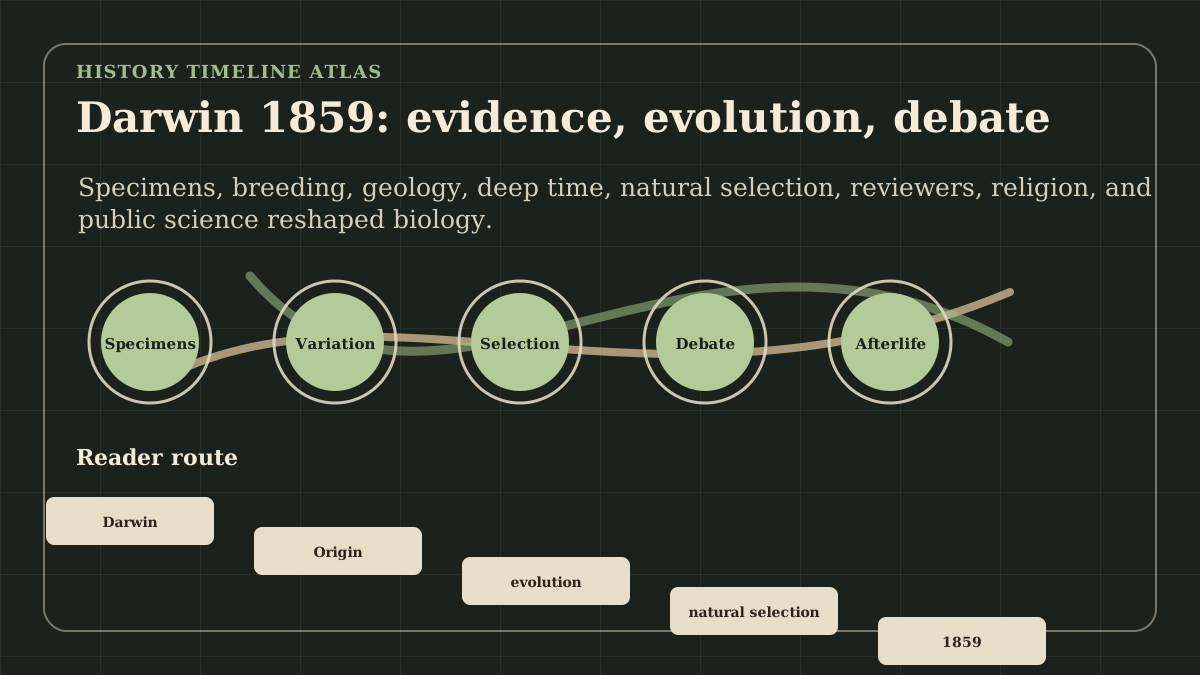
Interpretations differ over whether Darwin’s breakthrough was primarily the product of his individual synthesis or the inevitable outcome of broader scientific and social trends. This account keeps that tension visible, recognizing both the decisive role of Darwin’s writing and the structural pressures—networks of collectors, longer timescales posited by geologists, and a public eager for explanatory narratives—that made his idea consequential. Darwin's Origin of Species should not read like a single shocking idea dropped into Victorian society. The book gathered years of observation, correspondence, specimen collecting, breeding records, geology, island evidence, taxonomy, and debate about extinction and deep time. Darwin mattered because he turned scattered evidence into an argument about mechanism: variation, inheritance, struggle, and natural selection.
The publication also depended on a public world of science. Printers, reviewers, museums, private collectors, learned societies, clergy, farmers, pigeon breeders, geologists, botanists, and colonial travel networks all shaped how evidence moved. Readers did not simply accept or reject the book as a block. They argued over method, theology, human origins, species boundaries, and whether natural history could explain design without direct special creation. A richer page keeps Darwin connected to Alfred Russel Wallace without turning the story into a rivalry headline. Wallace's independent thinking pushed Darwin toward publication, while the joint 1858 presentation and the 1859 book show how priority, evidence, reputation, and publishing speed all mattered inside scientific life.
The Turning Point
Publication in 1859 crystallized choices that mattered. Charles Darwin decided to present a comprehensive argument, marshaling evidence and anticipating objections; his decision to frame natural selection as the primary mechanism gave critics a clear target. Publishers, reviewers and fellow scientists then chose how to respond: some engaged the evidence and tested predictions, others dismissed the proposal on theological or methodological grounds, and editors amplified reactions for the reading public. The change was not instantaneous but focused. A specialized, contested set of observations became lodged in public discourse when newspapers, magazines and lectures translated technical claims into moral and philosophical questions about human origins and destiny.
Specific actors mattered—Darwin as author, his correspondents who supplied specimens and data, and influential commentators who debated the book—but structural features shaped the moment too: improved communication networks, the centrality of London as an intellectual marketplace, and a culture increasingly willing to apply scientific reasoning beyond natural history. Because Darwin’s work offered a unified explanatory framework, subsequent scientists found a program to pursue: testing variation, heredity and adaptation. The turning point was therefore both an author's act of synthesis and a social reconfiguration that turned a scientific hypothesis into a subject for sustained public and professional contention. The turning point was the move from private notebooks and specialist correspondence into a readable book that gave natural selection public form.
The argument was powerful because it invited readers to see small variations, domestic breeding, fossils, geography, and adaptation as parts of one long process. The book's caution was also strategic. Darwin did not answer every question, and inheritance remained poorly understood before genetics. But the theory gave biologists a research program: compare organisms, ask how traits help survival or reproduction, and treat life as historical rather than fixed.
Consequences
In the near term, Darwin’s book generated heated scientific debate and public controversy. Naturalists divided over the adequacy of selection as an explanation; many researchers pursued new observations and experiments to support, refine or rebut it. Clergy, philosophers and educators confronted the book’s implications for human origins and moral teaching; some sought reconciliation, others insisted on rejection. Over the longer haul, Darwin’s ideas reoriented the life sciences: they provided a framework that guided research into adaptation, variation and the history of life, even as details—mechanisms of inheritance, rates of change—remained contested and subsequently revised. The influence also reached beyond biology.
Debates about evolution shaped discussions in religion, ethics, political thought and schooling, sometimes inspiring reinterpretation of scripture and sometimes fueling resistance to curricular change. Importantly, historians and philosophers continue to debate how much of this transformation owed to Darwin’s individual choices versus broader intellectual, institutional and technological currents. What is clear is that On the Origin of Species shifted both professional research agendas and public argument, creating new fault lines that would be worked over across generations of scientists, teachers and citizens. The immediate consequence was debate across science, religion, education, and print culture. Some readers saw the theory as a threat to theology; others saw it as a way to make biology more explanatory.
Scientific acceptance was uneven, but the question changed. Species could no longer be discussed as if history, environment, and adaptation were secondary details. The longer consequence was the transformation of biology. Evolutionary thinking reshaped classification, paleontology, ecology, genetics, medicine, anthropology, and public arguments about humanity's place in nature. A careful page must also separate Darwin's biological theory from later social and political misuses that claimed scientific authority for hierarchy or empire.
Interpretation Notes
Darwin Publishes On the Origin of Species raises a debate about scale: did the decisive change come from the visible scientific publication, or from older pressures around Science and Evolution that had already narrowed what people could do?
Why Keep Reading
Trace the next moments to see how ideas turned into movements and institutions. Follow accounts of later scientific work—especially studies of heredity and paleontology—that tested and revised Darwin’s claims. Read the social and cultural reactions that translated biological debate into classroom policy, sermons and political rhetoric. By moving from the book itself to the experiments, courtrooms and classrooms it influenced, you’ll see how a single publication can seed decades of inquiry, resistance and institutional change. Read Darwin after Newton, vaccination, geology, and industrial print culture, then continue to genetics, public health, and modern science pages. That route shows how evidence, controversy, institutions, and public trust make scientific change durable.
Reading Path
Follow the story without losing the thread
Before This
- Seneca Falls ConventionJuly 1848
- Smallpox Vaccine1796 CE
- Newton Publishes Principia1687 CE
After This
- Emancipation ProclamationJanuary 1, 1863
- First Transcontinental Railroad CompletedMay 10, 1869
- Paris CommuneMarch-May 1871
Same Period
- Seneca Falls ConventionJuly 1848
- Emancipation ProclamationJanuary 1, 1863
- Paris CommuneMarch-May 1871
Wider Timeline
Mind Map
How to think about Darwin Publishes On the Origin of Species
collecting networks
Global specimen exchanges and correspondence supplied the raw observations that Darwin synthesized
Map Layer
Where this event sits geographically
Gold pins mark the approximate locations of published event pages. This is a schematic locator map, not a historical border map.
Coordinates are approximate and are used to help readers orient themselves before opening a full event page.
References
Where to Check the Facts
- Science Museum: Objects and StoriesMuseum reference hub for science, technology, medicine, invention, and public understanding.
- Encyclopaedia BritannicaBackground reference for chronology, names, and historical context.
- WikidataStructured reference for dates, places, alternate names, and entity links.