At a Glance
The shape of the event
- Date
- May 10, 1869
- Place
- Promontory Summit
- Type
- Infrastructure
The first transcontinental railroad in the United States linked eastern and western rail networks after years of construction.
May 10, 1869; place the event in Promontory Summit before comparing causes or consequences.
The railroad transformed migration, commerce, Indigenous dispossession, labor politics, and the geography of U.S. expansion.
Railroad workers are the first names or groups to compare before widening the story.
Rail travel and freight across the continent became faster, cheaper, and more integrated.
Rail travel and freight across the continent became faster, cheaper, and more integrated.
The railroad transformed migration, commerce, Indigenous dispossession, labor politics, and the geography of U.S. expansion.
Follow the threads from Promontory Summit into local stories and broader timelines.
Background
The drive to connect Atlantic and Pacific rail networks built on decades of technological advances, sectional politics and economic ambition. Steam locomotion had matured into a reliable technology by the 1860s, and private investors, state governments, and federal policy converged on a plan to convert that capability into a continental artery. Funding promises, terrain surveys and wartime priorities created a narrow window in which two rival companies — one building east from the Pacific Coast and the other west from existing eastern lines — raced to meet. Large crews of railroad workers, drawn from immigrant communities and local labor pools, tackled bridges, cuts and miles of ballast with drills, picks and blasting powder.
At the same time, expansionist ideologies, commercial hopes for faster freight, and the federal desire for national integration pushed the project forward. Yet this was a project of choices: where track would run, whose land would be prioritized, and how labor would be organized. Those decisions left uneven legacies — faster travel and freight across the continent, alongside intensified dispossession, environmental change and new labor conflicts. The railroad's completion at Promontory Summit is often remembered through the golden spike, but the history behind the ceremony includes labor, finance, and violence. The Central Pacific relied heavily on Chinese workers who blasted tunnels through the Sierra Nevada, endured dangerous conditions, and faced discrimination.
The Union Pacific relied on many Irish workers, Civil War veterans, and others building westward across the plains. Federal land grants, bonds, corporate lobbying, and military power made the project possible, while Native nations faced invasion of land, buffalo destruction, and accelerated settler expansion.
The Turning Point
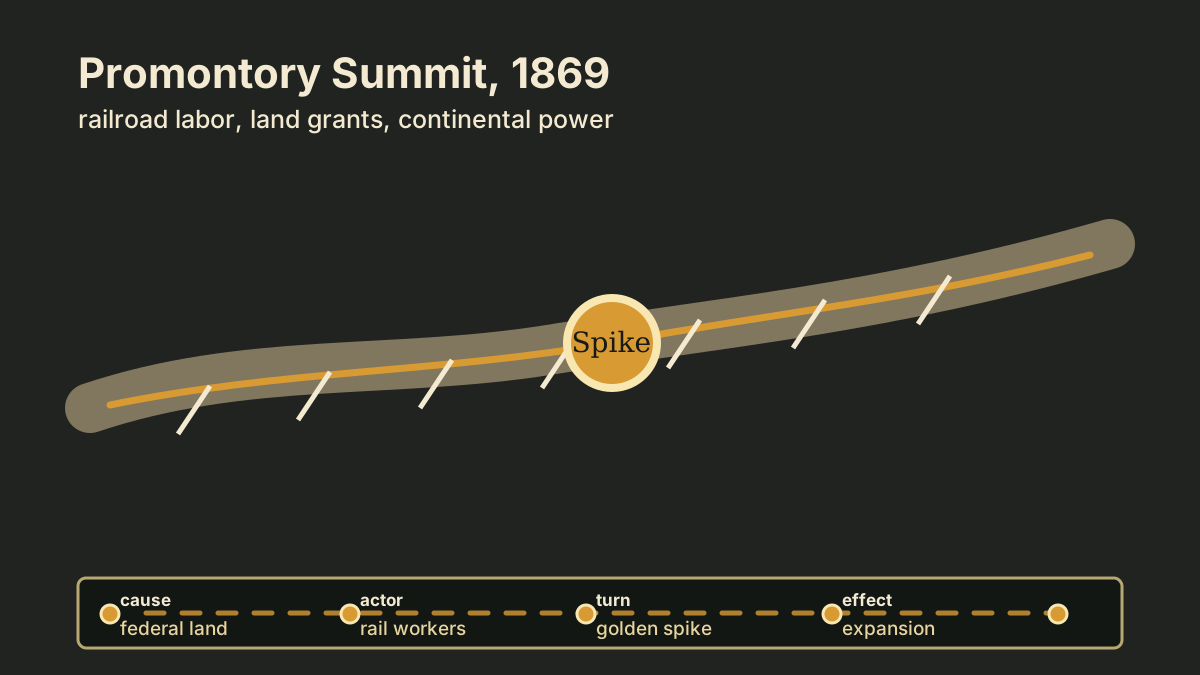
On the day the rails were joined at Promontory Summit, the abstract project of continental connection became a lived reality because of concrete acts by specific people. Railroad workers laid the last lengths of rail, set the spikes and aligned rails over a landscape they had battered into conformity. Company surveyors and engineers chose gradients and crossings, turning topography into a route that favored certain towns and bypassed others. Government officials had earlier authorized land grants and subsidies that made the enterprise financially viable; that support shaped the pace and direction of construction.
The final ceremonial driving of a ceremonial spike — one of several symbolic acts recorded at the meeting point — marked public recognition of completion but did not erase the uneven conditions that produced the railroad: subcontracted labor, hazardous working environments, and reliance on negotiated access through territory inhabited by Indigenous nations. The Promontory ceremony concentrated attention, but the real turning point lay in the operational change that followed: continuous rail service that made coast-to-coast travel and freight movement routine rather than exceptional, remaking calendars, markets and migration choices across North America. The turning point was the physical joining of eastern and western rail systems.
A journey that had taken months by wagon or ship around Cape Horn could now be made in days by rail. That changed the scale of migration, mail, military movement, markets, and federal authority. But infrastructure is never neutral. The same rails that made travel faster also made land speculation easier, pushed U. S. power deeper into Indigenous homelands, and tied western resources more tightly to eastern capital.
Consequences
In the immediate aftermath, travel times shrank and shipping costs fell, making it feasible to move people and goods across distances that once required long sea voyages or arduous wagon treks. Towns along the route grew as railheads, warehouses, and service industries developed; ports and long-established overland trails either adapted or declined. Over the longer term, the railway altered demographics by accelerating migration into new territories and enabling national markets for agricultural and manufactured goods. That transformation had starkly different human consequences: opportunity and mobility for some, dispossession and intensified pressure on Indigenous homelands for others. Labor politics shifted too — crews who had built the line faced new workplace structures, contested wages, and periodic conflicts over safety and representation.
Environmental effects followed as landscapes were cut, soils shifted, and patterns of settlement changed. Historians continue to debate the balance between individual decision-making and structural forces in these outcomes; this account aims to keep those disputes visible by tracing both the choices of people on the ground and the institutional frameworks that guided them. The railroad accelerated U. S. continental integration, but it also intensified dispossession and ecological transformation. Towns rose and fell with rail routes; time zones and schedules reorganized daily life; corporations gained enormous influence; and workers who built the line often did not share equally in its rewards. The event is therefore both a technological achievement and a story of empire, labor, finance, and memory.
The golden spike is a symbol that conceals as much as it celebrates.
Interpretation Notes
The memory of First Transcontinental Railroad Completed often depends on who tells the story. A court, army, religious community, merchant network, or later nation can emphasize different causes and make Promontory Summit stand for different lessons.
Why Keep Reading
Follow the threads from Promontory Summit into local stories and broader timelines. Read about the railroad crews who built the line to learn how labor was organized and contested. Track the growth of towns and the decline of older trade routes to see how economic geography rearranged. Explore accounts from Indigenous communities to understand how dispossession was intensified by new transport links. Each path shows a different consequence of the same technological break — and together they reveal how a single infrastructure project reconfigured power, place and possibility across North America. Read next through U. S. expansion, Indigenous resistance, Industrial Revolution, immigration, and railroad capitalism. The page connects technology to state power rather than treating infrastructure as progress by itself.
Reading Path
Follow the story without losing the thread
Before This
- Emancipation ProclamationJanuary 1, 1863
- American Civil War BeginsApril 12, 1861
- Darwin Publishes On the Origin of Species1859 CE
After This
- Paris CommuneMarch-May 1871
- Telephone Patented1876 CE
- Wall Street Crash of 1929October 1929
Same Period
- Seneca Falls ConventionJuly 1848
- Emancipation ProclamationJanuary 1, 1863
- Paris CommuneMarch-May 1871
Wider Timeline
Mind Map
How to think about First Transcontinental Railroad Completed
technology
Steam locomotion and track-laying methods enabled continuous coast-to-coast rail service.
Map Layer
Where this event sits geographically
Gold pins mark the approximate locations of published event pages. This is a schematic locator map, not a historical border map.
Coordinates are approximate and are used to help readers orient themselves before opening a full event page.
References
Where to Check the Facts
- Science and Industry Museum: Revolution in ProgressMuseum reference for industrial change, technology, railways, and public interpretation of industrial history.
- Encyclopaedia Britannica: Industrial RevolutionReference for industrialization, technology, labor, capital, and economic change.
- Science Museum: Objects and StoriesMuseum reference hub for science, technology, medicine, invention, and public understanding.