At a Glance
The shape of the event
- Date
- October 1929
- Place
- New York City
- Type
- Financial Crisis
A severe stock market collapse in New York signaled financial instability that helped deepen the worldwide Great Depression.
October 1929; place the event in New York City before comparing causes or consequences.
The crash forced new thinking about regulation, welfare, public works, and the role of the state in economic life.
Investors and policymakers are the first names or groups to compare before widening the story.
Markets fell sharply, banks and businesses failed, and confidence in the economy collapsed.
Markets fell sharply, banks and businesses failed, and confidence in the economy collapsed.
The crash forced new thinking about regulation, welfare, public works, and the role of the state in economic life.
Read next through the Great Depression, New Deal, Smoot-Hawley tariff, and global interwar pages to see how financial panic moved into politics, households, and international relations.
Background
The 1920s U. S. economy contained real growth and real imbalance. Automobiles, appliances, advertising, radio, and consumer credit expanded, while agriculture struggled and income gains were uneven. Stock purchases on margin allowed investors to control shares with borrowed money, increasing gains in good times and losses when prices dropped. Investment trusts, brokerage loans, and speculative enthusiasm drew ordinary savers as well as wealthy players into a market that felt modern and unstoppable. Yet the Federal Reserve, banks, and policymakers did not have a stable toolkit for managing a panic at this scale. Internationally, war debts, reparations, and the gold standard tied economies together in ways that could spread pain.
A richer account separates the stock crash from the Great Depression without disconnecting them. The market had climbed through a culture of optimism: newspapers celebrated winners, brokers extended credit, and many households believed modern finance offered a route into prosperity. But the real economy was uneven. Industrial productivity could outpace wages, farmers struggled with low prices, and consumer purchases increasingly depended on credit. Banks were often undercapitalized and fragmented. When stock prices fell, the damage moved through loans, expectations, and spending. That chain is why a financial event became a social and political turning point.
The Turning Point
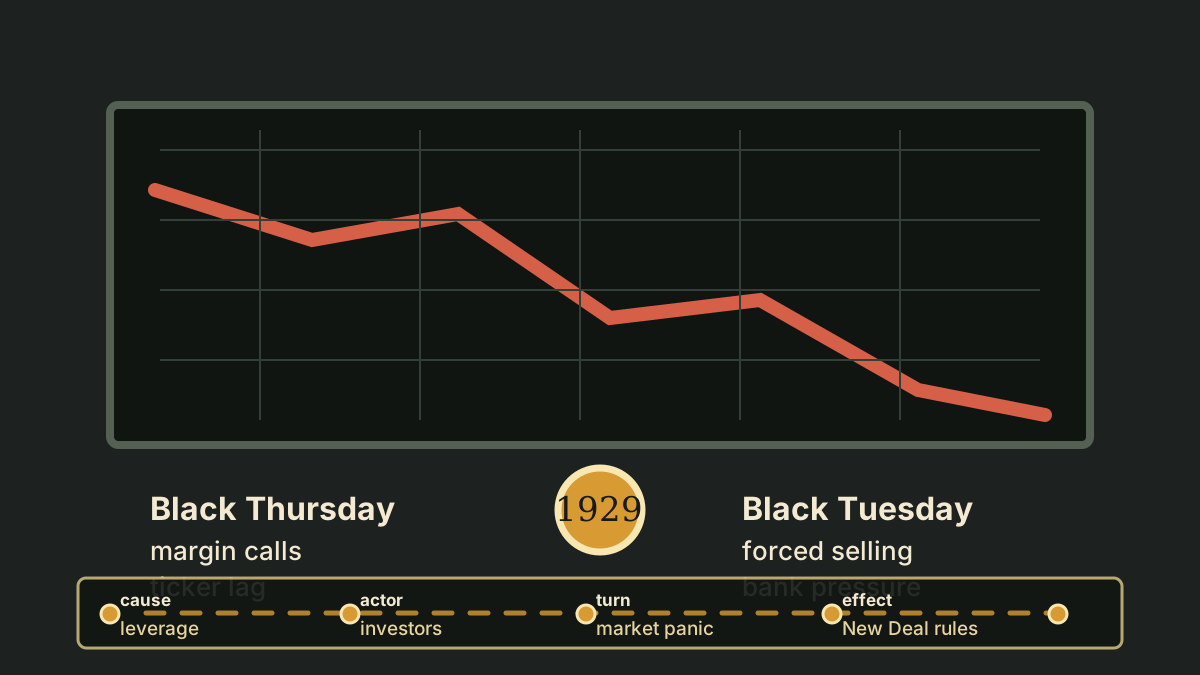
The turning point came in late October 1929 as selling pressure overwhelmed confidence. On Black Thursday, October 24, heavy selling shook the market even after leading bankers tried to organize support. On Black Tuesday, October 29, the collapse became sharper and more psychologically decisive. Margin calls forced investors to sell into a falling market, brokers demanded cash, and the ticker lagged behind reality, leaving many people unsure how much they had lost. The crash did not by itself create every cause of the Great Depression, but it punctured the story that prosperity was self-sustaining. Once confidence broke, credit tightened, consumption weakened, and banks faced pressure from frightened depositors and bad loans. The mechanics of panic deserve attention.
Margin buying meant that falling prices triggered demands for more cash. Investors who could not meet calls had to sell, and forced selling pushed prices down further. The ticker could not keep up with the volume, so information itself became unreliable. Attempts by major bankers to show confidence worked briefly but could not restore belief in a market whose assumptions had cracked. Black Tuesday became memorable because it revealed that no single reassuring performance could stabilize the system. Once trust failed, each actor's defensive move made the collective crisis worse.
Consequences
The immediate consequence was massive loss of paper wealth and a collapse of trust in financial markets. The longer consequence was political and institutional: the crash became one of the symbols through which Americans interpreted the Great Depression and demanded new rules. Bank failures, unemployment, deflation, and global trade contraction had multiple causes, but the crash made those vulnerabilities visible. It helped create the climate for New Deal reforms, securities regulation, deposit insurance, and a broader debate over whether markets could police themselves. The event should therefore be read both as a market crisis and as a turning point in public expectations about government responsibility. The crash's political consequences unfolded over years.
It damaged the prestige of financiers and helped turn regulation from a technical issue into a democratic demand. Securities disclosure, the Securities and Exchange Commission, Glass-Steagall banking separation, and deposit insurance all belonged to a broader rethinking of financial risk and public protection. Globally, the downturn interacted with tariff policy, gold-standard constraints, war debts, and political extremism. The crash was therefore not just an American finance story. It was part of the interwar world's failure to build stable economic governance after World War I. One more interpretive guardrail is essential: the stock market crash was not the Great Depression in miniature.
It was a signal and accelerator inside a wider system of fragile banks, uneven incomes, overextended credit, weak demand, agricultural distress, and international monetary constraint. That distinction helps readers avoid both extremes: blaming everything on reckless investors or pretending the crash was only symbolic. The real historical interest lies in the connection between market psychology and institutional weakness. When enough people tried to protect themselves at once, their individual caution helped deepen the collective crisis.
Interpretation Notes
The hardest question around Wall Street Crash of 1929 is causation. The event had immediate actors, but its meaning also came from institutions, geography, resources, and expectations already present in North America.
Why Keep Reading
Read next through the Great Depression, New Deal, Smoot-Hawley tariff, and global interwar pages to see how financial panic moved into politics, households, and international relations. This page helps readers avoid the common mistake of treating the crash as the sole cause of the Depression while still recognizing why October 1929 became its most memorable signal. Follow the crash into Great Depression, New Deal, interwar Europe, and World War II origins. The strongest reading path asks how financial fear becomes political change: first through market losses, then bank failures, then unemployment, then new expectations for what governments owe citizens. Evidence note: the page can point readers toward market data, newspaper reporting, memoirs, congressional investigations, banking records, and later economic analysis.
Those sources answer different questions. Price charts show speed and scale; newspapers show public fear; bank records show institutional weakness; later economists debate causation. Together they make clear why the crash was a dramatic event inside a deeper depression process, not a self-contained explanation for every hardship of the 1930s.
Reading Path
Follow the story without losing the thread
Before This
- Women's Suffrage in the United StatesAugust 18, 1920
- Treaty of VersaillesJune 28, 1919
- Spanish Flu Pandemic1918-1919
After This
- Salt MarchMarch-April 1930
- Rise of Nazi Germany1933 CE
- Invasion of PolandSeptember 1, 1939
Same Period
- Assassination of Archduke Franz FerdinandJune 28, 1914
- Russian Revolution1917 CE
- Treaty of VersaillesJune 28, 1919
Wider Timeline
Mind Map
How to think about Wall Street Crash of 1929
Speculative leverage
Margin buying and brokerage loans made the market vulnerable to forced selling.
Map Layer
Where this event sits geographically
Gold pins mark the approximate locations of published event pages. This is a schematic locator map, not a historical border map.
Coordinates are approximate and are used to help readers orient themselves before opening a full event page.
References
Where to Check the Facts
- Science and Industry Museum: Revolution in ProgressMuseum reference for industrial change, technology, railways, and public interpretation of industrial history.
- Encyclopaedia Britannica: Industrial RevolutionReference for industrialization, technology, labor, capital, and economic change.