At a Glance
The shape of the event
- Date
- September 1, 1939
- Place
- Poland
- Type
- Invasion
Germany invaded Poland, using speed, air power, and coordinated ground forces to begin the European phase of World War II.
September 1, 1939; place the event in Poland before comparing causes or consequences.
The invasion destroyed the interwar peace settlement and turned regional aggression into global war.
Adolf Hitler are the first names or groups to compare before widening the story.
Britain and France declared war on Germany, while Poland was partitioned after Soviet intervention from the east.
Britain and France declared war on Germany, while Poland was partitioned after Soviet intervention from the east.
The invasion destroyed the interwar peace settlement and turned regional aggression into global war.
Follow from this invasion to the immediate diplomatic and military sequences: the declarations of war by Britain and France, the Soviet advance from the east, and the subsequent campaigns that spread the conflict acro...
Background
The invasion of Poland came after two decades of strained international arrangements and mounting tensions in Europe. The interwar settlement established in 1918 and in the years that followed left unresolved questions of security, borders and political legitimacy. By 1939 Germany was governed by a regime willing to use military force to change the status quo; Adolf Hitler was the central figure in decisions that led to invasion. Across Europe, governments and publics watched a tightening pattern of challenges to the post‑war order and faced hard choices about deterrence, alliance commitments and the use of force. Some leaders moved to respond; others hesitated.
Historians continue to debate how much the outbreak of large‑scale war reflected particular decisions by individuals and regimes, and how much it was the product of longer structural pressures—economic dislocation, unsettled borders, and shifting alliances. This page preserves those disagreements rather than treating one explanation as definitive, because the balance between contingency and structure shapes how we read the invasion itself. The invasion of Poland should not use a D-Day image because the event belongs to a different beginning: the destruction of interwar security in Europe.
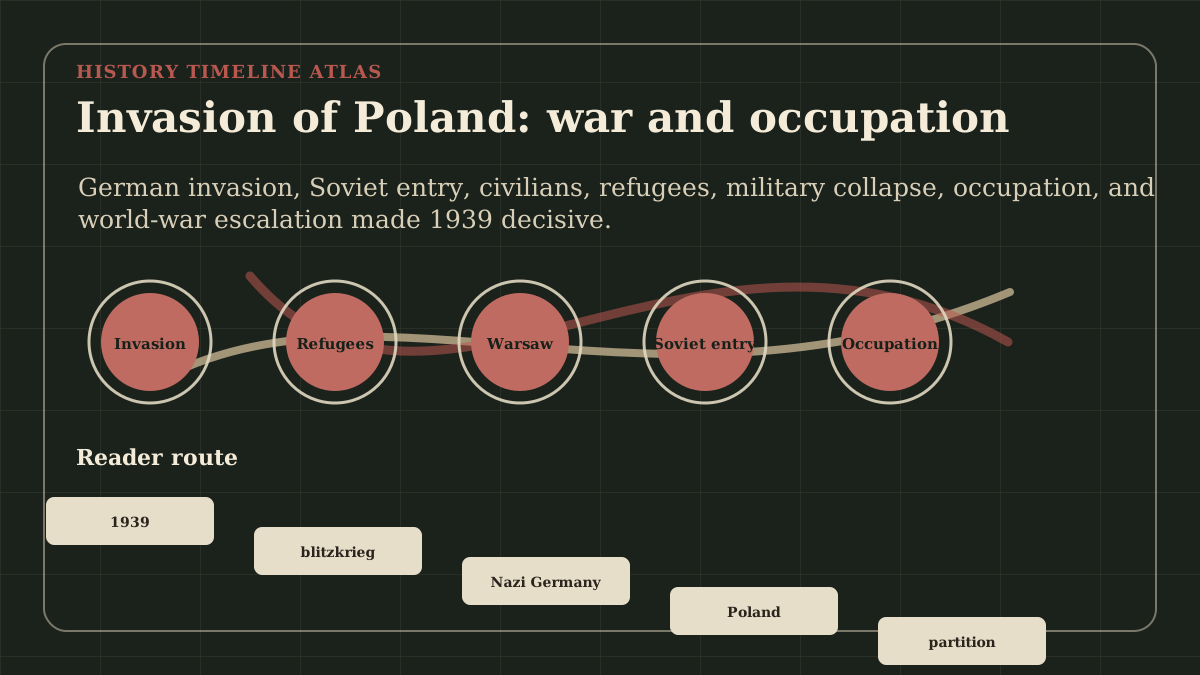
Nazi Germany attacked from the west, the Soviet Union entered from the east later in September under the logic of the Nazi-Soviet Pact, and Poland was forced into a war it could not win against two powerful neighbors. The event began World War II in Europe and opened an occupation history of extraordinary violence. The page needs more than the word blitzkrieg. German forces used air power, armor, infantry, radio coordination, terror bombing, and rapid movement, but Polish resistance was real and conditions varied by region. Warsaw, border towns, cavalry myths, refugees, mobilization delays, and the uneven response of Britain and France all complicate the simple story of instant collapse. The civilian layer is essential.
Bombing, flight, occupation, arrests, anti-Jewish violence, executions, forced labor, and partition made the invasion a human catastrophe as well as a military campaign. The event also shows why diplomatic agreements, alliance promises, and military realities can fail to line up when a crisis arrives.
The Turning Point
What changed on September 1, 1939 was not just the movement of troops but the collapse of a wider diplomatic equilibrium. German forces launched a fast, coordinated assault that relied on air power to disrupt communications and on the synchronized advance of ground units. That combination—velocity in attack, dominance of the air, and coordinated ground operations—overwhelmed Polish defenses and removed any expectation that the crisis could be contained locally. The choice to invade was made at the top of the German state; its execution required operational decisions by military commanders and the rapid application of new methods of warfare. The invasion forced other capitals to make immediate decisions about obligations and response.
Britain and France, confronting the breach of European order, declared war on Germany; those declarations marked the end of a diplomatic era in which aggression had sometimes been left unanswered. Simultaneously, action from the east by Soviet authorities led to the partition of Poland. In a matter of days a regional attack became the opening movement of a wider European conflict, transforming political risk into general war. The turning point was the crossing from diplomatic pressure into coordinated territorial destruction. Once Germany invaded, Britain and France declared war, but they could not immediately save Poland. That gap between formal alliance and practical relief shaped Polish experience and later Allied memory. The Soviet entry from the east deepened the catastrophe.
Poland was not simply defeated by a fast western offensive; it was partitioned by two authoritarian powers whose agreement had already anticipated division. That made occupation and state destruction part of the invasion's meaning from the start.
Consequences
In the near term, the invasion produced the political outcomes that follow directly from the facts: Britain and France declared war on Germany, and Poland was partitioned after Soviet intervention from the east. Those actions reshaped maps and chains of command, removed Poland as an independent strategic actor for the moment, and created fronts that would expand into broader campaigns. In the longer term, the invasion destroyed the credibility of the interwar peace settlement and converted regional aggression into an escalating global conflict. It established patterns—rapid mechanized offensives, the decisive use of air power, and the politicized use of partitions and occupations—that would reverberate through the next six years of warfare.
Equally important are the interpretive consequences: scholars ask whether the invasion reflected an inevitable breakdown of international order or the outcome of specific leadership choices, and both perspectives affect how we judge responsibility and contingency. The human consequences—displacement, military and civilian suffering, and the collapse of states—are central, even when precise figures lie beyond the scope of this summary. The immediate consequence was the collapse of the Polish state on its territory, exile government formation, mass displacement, and occupation by Germany and the Soviet Union. The longer consequence was the opening of a European war that would become global, genocidal, and total. For readers, the invasion is also a warning about how wars begin.
It was not a single shot in isolation. It followed appeasement debates, rearmament, the destruction of Czechoslovakia, the Nazi-Soviet Pact, alliance guarantees, and failed deterrence. The page should help readers trace that chain without making the outcome feel inevitable.
Interpretation Notes
Invasion of Poland raises a debate about scale: did the decisive change come from the visible invasion, or from older pressures around World War II and Nazi Germany that had already narrowed what people could do?
Why Keep Reading
Follow from this invasion to the immediate diplomatic and military sequences: the declarations of war by Britain and France, the Soviet advance from the east, and the subsequent campaigns that spread the conflict across the continent. Each step reveals how operational decisions, alliance politics and legal claims interacted. Read on to trace how a single campaign tested alliances, accelerated military innovation, and forced ordinary people into exile or resistance. The maps and timelines that follow will make visible how quickly local violence translated into a continental—and then global—war, and why that conversion remains a central question for historians and citizens alike.
Read the invasion of Poland after the Treaty of Versailles, Nazi dictatorship, and the Munich crisis route, then continue to the Holocaust, Operation Barbarossa, and 1945. That path shows how a regional invasion became the opening movement of World War II's European catastrophe.
Reading Path
Follow the story without losing the thread
Before This
- Munich AgreementSeptember 1938
- Rise of Nazi Germany1933 CE
- Salt MarchMarch-April 1930
After This
- Battle of BritainJuly-October 1940
- Attack on Pearl HarborDecember 7, 1941
- Operation BarbarossaJune 22, 1941
Same Period
- Assassination of Archduke Franz FerdinandJune 28, 1914
- Russian Revolution1917 CE
- Treaty of VersaillesJune 28, 1919
Wider Timeline
Mind Map
How to think about Invasion of Poland
Fragile peace
Post‑1918 arrangements left unresolved security and border questions that weakened deterrence
Map Layer
Where this event sits geographically
Gold pins mark the approximate locations of published event pages. This is a schematic locator map, not a historical border map.
Coordinates are approximate and are used to help readers orient themselves before opening a full event page.
References
Where to Check the Facts
- National WWI Museum and Memorial: All About WWIMuseum reference hub for World War I chronology, maps, articles, and educational context.
- U.S. National Archives: World War I CentennialArchive reference hub for World War I records, photographs, documents, and educational resources.
- The National WWII Museum: Explore By TopicMuseum reference hub for World War II theaters, battles, home fronts, aftermath, and memory.
- Imperial War Museums: What You Need to Know About the Second World WarMuseum reference for the global war, civilian experience, military fronts, and consequences.