At a Glance
The shape of the event
- Date
- June 28, 1919
- Place
- Versailles
- Type
- Peace Treaty
The Treaty of Versailles ended formal war between Germany and the Allied powers while assigning responsibility, reparations, and territorial changes.
June 28, 1919; place the event in Versailles before comparing causes or consequences.
The treaty influenced interwar politics, grievances, border disputes, and debates about collective security.
Woodrow Wilson / Georges Clemenceau / David Lloyd George are the first names or groups to compare before widening the story.
Germany accepted harsh terms under protest, and the League of Nations was created.
Germany accepted harsh terms under protest, and the League of Nations was created.
The treaty influenced interwar politics, grievances, border disputes, and debates about collective security.
Follow the negotiations and their aftermath to see how a single diplomatic settlement echoed through politics, borders and memory.
Background
By mid-1919, Europe carried the ruins of the First World War and the pressure to translate military victory into a lasting peace. The Allied powers arrived at Versailles bound by competing aims: to punish and secure, to reshape borders, and to prevent future wars. Public opinion in Britain and France demanded accountability for the unprecedented destruction; political leaders faced domestic demands for justice and security. At the same time, new ideas about collective security and international order were circulating, led publicly by Woodrow Wilson’s call for a League of Nations. Germany, defeated and exhausted, was not party to drafting many of the alliance terms but had to accept the final text.
The conference blended high-stakes diplomacy, national anxieties and emerging international institutions. Historians continue to debate how much of the treaty’s shape came from the strategic decisions of named leaders and how much reflected deeper social, economic and political forces that the negotiators could not fully control. Versailles becomes richer when the armistice and the peace are separated. The guns stopped in November 1918, but the political settlement had to answer dead soldiers, devastated regions, collapsed empires, hungry civilians, revolutionary fears, debt, influenza, colonial expectations, and voters who wanted both security and justice. The treaty carried more weight than any document could comfortably bear.
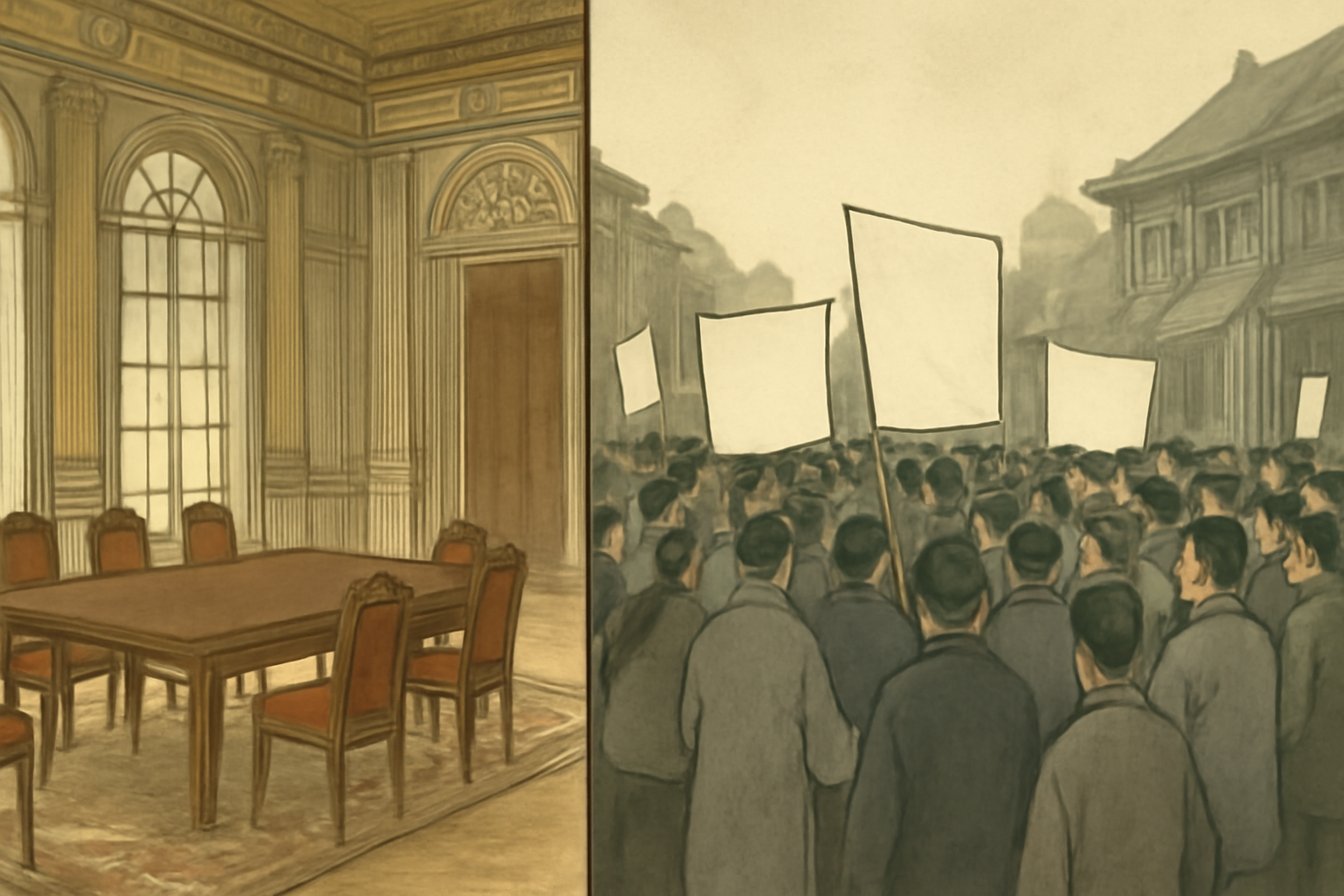
The conference was also global, even when the most powerful rooms were dominated by the victors of Europe and the United States. Delegations and petitioners came with claims about Korea, China, the Arab provinces, India, Africa, Ireland, Vietnam, and racial equality. Many left disappointed. That gap between self-determination language and imperial practice is one of the treaty's central tensions.
The Turning Point
The decisive shift at Versailles was not a single clause but the collective choices made by three prominent statesmen and their governments at the negotiating table: Woodrow Wilson, Georges Clemenceau and David Lloyd George. Each brought different priorities. Wilson promoted a framework for collective security embodied in the League of Nations; Clemenceau pushed for strict measures to secure France against future German aggression; Lloyd George navigated competing public pressures in Britain between punishment and reconciliation. Concretely, the treaty assigned legal responsibility for the war, stipulated reparations, and mandated territorial adjustments. Those decisions crystallized during intense sessions in June 1919, when Allied leaders settled on language and limits that Germany would be obliged to accept.
Germany protested the terms but ultimately signed. The turning point, therefore, was the moment the victors translated wartime grievances and postwar anxieties into enforceable legal obligations and institutional commitments — a settlement that combined punitive measures with the promise of a new international organization. The turning point was the decision to build peace through a mixture of punishment, security guarantees, border revision, reparations, disarmament, and a new League of Nations. Each piece answered a real fear; together they produced a settlement many actors found either too harsh, too weak, or too hypocritical. Germany's exclusion from most drafting magnified the problem. The treaty did not simply impose burdens; it also created a public script of humiliation that German parties could reuse.
Yet the treaty should not be treated as a mechanical cause of World War II. Economic crisis, political violence, fascist choices, diplomatic failures, and global depression all mattered later.
Consequences
In the immediate aftermath, the treaty ended formal hostilities between Germany and the Allied powers and inaugurated the League of Nations as an experiment in collective security. Germany’s acceptance of the terms, given under protest, left a legacy of grievance that political actors and publics across Europe would repeatedly invoke. In the near term, states adjusted to new borders and obligations; diplomatic energy shifted from battlefield campaigns to enforcement, reparations and reconciliation debates. Over the longer term, the treaty influenced interwar politics in multiple ways: it became a focal point for disputes over responsibility and fairness; it framed arguments about revision and revisionism; and it shaped debates over the effectiveness of international institutions designed to prevent conflict.
Interpretations differ sharply about causation. Some historians emphasize the personal decisions of leaders in 1919; others point to deeper structural forces — economic dislocation, national self-determination movements, and unresolved social tensions — that limited what any treaty could achieve. This account keeps those disputes visible: the treaty was a concrete set of decisions that both reflected and reshaped broader currents in twentieth-century Europe. Versailles redrew maps beyond Germany. Poland reappeared, Czechoslovakia and Yugoslavia took shape, mandates replaced some Ottoman and German colonial holdings, and border minorities became a permanent problem for new states. The settlement promised national order while producing mixed populations, disputed frontiers, and minority petitions. Its longest consequence was the problem of legitimacy.
France doubted enforcement, Britain debated revision, the United States never joined the League, Germany protested war guilt and reparations, colonized peoples saw self-determination applied unevenly, and Japan's racial equality proposal was rejected. The treaty became a living argument about who had the right to make a world order.
Interpretation Notes
The memory of Treaty of Versailles often depends on who tells the story. A court, army, religious community, merchant network, or later nation can emphasize different causes and make Versailles stand for different lessons.
Why Keep Reading
Follow the negotiations and their aftermath to see how a single diplomatic settlement echoed through politics, borders and memory. Read next about the League of Nations’ early challenges, the economic and political disputes over reparations, and how German opinions about the treaty were mobilized by different parties. Each linked episode reveals whether the Versailles settlement stitched Europe back together or left seams that other actors tried to exploit. Read Versailles beside the League of Nations, May Fourth, the mandate system, Weimar Germany, reparations diplomacy, and the road to World War II. The route shows how peace settlements succeed or fail through enforcement, legitimacy, economics, and memory rather than clauses alone.
Reading Path
Follow the story without losing the thread
Before This
- Armistice of 1918November 11, 1918
- Spanish Flu Pandemic1918-1919
- Russian Revolution1917 CE
After This
- League of Nations FoundedJanuary 10, 1920
- Women's Suffrage in the United StatesAugust 18, 1920
- Wall Street Crash of 1929October 1929
Same Period
- Assassination of Archduke Franz FerdinandJune 28, 1914
- Russian Revolution1917 CE
- Wall Street Crash of 1929October 1929
Wider Timeline
Mind Map
How to think about Treaty of Versailles
Reparations
Treaty language assigned financial responsibility to Germany, making reparations a central and contested outcome
Map Layer
Where this event sits geographically
Gold pins mark the approximate locations of published event pages. This is a schematic locator map, not a historical border map.
Coordinates are approximate and are used to help readers orient themselves before opening a full event page.
References
Where to Check the Facts
- National WWI Museum and Memorial: All About WWIMuseum reference hub for World War I chronology, maps, articles, and educational context.
- U.S. National Archives: World War I CentennialArchive reference hub for World War I records, photographs, documents, and educational resources.