Historical Role
Woodrow Wilson belongs in the atlas because he turned U.S. entry into World War I into a diplomatic argument about the postwar world. The Zimmermann Telegram, wartime mobilization, the Fourteen Points, Versailles, and the League of Nations vision all show a president trying to connect military victory to public principles about self-determination, open diplomacy, collective security, and lawful international order.
The biography becomes richer when its contradictions are kept visible. Wilson spoke a language of democratic principle while governing a segregated United States and while many colonized peoples found that self-determination did not apply equally to them. The gap between promise and application is not a side issue. It is one reason his legacy still matters for readers trying to understand liberal internationalism.
Versailles also shows the limits of one leader's program. Allied priorities, French security fears, British imperial interests, congressional politics, German defeat, colonial claims, and public exhaustion all shaped the settlement. Wilson could frame the debate, but he could not make postwar order obey his vocabulary.
The Senate fight turns the biography back toward domestic politics. Wilson imagined a global institution, but treaty ratification depended on American constitutional procedure, partisan distrust, public fatigue, and arguments over whether collective security would protect sovereignty or entangle the United States in future wars.
The race question gives the page necessary moral weight. Federal segregation, the screening of Birth of a Nation at the White House, and the rejection of Japan's racial equality proposal at Paris show that Wilsonian language was not universal in practice. Readers need this tension to understand why colonized and racialized audiences heard the promise of rights differently.
The League of Nations also belongs to institutional history, not only biography. Mandates, assemblies, councils, minority protections, public diplomacy, and the absence of the United States all made the organization both a real experiment and a fragile one. Wilson's failure became a source from which later architects of the United Nations learned.
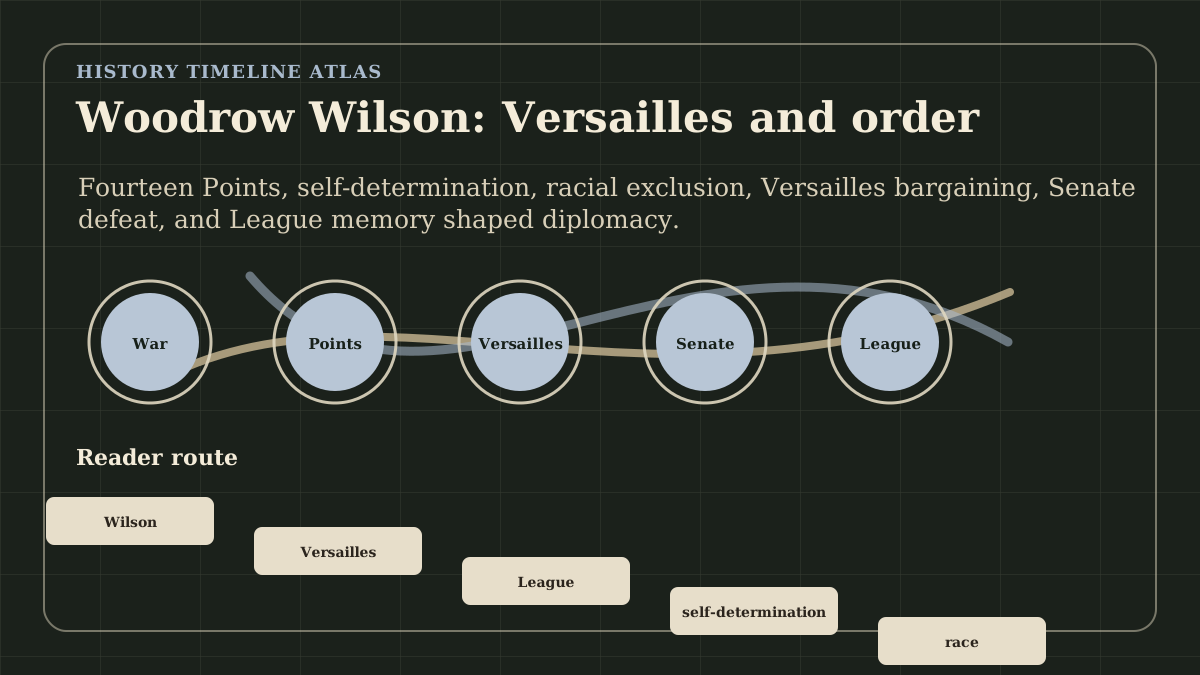
A strong reading route follows Wilson from war message to Fourteen Points, Paris, Senate defeat, League memory, and post-1945 institution-building. That sequence lets readers see idealism as a political technology: powerful enough to mobilize language, too weak by itself to overcome interests, exclusions, and ratification rules.
Woodrow Wilson helps connect individual action with wider historical change in United States. The biography works best when it keeps the surrounding world visible: authority, conflict, belief, reform, or discovery moved through decisions made under pressure.
The related events show how roles such as U.S. president, Postwar settlement advocate can be read through dates, places, institutions, and consequences rather than through reputation alone. The biography explains why this person matters, while the linked events explain what changed around them.
A richer reading starts with the limits around the person. Some figures acted through offices, armies, courts, laboratories, churches, parties, ships, trade networks, or protest movements; others became important because later communities turned their lives into symbols. The page therefore asks what this person could actually change, what was already moving before them, and which consequences later readers attached to the name.
Read the biography against absence as well. Many lives around Woodrow Wilson are less visible in the record: opponents, collaborators, family members, workers, soldiers, students, subjects, victims, translators, scribes, or local communities. Keeping those surrounding people in view makes the page less like a name card and more like an entry point into historical systems.
Woodrow Wilson also works as a navigation point. Open the linked event pages to see where the biography becomes chronology, then use the topic routes to test whether the same pattern appears beyond one life. That extra step matters because historical importance is rarely contained inside a single decision; it usually spreads through institutions, witnesses, opponents, imitators, and later arguments over memory.
Sources and Method
Source method: read Wilson through the Zimmermann Telegram, Treaty of Versailles, and League of Nations pages, using those events to test the distance between diplomatic ideals, wartime politics, and institutional failure.
Evidence Notes
How Sensitive Claims Are Sourced
- 1
Principles, exclusion, and institutional failure
The biography reads Wilson through diplomatic language and through the groups that language did not fully include, then connects the failed League campaign to later international institutions.
Why This Person Matters
Woodrow Wilson matters because the connected events make a larger historical pattern easier to follow. The page links biography to consequences so readers can move from a life story into the wider atlas, compare the person with contemporaries, and understand why later memory kept returning to this figure. Woodrow Wilson matters because he makes the twentieth-century problem of international order visible. His career connects democratic rhetoric, racial exclusion, wartime diplomacy, failed ratification, national self-determination, and the fragile hope that institutions could prevent another world war. The page helps readers study how ideals become institutions, how institutions fail, and why excluded people can reuse political language in ways its author did not intend.
How can a leader's language about freedom shape world politics even when the leader's own politics exclude many people from that promise?
How to Read This Life
Woodrow Wilson is easiest to understand when the biography is read beside Zimmermann Telegram, Treaty of Versailles, League of Nations Founded. Those events show the historical setting in motion: dates, places, institutions, conflict, and consequences give the life a structure that a short biography alone cannot provide.
The surrounding route crosses World War I, Twentieth Century, Interwar Period and locations such as Berlin and Washington, Versailles, Geneva. That matters because influence rarely stays inside one person. It moves through offices, armies, movements, laws, texts, speeches, institutions, and later memory.
A useful reading path starts with the role labels, then opens the event pages to see what changed, and finally compares this person with other actors facing similar pressures.
For readers who arrive on a biography first, this page is meant to become a doorway rather than a stop. Read one paragraph for the answer, then use the turning points, topic routes, and event links to test whether the person's reputation matches the wider evidence.
Read Wilson beside World War I, Versailles, League of Nations, United Nations, and later Cold War institutions. That path helps readers see how an idea can fail in one form and still shape later international organization.
Compare him with Roosevelt, Churchill, Lenin, and Gandhi. The comparison asks who got to define self-determination, security, nationhood, empire, and the rights language of the twentieth century.
Read Woodrow Wilson through the roles of U.S. president, Postwar settlement advocate rather than as reputation alone.
Place the biography inside United States and the wider events linked below.
Ask which choices were personal and which were constrained by institutions or crisis.
Follow how later memory simplified, contested, or reused this person's role.
Read the Fourteen Points and League vision as arguments about how wars can end and how states can relate.
Ask who was left outside Wilsonian promises: colonized peoples, racial minorities, defeated states, and domestic critics.
Follow how an idea about collective security became a contested organization and then a memory used after World War II.
Legacy, Limits, and Memory
A useful biography keeps scale in view. Woodrow Wilson mattered because individual choices met a wider structure: institutions, enemies, allies, audiences, technologies, beliefs, and inherited conflicts. The related event pages help separate personal agency from conditions that no single person controlled.
Memory is part of the biography too. Later readers often simplify a figure into a hero, villain, founder, reformer, conqueror, prophet, scientist, or symbol. Those labels can be helpful, but they become misleading when they hide conflict, compromise, exclusion, uncertainty, or the experiences of people outside the main biography.
For the next step, compare this life with a topic route rather than stopping at the name. If the same pattern appears across several figures, the reader has found a historical structure; if this person breaks the pattern, the contrast is usually where the most interesting question begins.
Wilson's legacy does not force a choice between idealism and hypocrisy. His influence came partly from the power of his language and partly from the fact that his language was applied unevenly.
The League of Nations story is not just a failed institution. It is a lesson in how domestic politics, treaty obligations, public opinion, and fear of future war can make international cooperation fragile.
Turning Points to Read Next
Zimmermann Telegram
Germany proposed a potential alliance with Mexico if the United States entered World War I, and British interception helped inflame American opinion.
Treaty of Versailles
The Treaty of Versailles ended formal war between Germany and the Allied powers while assigning responsibility, reparations, and territorial changes.
League of Nations Founded
The League of Nations began as an international organization meant to reduce the chances of future war through collective security and diplomacy.
Related Timeline
- January 1917Zimmermann Telegram
Germany proposed a potential alliance with Mexico if the United States entered World War I, and British interception helped inflame American opinion.
- June 28, 1919Treaty of Versailles
The Treaty of Versailles ended formal war between Germany and the Allied powers while assigning responsibility, reparations, and territorial changes.
- January 10, 1920League of Nations Founded
The League of Nations began as an international organization meant to reduce the chances of future war through collective security and diplomacy.
References
Where to Check the Facts
- Encyclopaedia Britannica: Woodrow WilsonBiography reference for Wilson's presidency and diplomacy.
- U.S. National Archives: President Woodrow Wilson's Fourteen PointsArchive reference for Wilson's Fourteen Points.