At a Glance
The shape of the event
- Date
- July-October 1940
- Place
- United Kingdom
- Type
- Air Battle
The Royal Air Force resisted German air attacks in 1940, preventing Germany from gaining the air superiority needed for an invasion of Britain.
July-October 1940; place the event in United Kingdom before comparing causes or consequences.
The battle kept Britain in the war, preserved an Allied base in western Europe, and made air defense central to modern military memory.
Winston Churchill / Hermann Goring are the first names or groups to compare before widening the story.
Germany postponed and then abandoned immediate invasion plans against Britain.
Germany postponed and then abandoned immediate invasion plans against Britain.
The battle kept Britain in the war, preserved an Allied base in western Europe, and made air defense central to modern military memory.
If this account has held your attention, follow the thread to adjacent events and decisions that the Battle of Britain made possible or impossible.
Background
By July 1940 Britain stood under direct aerial threat for the first time on a scale previously unseen in its history. The conflict had moved from continental manoeuvre into the air above the Channel and the British Isles, turning air power into the instrument that would decide whether an invasion could be attempted. The United Kingdom faced not only physical bombardment but wider pressures: political leadership that had to weigh risk and morale, industrial capacity to replace losses, and the strategic need to hold a western foothold in Europe. Germany, under Hermann Göring's direction for its air arm, sought to neutralise Britain’s ability to challenge German operations in Western Europe.
The Royal Air Force confronted these attacks while also balancing defence of cities, ports and military infrastructure. Historians still debate how much of the outcome rested on individual choices—command judgments by figures such as Winston Churchill and Göring—and how much flowed from broader factors like geography, production, training and the sheer difficulty of sustained offensive air operations. This page sets those contested explanations side by side rather than presenting a single definitive cause. The Battle of Britain should not read as pilots alone deciding the island's fate.
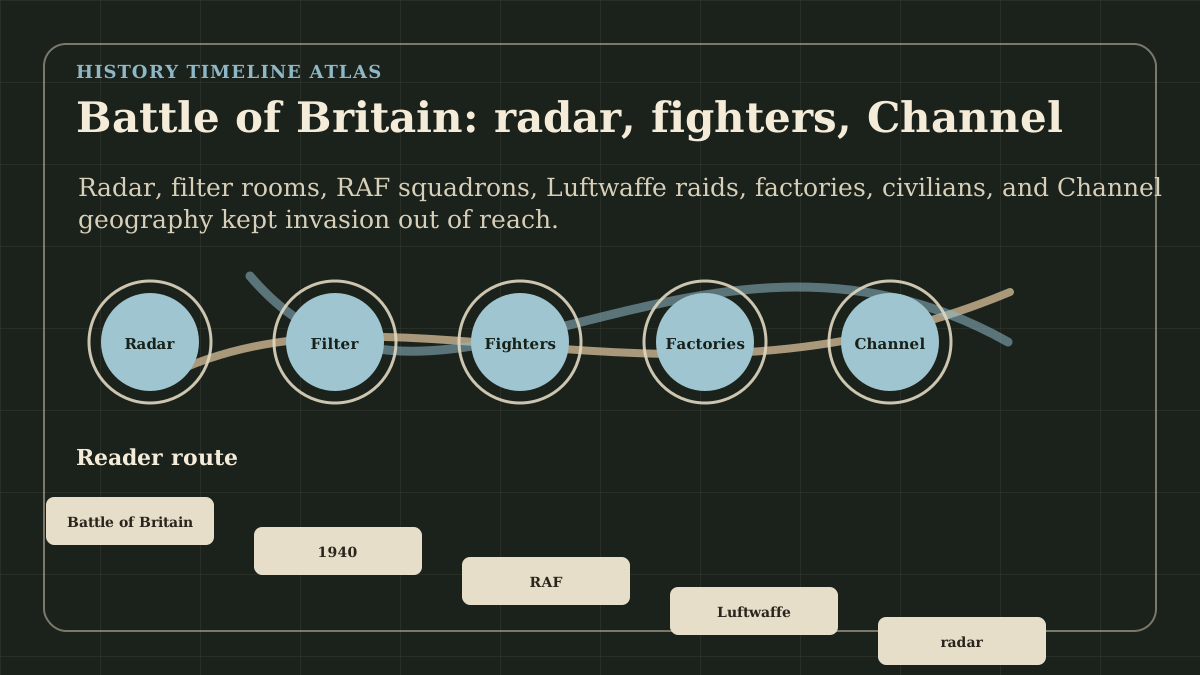
Pilots mattered, but they fought inside a defensive system: radar stations, observer posts, filter rooms, sector control rooms, ground crews, aircraft factories, fuel supplies, repair teams, anti-aircraft batteries, and civilians who kept cities and airfields functioning under attack. The Channel made geography part of strategy. German aircraft had to cross water, operate at range, protect bombers, and return to bases while RAF fighters could use home fields, local repair networks, and warning time. That geography did not guarantee victory, but it made air superiority harder to win than German planners hoped. The page should also separate wartime memory from operational history.
Churchill's language, the image of 'the Few,' and later national commemoration are important, but they can hide the wider machine of women plotters, mechanics, radar operators, factory workers, merchant shipping, and civilians who experienced bombing as daily danger.
The Turning Point
What changed between July and October 1940 was not a single dramatic moment but a sequence of contested choices and resilient responses that together denied Germany the air superiority it needed. German air attacks aimed to break British air defences and disrupt Britain’s capacity to contest control of the skies; the Royal Air Force responded with sustained interception and defence. Political and military leaders made consequential decisions: commanders directed the disposition of fighters and the allocation of resources; political leaders weighed whether to expose the nation to greater risk in order to preserve offensive options. Interpretations differ about which choices mattered most.
Some emphasise command-level judgment—how Göring directed the Luftwaffe, or how British leaders ordered the RAF to prioritise defensive sectors—while others point to structural limits on the assault, such as operational range, maintenance demands and cumulative attrition. Whatever the balance, the combined effect was clear: the Luftwaffe did not achieve the control of the air that an invasion force would have required. That failure prompted a shift in German planning and gave the British government room to continue organising resistance and to maintain Britain as an Allied base in Western Europe. The turning point was the failure of the Luftwaffe to destroy Fighter Command or make invasion safe.
Radar warning, command-and-control, replacement aircraft, and the ability to keep squadrons in the fight made attrition politically and operationally bearable for Britain. A second turning point came when the campaign shifted toward heavier attacks on cities. The Blitz inflicted suffering and destruction, but it did not produce the air superiority needed for Operation Sea Lion. The invasion window narrowed as weather, losses, and strategic priorities changed.
Consequences
The immediate consequence was strategic: Germany postponed and then abandoned its immediate plans for invasion. That decision kept Britain in the war as an active base from which future Allied operations could be planned and executed. Politically and psychologically, the battle bolstered British morale and sustained international perceptions that Britain would continue to resist. Militarily, the Battle of Britain made air defence a central element of twentieth-century conflict narrative; defending the home islands became an enduring example of how air power could determine national survival. In the longer term, the campaign influenced how states thought about air operations, homeland protection and the allocation of industrial resources to aircraft production, training and repair.
It also fed ongoing debates among historians and strategists about the role of individual leaders versus structural constraints: was the outcome the product of inspired command and courageous pilots, or the predictable result of logistical limits and strategic overreach? This page keeps those questions visible—showing consequences that are both concrete (no immediate invasion) and interpretive (how we remember and learn from air campaigns). The immediate consequence was the postponement and effective abandonment of a near-term invasion. Britain remained a base for blockade, intelligence, air operations, and later Allied planning, making western Europe harder for Germany to close completely. The longer consequence was a durable lesson about integrated air defense.
Radar, command networks, production, morale, and civilian endurance became part of modern security thinking, while the battle's memory shaped British identity and Allied narratives of resistance.
Interpretation Notes
The hardest question around Battle of Britain is causation. The event had immediate actors, but its meaning also came from institutions, geography, resources, and expectations already present in Western Europe.
Why Keep Reading
If this account has held your attention, follow the thread to adjacent events and decisions that the Battle of Britain made possible or impossible. See how Britain used its preserved position to sustain air and naval operations, how German strategy in Western Europe evolved after the campaign, and how debates from 1940 shaped post‑war air doctrine and civil defence planning. Explore profiles of the commanders involved, timelines of the campaign’s phases, and comparative studies that place the battle alongside other struggles for air superiority. Each path deepens the question the battle leaves open: were outcomes driven by a few bold decisions, or by forces beyond any one person’s control?
Read the Battle of Britain after Dunkirk and before the Blitz, Barbarossa, Pearl Harbor, and D-Day. That path shows how Britain's survival kept a western Allied base alive long before liberation became possible.
Reading Path
Follow the story without losing the thread
Before This
- Invasion of PolandSeptember 1, 1939
- Munich AgreementSeptember 1938
- Rise of Nazi Germany1933 CE
After This
- Attack on Pearl HarborDecember 7, 1941
- Operation BarbarossaJune 22, 1941
- Atlantic CharterAugust 14, 1941
Same Period
- Operation BarbarossaJune 22, 1941
- Battle of MidwayJune 1942
- Battle of Stalingrad1942-1943
Wider Timeline
Mind Map
How to think about Battle of Britain
Invasion risk
Germany needed air superiority to make a cross‑Channel invasion feasible, driving the Luftwaffe campaign
Map Layer
Where this event sits geographically
Gold pins mark the approximate locations of published event pages. This is a schematic locator map, not a historical border map.
Coordinates are approximate and are used to help readers orient themselves before opening a full event page.
References
Where to Check the Facts
- National WWI Museum and Memorial: All About WWIMuseum reference hub for World War I chronology, maps, articles, and educational context.
- U.S. National Archives: World War I CentennialArchive reference hub for World War I records, photographs, documents, and educational resources.
- The National WWII Museum: Explore By TopicMuseum reference hub for World War II theaters, battles, home fronts, aftermath, and memory.
- Imperial War Museums: What You Need to Know About the Second World WarMuseum reference for the global war, civilian experience, military fronts, and consequences.