Historical Role
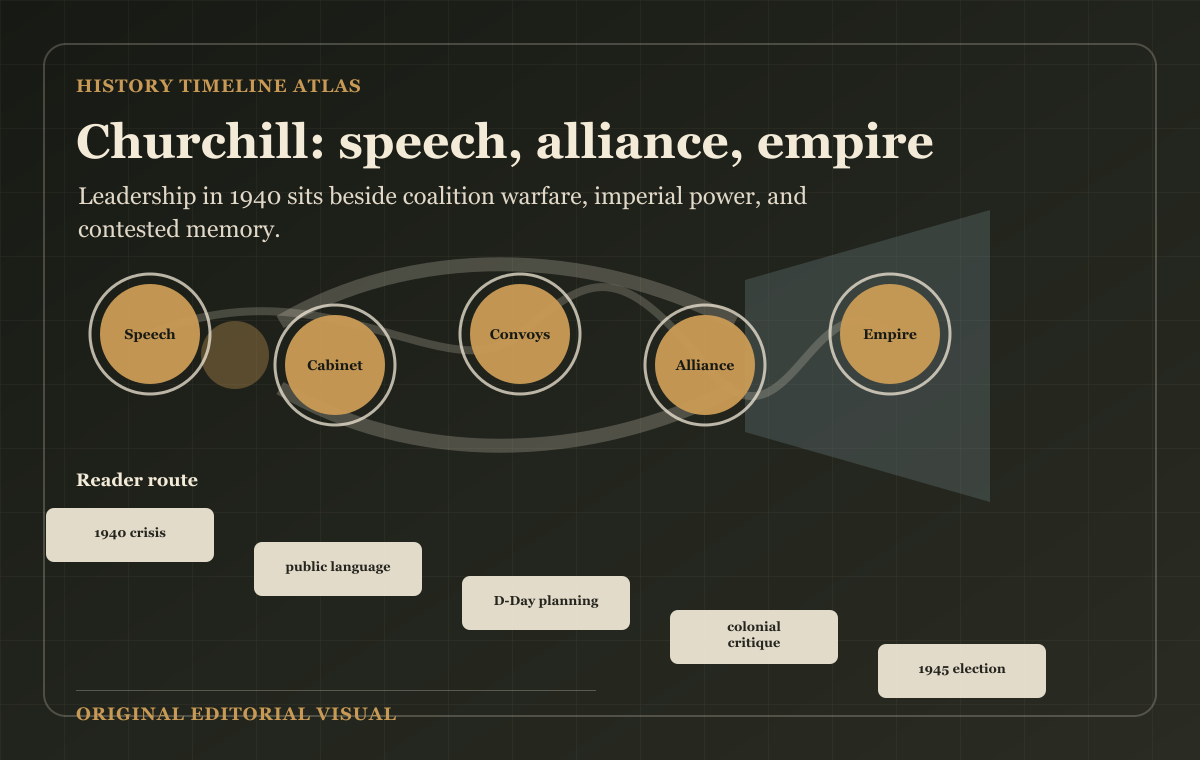
Winston Churchill's public life ran from imperial soldiering and journalism through cabinet office, the Gallipoli disaster, interwar isolation, wartime premiership in May 1940, the Blitz, alliance with Roosevelt and Stalin, D-Day planning, defeat in the 1945 election, and the Iron Curtain speech of 1946. That spine matters because the famous speeches make sense only when they are placed inside offices, crises, alliances, and earlier failures.
In May 1940, the biographical drama was not only a microphone and a phrase. The British cabinet debated whether to explore terms through Italy, the army was being evacuated from Dunkirk, France was close to defeat, and the United States had not yet entered the war. Churchill's refusal language mattered because it was spoken inside that narrow political and military window.
Churchill is read through World War II because his public role is inseparable from Britain's wartime survival, coalition politics, and the language of resistance. He did not win the war alone. Cabinet government, shipping, codebreaking, aircraft production, Soviet endurance, American resources, Commonwealth troops, colonial manpower, and civilian labor all sit behind the voice that later memory made so dominant.
The D-Day and United Nations pages help place Churchill beyond speeches. They connect rhetoric to logistics, alliances, empire, civilian endurance, postwar institutions, and controversies over race, colonial rule, strategic bombing, and the Bengal famine debates that still shape his reputation.
A concrete Churchill opening begins in May 1940, with evacuation from Dunkirk still uncertain, cabinet colleagues weighing negotiation, airfields and ports exposed, and newspapers trying to describe danger without collapsing morale. Churchill's leadership mattered there because a political decision, a military emergency, and public language met in the same week.
One short phrase shows why the speeches endure: Churchill promised 'blood, toil, tears and sweat' before victory looked secure, and later framed Britain's crisis as a 'finest hour.' Those phrases did not win battles by themselves. They worked because cabinet authority, radio, newspapers, civil defense, factories, pilots, sailors, and future alliance made public language actionable.
Many readers arrive at Churchill through World War II speeches, but the biography is richer when rhetoric is tied to institutions and constraints. In 1940 Britain faced military danger, imperial commitments, shipping vulnerability, air attack, party politics, and the need to coordinate with allies that were not yet fully aligned. Churchill's words mattered because they operated inside that pressure system.
His wartime leadership did not replace collective effort. Cabinet government, civil servants, commanders, codebreakers, factory workers, colonial troops, merchant sailors, women in war industries, air defense, rationing, and public endurance all carried the war. Churchill's role was to give political direction and public language to a society whose survival depended on many forms of labor. A clear reading keeps those layers visible.
The D-Day connection places Churchill inside coalition warfare. By 1944 Britain was no longer acting alone; Allied planning required American production, Soviet sacrifice, Canadian and Commonwealth forces, French resistance, intelligence, weather judgment, landing craft, ports, deception, and command compromise. Churchill had preferences and fears, but coalition war limited every leader. That makes him a case study in leadership inside alliance, not solitary command.
The United Nations connection widens the afterlife of victory. Churchill is often remembered for defiance in 1940 and the Iron Curtain speech in 1946, but the postwar order also involved arguments over institutions, empire, reconstruction, nuclear weapons, and the future of Europe. His career helps readers see how wartime cooperation could turn into Cold War suspicion while older imperial assumptions still lingered.
Empire is central to the controversy. Churchill defended British imperial power and often spoke in assumptions that later readers find deeply troubling. Those views were not marginal to his worldview. They shaped how he understood Britain's role, colonial subjects, India, and global order. A useful biography can recognize wartime leadership while refusing to turn imperial politics into a footnote.
The most contested topics need evidentiary scaffolding rather than slogan. The Bengal famine debates involve wartime shipping, provincial administration, imperial priorities, crop failure, market disruption, racism, and arguments over responsibility. Bombing policy involves German attacks, Allied strategy, civilian casualties, area bombing, and later moral criticism. Race and empire involve documented language and policy choices, but historians still weigh context, agency, and alternatives differently.
A colonial view changes the biography's temperature. An Indian family facing hunger in Bengal, a Caribbean volunteer serving in imperial war, an African soldier in British uniform, and an Egyptian or Iraqi nationalist watching British power did not experience Churchill only as a defender of freedom. For many, his wartime leadership sat beside imperial hierarchy, racial language, resource extraction, and delayed self-rule.
The controversies are not equal footnotes. The Bengal famine of 1943 involved crop failure, wartime disruption, shipping constraints, market failures, provincial decisions, and imperial priorities; historians disagree over the weight of Churchill's responsibility, but few treat the famine as irrelevant to judging imperial governance. Strategic bombing raises a different debate over military necessity, German attacks, civilian death, morale, and later moral memory.
Churchill's memory is unusually selective. Public culture often keeps the speeches and edits out failures, party conflict, strategic disputes, and colonial violence. That selectivity is part of his historical importance. He became not only a wartime prime minister but a symbol used in later arguments about courage, national identity, western civilization, and resistance to tyranny. Symbols simplify because they are built to travel.
His career before 1940 matters because it made him both prepared and distrusted. Gallipoli, interwar warnings, party switches, imperial offices, journalism, military experience, and political isolation all shaped how he entered the crisis. The wartime leader was not created in a day. He carried earlier successes and failures into the moment that made him famous.
A sharper reading separates three questions. Did Churchill help sustain resistance at a dangerous moment? Yes. Did he win the war alone? No. Does wartime leadership erase the moral and political problems of empire? No. Holding those answers together makes the biography more useful than either celebration or dismissal.
Churchill also helps readers understand political speech. Speeches do not change history by magic. They matter when audiences need a frame for sacrifice, when institutions can act on the frame, and when events give the words credibility. In 1940, language, morale, air defense, shipping, finance, and future alliance all had to reinforce one another.
The best next route moves from Churchill to World War II, D-Day, the United Nations, the Cold War, and decolonization. That route shows why a biography centered on one leader must eventually become a map of coalition, empire, law, memory, and postwar change.
Churchill also makes a strong doorway into the problem of democratic leadership during total war. Democratic states still used secrecy, censorship, emergency power, rationing, propaganda, and coercive planning. They still had to decide how much sacrifice could be demanded and how much dissent could be tolerated. Churchill's leadership therefore belongs in a wider comparison with wartime democracies and dictatorships, not because they were morally identical, but because all wartime states tested the boundary between survival and liberty.
The biography leaves readers with a double awareness. Churchill was unusually important in sustaining Britain's refusal to accept German domination in 1940. At the same time, the war was won by an alliance, by production, by intelligence, by Soviet and American power, by resistance movements, and by millions of people whose names are not attached to famous speeches. That double awareness is what keeps the page readable: it gives the drama of leadership without letting drama swallow structure.
Churchill's defeat in the 1945 election adds another useful turn. The electorate could honor wartime endurance and still choose a different peacetime future built around welfare, housing, health care, and reconstruction. That moment prevents the biography from ending in triumphal memory. It shows that democratic legitimacy can separate wartime gratitude from postwar priorities, and that a leader's symbolic role can outlast his immediate political mandate.
Winston Churchill also works as a navigation point. Open the linked event pages to see where the biography becomes chronology, then use the topic routes to test whether the same pattern appears beyond one life. That extra step matters because historical importance is rarely contained inside a single decision; it usually spreads through institutions, witnesses, opponents, imitators, and later arguments over memory.
Sources and Method
Source method: read Churchill through wartime speeches, cabinet politics, D-Day and United Nations event routes, World War II sources, and decolonization pages. The biography treats public memory as evidence to be explained, not as proof that the popular image is complete.
Method note: the page separates three kinds of evidence: what Churchill said, what institutions and alliances made possible, and how colonial subjects or later critics experienced the consequences of British imperial power.
Evidence Notes
How Sensitive Claims Are Sourced
- 1
Speech inside institutions
Churchill's rhetoric is interpreted through cabinet authority, radio, newspapers, civil defense, production, shipping, and coalition planning rather than as words acting alone.
- 2
Empire and selective memory
The biography keeps empire, Bengal famine debates, colonial troops, anti-colonial criticism, and the 1945 election beside wartime leadership so the page does not become a one-note memorial.
Why This Person Matters
Churchill matters because he lets readers study leadership under extreme pressure without reducing history to personality. His career also forces uncomfortable questions about empire, strategy, memory, and the difference between wartime necessity and long-term political legacy. Churchill matters because he lets readers study leadership without losing structure. His career links public language, democratic crisis, alliance warfare, empire, civilian endurance, postwar institutions, Cold War memory, and the moral problem of celebrating wartime resolve without erasing imperial harm.
How can a leader be historically essential in one crisis while still carrying assumptions and policies that later readers must judge seriously?
How to Read This Life
Winston Churchill is easiest to understand when the biography is read beside D-Day Landings, United Nations Founded. Those events show the historical setting in motion: dates, places, institutions, conflict, and consequences give the life a structure that a short biography alone cannot provide.
The surrounding route crosses Twentieth Century and locations such as Normandy, San Francisco and New York. That matters because influence rarely stays inside one person. It moves through offices, armies, movements, laws, texts, speeches, institutions, and later memory.
A useful reading path starts with the role labels, then opens the event pages to see what changed, and finally compares this person with other actors facing similar pressures.
For readers who arrive on a biography first, this page is meant to become a doorway rather than a stop. Read one paragraph for the answer, then use the turning points, topic routes, and event links to test whether the person's reputation matches the wider evidence.
Open D-Day after this biography to see Churchill inside coalition planning rather than only at a microphone. Then open the United Nations and Iron Curtain routes to follow how victory became postwar order and Cold War language.
Compare Churchill with Roosevelt, Stalin, Gandhi, and Nasser to keep empire, democracy, dictatorship, anti-colonial politics, and postwar legitimacy in the same frame.
Read Winston Churchill through the roles of British prime minister, Wartime leader rather than as reputation alone.
Place the biography inside United Kingdom and the wider events linked below.
Ask which choices were personal and which were constrained by institutions or crisis.
Follow how later memory simplified, contested, or reused this person's role.
Ask when political language changes public capacity to endure crisis and when it becomes memory after the fact.
Place Churchill inside Allied logistics, diplomacy, command compromise, and imperial manpower.
Keep colonial politics and anti-colonial criticism visible beside wartime leadership.
Legacy, Limits, and Memory
A useful biography keeps scale in view. Winston Churchill mattered because individual choices met a wider structure: institutions, enemies, allies, audiences, technologies, beliefs, and inherited conflicts. The related event pages help separate personal agency from conditions that no single person controlled.
Memory is part of the biography too. Later readers often simplify a figure into a hero, villain, founder, reformer, conqueror, prophet, scientist, or symbol. Those labels can be helpful, but they become misleading when they hide conflict, compromise, exclusion, uncertainty, or the experiences of people outside the main biography.
For the next step, compare this life with a topic route rather than stopping at the name. If the same pattern appears across several figures, the reader has found a historical structure; if this person breaks the pattern, the contrast is usually where the most interesting question begins.
Churchill's public memory often asks readers to choose between hero and villain. History works better by separating function, context, and consequence: what his leadership did, what conditions made it possible, and what his imperial worldview damaged or obscured.
The biography also shows why wartime memory is politically useful. Later leaders invoke Churchill because the name compresses danger, resolve, and national endurance. That compression can inspire, but it can also hide the harder work of alliance, logistics, and moral judgment.
Turning Points to Read Next
D-Day Landings
Allied forces landed in Normandy in the largest amphibious operation of the war, opening a western front against Nazi Germany.
United Nations Founded
The United Nations came into force after World War II as states tried to build a stronger framework for peace, security, and cooperation.
Related Timeline
- June 6, 1944D-Day Landings
Allied forces landed in Normandy in the largest amphibious operation of the war, opening a western front against Nazi Germany.
- October 24, 1945United Nations Founded
The United Nations came into force after World War II as states tried to build a stronger framework for peace, security, and cooperation.
References
Where to Check the Facts
- Imperial War Museums: Churchill War RoomsMuseum reference for Churchill's wartime leadership setting and cabinet war-room context.
- Imperial War Museums: Winston Churchill and the Second World WarMuseum reference for Churchill's role in wartime leadership, public memory, and World War II politics.
- Encyclopaedia Britannica: Winston ChurchillBiographical reference for Winston Churchill's life dates, roles, institutions, and historical setting.