Central Question
How did industrial growth change the scale and methods of empire?
Start With These Dates
- 1602 CEDutch East India Company Founded
The Dutch East India Company was founded as a chartered corporation with commercial and political powers in Asian trade.
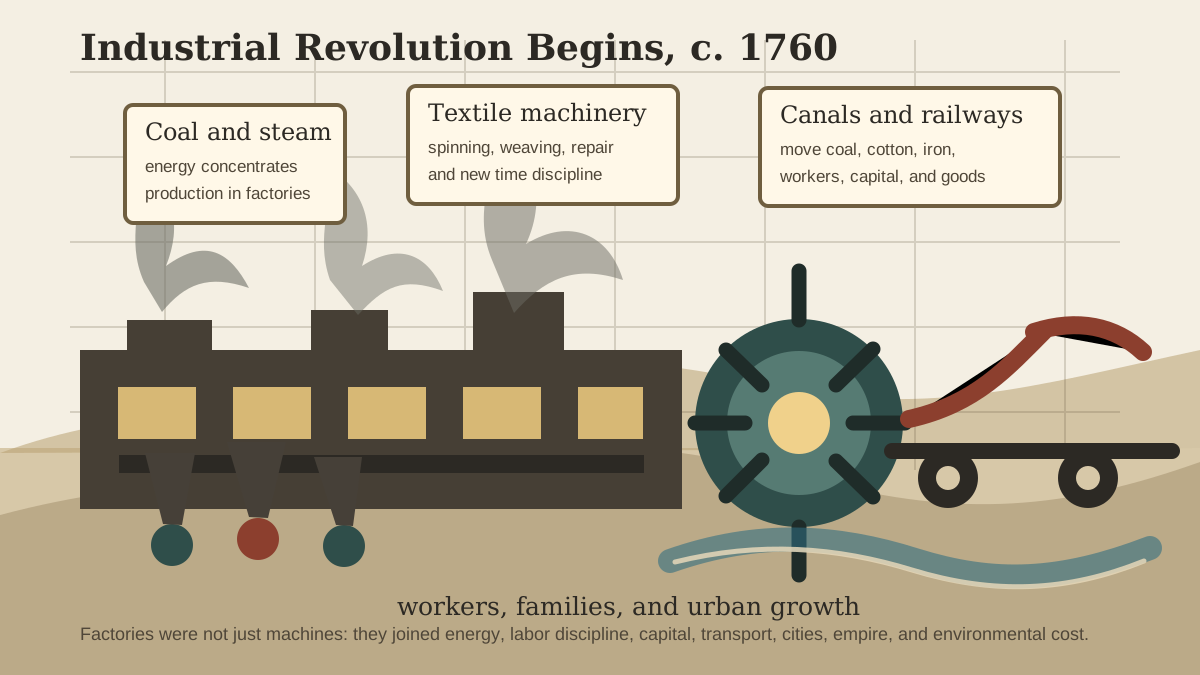
- c. 1760 CEIndustrial Revolution Begins
Mechanized production, coal energy, factory organization, and new transport systems began transforming work and wealth in Britain before spreading globally.
- 1839 CEFirst Opium War Begins
Disputes over opium smuggling, trade access, and imperial authority escalated into war between Qing China and Britain.
- 1868 CEMeiji Restoration
The Tokugawa shogunate collapsed and imperial rule was restored in a political settlement that launched intense state-led modernization.
- November 17, 1869Opening of the Suez Canal
The Suez Canal opened a direct water route between the Mediterranean and Red Sea, shortening sea travel between Europe and Asia.
- 1884-1885Berlin Conference
European powers met in Berlin to regulate colonial claims in Africa without African political representation.
- October 1929Wall Street Crash of 1929
A severe stock market collapse in New York signaled financial instability that helped deepen the worldwide Great Depression.
Sources Used Here
- Encyclopaedia Britannica: Industrial Revolution
Reference for industrialization, machine manufacturing, energy use, and socioeconomic change.
- Science Museum Group Collection
Museum collection reference for industrial, technological, railway, and manufacturing objects and archives.
- Science and Industry Museum: Revolution in Progress
Museum reference linking industrial heritage, Manchester, railways, and technological change.
Industry, Capital, and Imperialism is designed as a route, not a folder. It gathers events that answer related reader questions about power, belief, conflict, exchange, institutions, and memory. The strongest way to read the page is to move from the earliest events toward the later ones, watching how one kind of pressure changes form across different places.
The route currently runs from c. 1760 CE to October 1929. That span lets readers compare immediate turning points with slower consequences: the founding of institutions, the spread of ideas, the shock of war or disease, and the way later societies reused earlier events as warnings, models, or symbols.
Start with Industrial Revolution Begins, Dutch East India Company Founded, First Opium War Begins, Meiji Restoration, Opening of the Suez Canal and then follow the internal links into people, timelines, years, maps, and source lists. The route structure stays visible when each event explains why it belongs with the others and where the next useful page is.
Compare the events by scale. Some are concentrated moments, such as a battle, proclamation, trial, or publication. Others are long processes, such as a reform movement, pandemic, trade route, or diplomatic order. Reading both types together helps prevent the page from becoming a list of dates.
A useful route keeps uncertainty visible. Historical change rarely has one cause or one clean ending, so the reader can separate background pressure, immediate trigger, turning point, result, and later memory. That pattern is what makes the atlas expandable without making the reader start over each time.
This route is also a comparison tool. After reading one event, compare it with a later event on the same page and ask what changed in scale, language, geography, technology, authority, or public memory. The comparison is often more useful than the individual summary because it reveals the pattern the topic page is built to expose. When a claim feels too neat, open the full event page and check whether the evidence supports one cause, several causes, or a contested interpretation before moving on.
This route follows industrial power as a system, not as a list of inventions. Machines mattered, but so did coal, cotton, finance, canals, railways, factories, ports, patents, colonial markets, military pressure, and workers whose labor made growth visible. Industrialization changed what states and companies could demand from distance: faster transport, larger output, new weapons, tighter credit, and wider commodity chains made empire more intrusive.
The Industrial Revolution page gives the route its engine, but the Opium War, Suez Canal, Meiji Restoration, Berlin Conference, and Wall Street Crash show the wider consequences. Industrial power did not stay inside British factories. It altered Qing trade pressure, Japanese state reform, Egyptian and global transit, African partition, and financial crisis. The hub is therefore about connections between production, capital, coercion, and imperial bargaining.
A human reading keeps the topic from becoming mechanical. Factory workers, sailors, dock laborers, railway builders, enslaved and coerced workers, consumers, investors, colonial officials, merchants, farmers, and soldiers all felt industrial capitalism differently. Some gained wages, goods, mobility, or state power; others faced exploitation, displacement, famine risk, debt, racial hierarchy, or violent incorporation into global markets.
The route also asks readers to separate innovation from control. A steam engine can be a technical achievement; a railway can move food, troops, migrants, raw materials, and imperial authority; a canal can shorten trade while deepening dependency; a financial crash can reveal how connected economies had become. That double reading makes the hub useful for students who need to explain both progress and cost without reducing either side to a slogan.
The route begins before the nineteenth century because company capitalism helped prepare the world that industrial empire later intensified. The Dutch East India Company shows shares, ships, forts, monopoly claims, Asian ports, and state-backed violence operating together. That earlier corporate form matters because later industrial power did not invent extraction from nothing. It inherited habits of risk pooling, commercial lobbying, armed trade, and distant bookkeeping that made empire look like a business problem.
Cotton gives the hub an everyday object with a hard history. Cloth could be worn, traded, taxed, copied, mechanized, and used to reorganize labor across continents. British mills depended on raw cotton, colonial markets, shipping, credit, and later plantation slavery and imperial tariff rules. A shirt or bolt of cloth therefore connects a factory town, a plantation, a merchant house, a port, a household budget, and a law that decides whose labor becomes cheap.
China enters the route through trade imbalance and coercion. The Opium War is not a side story about drugs alone. It shows how industrial and commercial power could force legal change, treaty ports, indemnities, extraterritorial rights, and new diplomatic language on a state that still possessed deep traditions of government. Reading it beside factories and canals helps readers see that industrial capitalism was also a system for changing rules when markets did not behave as powerful states wanted.
Japan gives the route a different answer to pressure. Meiji leaders did not simply imitate the West; they reorganized taxation, conscription, education, industry, railways, and military institutions because survival seemed to require state capacity at industrial speed. The same pressure that produced unequal treaties in some places pushed reform in others. The comparison makes the hub sharper: industrial imperialism created victims, collaborators, reformers, and rival empires, not one uniform response.
Infrastructure is the route's visible skeleton. Suez, railroads, telegraphs, steamships, ports, mines, and warehouses compressed distance while making territory easier to price, police, and move through. These systems could lower costs and carry food, mail, medicine, and passengers, but they also carried troops, debt, surveillance, forced crops, and extraction. The strongest visual frame is a network of routes and chokepoints rather than a single heroic machine.
Finance turns the route from machinery into vulnerability. Banks, insurance, stock exchanges, bond markets, futures contracts, and government debt allowed investment to reach farther than an individual merchant could travel. They also made panic contagious. The Wall Street Crash belongs here because it reveals that industrial capitalism had created a world where confidence, credit, commodity prices, employment, and public trust were tied together across borders.
The environmental layer is just as important. Coal smoke, mine shafts, textile waste, deforestation, railway cuts, canal dredging, plantations, and urban crowding made industrial growth visible in landscapes and bodies. Workers breathed polluted air; rivers carried chemical discharge; colonies were reorganized around export crops or minerals; cities grew faster than housing and sanitation. Industrial history becomes fuller when readers see that energy systems leave environmental archives.
The hub also needs a source trail. Factory inspectors, parliamentary reports, company ledgers, patent drawings, workers' memoirs, port records, treaty texts, maps, photographs, and museum objects each show a different part of the system. A locomotive image shows engineering pride; a wage table shows discipline; a treaty shows coercive law; a crash chart shows financial trust breaking. No single source can explain the whole route.
Workers make the story legible because industrial capitalism changed time. Bells, shifts, wages, piece rates, debt, factory rules, migration, strikes, child labor, domestic work, and family budgets made abstract growth personal. The route leaves room for skilled artisans who lost status, women whose paid and unpaid labor held households together, migrants who built railways, and colonial workers whose labor made distant consumption possible.
The final synthesis is that industry changed the scale of action. States could mobilize troops and raw materials faster; companies could coordinate production across oceans; investors could profit from distant risk; reformers could use print and statistics to criticize abuse; workers could organize across new cities. The same system produced wealth and insecurity. That tension is why this hub belongs beside trade, colonialism, rights movements, science, and world-war mobilization.
Chronology matters because industrial capitalism did not mature all at once. Early mechanization reorganized textile production; steam and coal changed transport and factory geography; railways and telegraphs tightened state control; steel, chemicals, and electricity widened the industrial base; mass finance and global commodity markets made crisis travel faster. The route helps readers avoid a common mistake: treating the Industrial Revolution as one invention moment rather than a long series of linked reorganizations.
Gender and household labor belong inside the story. Women and children worked in mills, mines, homes, fields, markets, and informal economies that industrial statistics often undercount. Household budgets changed as wages, food prices, rent, and factory schedules shifted. Middle-class reformers sometimes used family language to criticize industrial abuse, while employers used gendered wage assumptions to keep labor cheap. Reading the household beside the factory makes industrial change more human and more accurate.
Imperial knowledge also became industrial. Surveys, censuses, railway timetables, geological maps, shipping tables, price reports, and engineering drawings helped states and companies see territories as resources. Those tools could support roads, schools, and public works, but they could also reduce communities to labor pools, taxable units, or mineral zones. Machines and measurement belong together here because power grew when information became standardized.
The Berlin Conference gives the route a geopolitical endpoint before the financial crash. Industrial powers did not partition Africa only because of ideology; they also cared about raw materials, transport corridors, prestige, missionary pressure, military positioning, and investment claims. The conference shows how map lines could turn economic ambition into diplomatic procedure. It also reminds readers that decisions made in European rooms reshaped African lives without African consent.
Comparison stays open. Britain industrialized early with coal, colonies, finance, and textile production; Japan industrialized under pressure through state-led reform; Qing China faced coercive trade and internal crisis; Egypt and the Suez corridor became strategic infrastructure; African regions were pulled into partition. These are not examples of one ladder of progress. They are different positions inside a world economy becoming more unequal and more connected.
Readers also need a way to ask whether industry caused imperialism. The careful answer is not automatic. Industrial capacity gave states weapons, transport, capital, and appetite for markets, but political decisions, racism, nationalism, missionary movements, corporate lobbying, and local resistance shaped how that capacity was used. The route therefore treats industrial imperialism as an interaction between material power and political choice.
A useful next-click path starts with the factory, then follows the route outward. Industrialization explains energy and production; the VOC page explains corporate empire before steam; the Opium War explains coerced trade; Meiji explains reform under pressure; Suez and railroads explain infrastructure; Berlin explains diplomatic partition; 1929 explains global financial fragility. That sequence turns a broad topic into a readable chain.
The causes-and-effects answer is built into the route. Causes include energy access, capital, labor discipline, technological borrowing, imperial markets, transport, and state policy. Effects include urban growth, worker organization, environmental damage, colonial pressure, new military capacity, mass consumption, and connected financial crisis. Naming both sides helps the hub serve as an explainer without splitting into thin duplicate pages.
The strongest closing question is not whether industry was good or bad. It is who gained the power to move faster, produce more, borrow more, command more labor, and absorb more risk. Once readers ask that question, the events on the route stop looking like isolated episodes. They become a connected history of speed, scale, profit, coercion, and resistance.
That question also gives the page a stronger internal structure. Readers can move from energy to labor, from labor to infrastructure, from infrastructure to empire, and from empire to finance. Each click should answer why industrial power traveled and why people resisted its costs. The route stays readable because every event shows one layer of that system becoming visible.
This hub is strongest when industry and empire stay in the same system. Factories, railways, coal, banks, insurance, telegraphs, steamships, company law, cotton, plantation labor, and colonial raw materials all changed each other's possibilities. Industrialization was never only a machine story; it was a story about capital finding labor, energy, markets, land, and state protection.
Work comes before abstraction. Mill hands, miners, railway builders, dockworkers, clerks, engineers, enslaved and coerced laborers, colonized farmers, and consumers all made industrial capitalism real. The hub becomes more readable when it follows how a commodity moved from field or mine to factory, port, shop, household, and empire.
Read the events in order first; the page is built to reveal change over time.
Ask which pressures existed before the visible turning point and which actors had room to choose.
Follow what changed afterward in institutions, borders, law, belief, or everyday life.
Notice which events became symbols and why later generations kept returning to them.
Track how coal, steam, electricity, and mechanized production changed the scale of economic and military action.
Follow credit, investment, company power, markets, and speculation as historical forces, not background details.
Ask where industrial growth depended on unequal treaties, forced labor, colonial rule, or military pressure.
Keep workers, migrants, enslaved people, dock crews, farmers, and factory families visible beside machines.
Read canals, railways, steamships, telegraphs, ports, mines, and warehouses as systems that moved goods, people, soldiers, and information.
Watch how coal, smoke, mines, plantations, river waste, and urban crowding made industrial growth visible in landscapes and bodies.
Choose a Reading Path
Start With the Timeline
Use the related timeline first when you want a chronological route through the topic.
Start with 1602 CE: Dutch East India Company FoundedOpen a Person Page
Use people pages when the topic is easier to understand through leadership, resistance, reform, or memory.
Start with c. 1760 CE: Industrial Revolution BeginsUse Year Pages
Use year pages when you need a fast answer to what changed in a specific year.
Start with 1839 CE: First Opium War BeginsReturn to the Map
Use the map to keep geography visible while moving between events and regions.
Start with 1868 CE: Meiji RestorationFactory Route
Begin with industrialization and ask how machines reorganized work, cities, families, energy use, and output.
Start with November 17, 1869: Opening of the Suez CanalTrade Pressure
Use the Opium War and Suez Canal to connect industrial demand with ports, treaties, shipping, and coercion.
Start with 1884-1885: Berlin ConferenceState Reform
Read Meiji Japan as one response to industrial imperial pressure: reform, military modernization, and new state capacity.
Start with October 1929: Wall Street Crash of 1929Global Risk
End with 1929 to see how capital networks could turn confidence, credit, and speculation into worldwide crisis.
Object Route
Follow cotton, coal, opium, steel, or a railway ticket to connect production, consumption, labor, law, and empire.
How the Story Builds
Begin with Industrial Revolution Begins. The opening event usually shows the pressure that made the route necessary: a crisis of authority, an expanding exchange system, a new technology, a contested idea, or a conflict that older institutions could no longer contain.
Opening of the Suez Canal works as a checkpoint because it lets readers ask what had become irreversible, which actors still had choices, and how the route changed scale between the opening event and the later consequences.
The later edge of the route includes Telephone Patented, Berlin Conference, and Wall Street Crash of 1929. These pages help readers see what survived beyond the first shock: institutions, borders, laws, memories, technologies, movements, or arguments that kept shaping later history.
The route is easier to remember through people and places. Watch figures such as James Watt, Richard Arkwright, Dutch merchants, Lin Zexu, Queen Victoria, and Emperor Meiji move through settings such as Britain, Amsterdam, Guangzhou, Kyoto and Tokyo, and Suez Canal; that is where large structures become visible as choices, risks, costs, and memories.
Factories and new energy systems changed output, labor discipline, urban life, and the pace of economic growth.
Industrial states used trade demands, gunboats, companies, treaties, and finance to reshape weaker political economies.
Canals, railways, ports, telegraphs, and shipping routes made distance cheaper while expanding surveillance and control.
The Wall Street Crash shows that industrial capitalism created connected vulnerability as well as productive power.
Mines, smoke, crowded housing, plantation expansion, and river pollution show that industrial power changed landscapes as well as markets.
Workers, reformers, anti-imperial critics, scientists, and state planners used the same industrial tools of print, statistics, and networks to challenge abuse.
- Which event in Industry, Capital, and Imperialism feels like the true point of no return, and why might another reader choose a different event?
- What changes if the route is read from the perspective of ordinary people rather than rulers, armies, inventors, reformers, or institutions?
- Which consequence was immediate, and which consequence only became clear decades later?
- Where does the map change the interpretation by showing distance, borders, routes, ports, capitals, or frontiers?
- How can readers explain industrialization without treating machines as the only cause?
- Where did industrial growth depend on empire, coerced labor, or unequal trade?
- Why did some states reform quickly under industrial pressure while others were forced into unequal bargains?
- What changes when a canal, railway, or factory is read as both technology and power?
- Why does finance belong inside industrial history rather than only economic history?
- How did industrial growth change landscapes, public health, and daily time discipline?
- Which sources make workers, colonized communities, investors, and officials visible in the same route?
- Where did industrial growth depend on colonial extraction, coerced labor, or unequal trade rather than invention alone?
Interactive Timeline
Follow Industry, Capital, and Imperialism by sequence
Dutch East India Company Founded
The Dutch East India Company was founded as a chartered corporation with commercial and political powers in Asian trade.
Read the full event pageMap Layer
Industry, Capital, and Imperialism geography
Gold pins mark the approximate locations of published event pages. This is a schematic locator map, not a historical border map.
Coordinates are approximate and are used to help readers orient themselves before opening a full event page.
Route Events
Events in This Topic
Dutch East India Company Founded
The Dutch East India Company was founded as a chartered corporation with commercial and political powers in Asian trade.
Industrial Revolution Begins
Mechanized production, coal energy, factory organization, and new transport systems began transforming work and wealth in Britain before spreading globally.
First Opium War Begins
Disputes over opium smuggling, trade access, and imperial authority escalated into war between Qing China and Britain.
Meiji Restoration
The Tokugawa shogunate collapsed and imperial rule was restored in a political settlement that launched intense state-led modernization.
Opening of the Suez Canal
The Suez Canal opened a direct water path between the Mediterranean and Red Sea, shortening sea travel between Europe and Asia.
First Transcontinental Railroad Completed
The first transcontinental railroad in the United States linked eastern and western rail networks after years of construction.
Telephone Patented
Alexander Graham Bell received a patent for the telephone, helping launch a new era of voice communication over distance.
Berlin Conference
European powers met in Berlin to regulate colonial claims in Africa without African political representation.
Wall Street Crash of 1929
A severe stock market collapse in New York signaled financial instability that helped deepen the worldwide Great Depression.
References
Where to Check the Facts
- Encyclopaedia Britannica: Industrial RevolutionReference for industrialization, machine manufacturing, energy use, and socioeconomic change.
- Science Museum Group CollectionMuseum collection reference for industrial, technological, railway, and manufacturing objects and archives.
- Science and Industry Museum: Revolution in ProgressMuseum reference linking industrial heritage, Manchester, railways, and technological change.