At a Glance
The shape of the event
- Date
- 1687 CE
- Place
- London
- Type
- Scientific Publication
Isaac Newton published the Principia, presenting laws of motion and universal gravitation in a mathematical framework.
1687 CE; place the event in London before comparing causes or consequences.
The work transformed science, education, engineering, and Enlightenment ideas about order, proof, and nature.
Isaac Newton are the first names or groups to compare before widening the story.
Newtonian mechanics became a powerful model for explaining motion on Earth and in the heavens.
Newtonian mechanics became a powerful model for explaining motion on Earth and in the heavens.
The work transformed science, education, engineering, and Enlightenment ideas about order, proof, and nature.
If you want to follow how ideas become instruments, read on.
Background
By 1687, across London and broader Western Europe, a ferment of questions pressed on natural philosophers and mathematicians: how to describe motion, how to connect terrestrial observations with the behavior of bodies in the sky, and which modes of proof should settle disputes. Publishing a major scientific work in this moment was not a neutral act; it translated private calculation into a public instrument for persuasion. Isaac Newton’s Principia arrived into that fraught field. Historians differ about why one book can alter a field so thoroughly. Some emphasize decisive individual choices—Newton’s decisions about framing, language and publication.
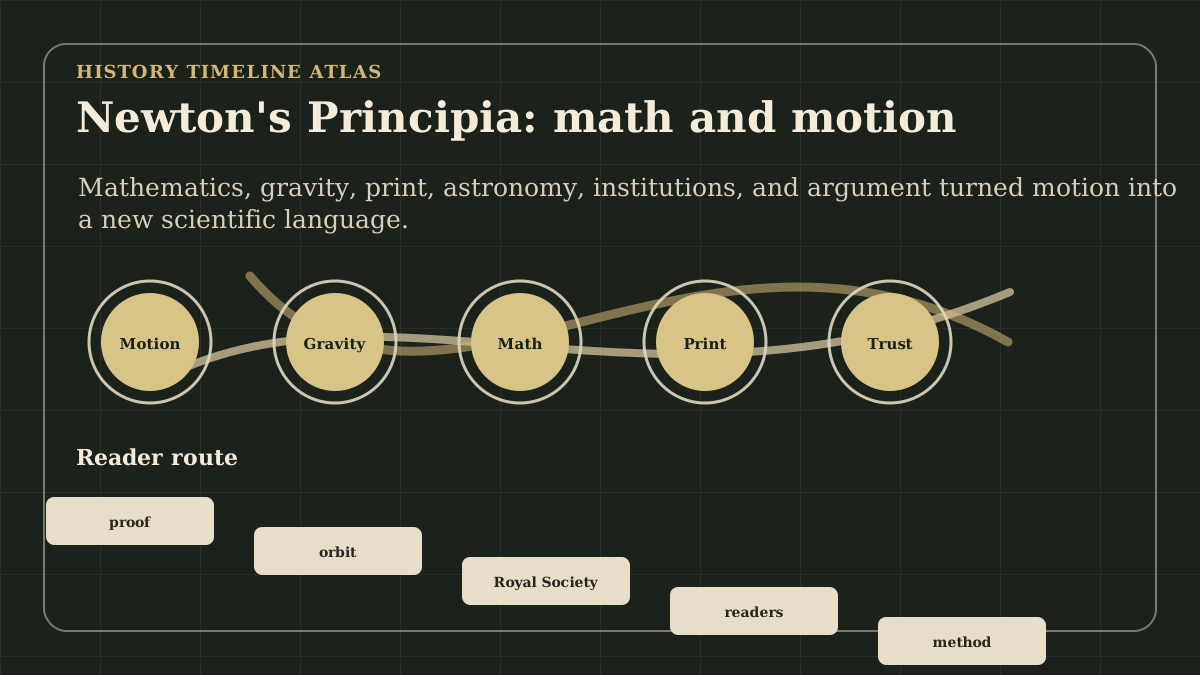
Others point to deeper structural forces: growing networks of correspondence, expanding opportunities for printing and teaching, and a public increasingly disposed to quantitative demonstration. This page aims neither to resolve that debate nor to erase it. Instead it keeps both lines visible: the intentional acts of a single author and the broader intellectual and institutional pressures that made a mathematical presentation both possible and persuasive. Newton's Principia should not read like a lone genius story detached from institutions. Newton's mathematics mattered enormously, but the book also depended on correspondence, print culture, astronomical observation, previous debates about motion, the Royal Society, and Edmond Halley's encouragement.
The event is more interesting when readers see an argument moving through a community that could challenge, sponsor, print, and interpret it. The book joined terrestrial and celestial problems in a new way. Falling bodies, planetary orbits, tides, comets, inertia, force, and mathematical proof became parts of one language. That does not mean every reader immediately understood the text. The Principia was difficult, Latin, mathematical, and embedded in expert debate. Its influence grew through commentary, teaching, application, and later simplification. The page should also keep controversy and limits visible. Hooke, Leibniz, Huygens, Descartes' legacy, religious interpretation, and later debates over action at a distance all shaped how Newtonian physics was received.
Science here was not a clean replacement of superstition with facts. It was a contested method for making nature calculable, public, and reusable.
The Turning Point
The decisive change in 1687 was not a sudden discovery so much as a deliberate presentation. Isaac Newton assembled his laws of motion and an account of universal gravitation into a single, rigorous mathematical statement and made the choice to publish that statement in London. The act of publication fixed his ideas in a durable form and invited scrutiny, replication and application. The key actor is plainly Newton: he framed motion in terms of mathematical laws, he brought gravitational attraction into the same explanatory scheme for both heavens and Earth, and he allowed those formulations to circulate beyond his immediate circle.
Yet the turning point also depended on choices that lie outside the author’s singular genius—the willingness of readers to accept mathematical demonstration as dispositive, the capacity of printers and readers to handle complex diagrams and calculations, and the appetite of schools, engineers and other practitioners for new tools. In short, the event combined a concrete human decision—the decision to publish a particular mathematical framing—with a receptive environment that made that framing consequential. The turning point was the publication of a mathematical system that could explain motion on Earth and in the heavens under common principles. That made the book more than a famous title.
It gave natural philosophy a model of proof that later readers could imitate, extend, attack, or teach. Printing also mattered. A manuscript known only to a few would have had a different afterlife. Publication let claims travel through universities, academies, textbooks, observatories, navigators, engineers, and critics. The Principia became powerful because it could be argued with in public.
Consequences
In the near term, the Principia offered a new, powerful model for explaining motion that could be applied to problems both practical and speculative. Engineers, navigators, and instructors found in Newtonian mechanics a compact set of principles that could be put to work in calculation and design. Over the longer term, the book helped to transform how knowledge was organized and justified: mathematical proof moved closer to the center of natural philosophy, and explanations that appealed to universal laws acquired new prestige. The work’s influence extended beyond laboratories and workshops into education and into debates about the order of nature and the demands of demonstration—features of Enlightenment intellectual life. Importantly, these outcomes were not preordained.
Whether the Principia precipitated immediate, universal change, or whether its authority grew over decades through teaching, translation and application, remains a matter of interpretation. What is clear is that Newton’s published mathematical scheme became a central reference point for thinking about motion on Earth and in the heavens, and that this shift reshaped scientific practices, curricular priorities and the cultural weight given to mathematical proof. The immediate consequence was not instant scientific unanimity. Newtonian ideas spread unevenly and required translation into lectures, diagrams, commentaries, experiments, and practical applications. Over time, however, the book helped make mathematical physics a central standard for credible explanation. The longer consequence reached beyond science.
Enlightenment thinkers used Newton as a model of order, law, method, and intellectual authority. Engineers, navigators, astronomers, and educators drew on Newtonian frameworks, while later physics would revise parts of the system. The page should present Newton as foundational, not final.
Interpretation Notes
The hardest question around Newton Publishes Principia is causation. The event had immediate actors, but its meaning also came from institutions, geography, resources, and expectations already present in Western Europe.
Why Keep Reading
If you want to follow how ideas become instruments, read on. The Principia sits at a crossroads: it offers a case study in how one published argument can propagate through classrooms, workshops and political discourse, and it invites comparison with other episodes where publication, persuasion and practice collided. Subsequent pages trace how Newton’s mechanics was taught, contested and repurposed; how engineers and navigators translated abstract laws into concrete calculations; and how rival explanations competed for authority. Exploring those threads will help you see whether the spread of Newtonian ideas was the product of a single author’s brilliance or the result of slow institutional uptake—and why that distinction still matters for how we think about science today.
Read Principia after the Scientific Revolution and before the Industrial Revolution, vaccination, Darwin, and space-race pages. The path shows how evidence, mathematics, instruments, institutions, and public trust repeatedly reshape what counts as knowledge.
Reading Path
Follow the story without losing the thread
Before This
- Peace of Westphalia1648 CE
- English Civil War Begins1642 CE
- Dutch East India Company Founded1602 CE
After This
- Glorious Revolution1688 CE
- Smallpox Vaccine1796 CE
- Darwin Publishes On the Origin of Species1859 CE
Same Period
Wider Timeline
Mind Map
How to think about Newton Publishes Principia
intellectual need
A pressing demand to explain motion on Earth and in the heavens in unified terms
Map Layer
Where this event sits geographically
Gold pins mark the approximate locations of published event pages. This is a schematic locator map, not a historical border map.
Coordinates are approximate and are used to help readers orient themselves before opening a full event page.
References
Where to Check the Facts
- Science Museum: Objects and StoriesMuseum reference hub for science, technology, medicine, invention, and public understanding.
- Encyclopaedia BritannicaBackground reference for chronology, names, and historical context.
- WikidataStructured reference for dates, places, alternate names, and entity links.