At a Glance
The shape of the event
- Date
- 1648 CE
- Place
- Westphalia
- Type
- Peace Settlement
The Peace of Westphalia ended major phases of the Thirty Years' War and adjusted political and religious arrangements in Europe.
1648 CE; place the event in Westphalia before comparing causes or consequences.
Westphalia became a reference point in discussions of sovereignty, diplomacy, religious conflict, and the European state system.
European diplomats are the first names or groups to compare before widening the story.
The settlement recognized political compromises among states and confessions after devastating warfare.
The settlement recognized political compromises among states and confessions after devastating warfare.
Westphalia became a reference point in discussions of sovereignty, diplomacy, religious conflict, and the European state system.
Read on to follow how the compromises struck in 1648 set patterns for diplomacy and statecraft across Europe.
Background
Across the first half of the seventeenth century a constellation of pressures pushed Europe toward a negotiated settlement. Religious division—Catholic, Protestant and other confessional identities—had become a fault line that shaped loyalties and political claims. Overlapping claims of rulers, shifting alliances and competition among principalities and kingdoms created a crowded map of contested authority. Prolonged warfare produced political fragility, demographic disruption and economic strain in regions caught between armies. Diplomacy evolved as the practical means to manage these pressures: envoys and plenipotentiaries carried the burdens of compromise and the authority to bind states and confessions to new arrangements. At the same time, the balance between decisions made by individual negotiators and deeper structural forces—religion, military exhaustion, and institutional change—remains contested.
This page avoids settling that debate; instead it traces how, in 1648, those pressures met at Westphalia and required choices about order, rights, and the limits of violence. Local communities and urban centers negotiated survival alongside rulers; religious practice, landholding and legal jurisdictions were all contested in ways that required settlement beyond battlefield victory. The practical work of diplomacy—drawing lines, codifying privileges, and specifying which confession would hold recognized rights in which territories—became urgent. The diplomats who met in Westphalia represented a broad array of interests and carried instructions that mixed territorial ambition with requests for religious security. Those mixed objectives meant the eventual settlement was less a neat blueprint than a negotiated bundle of compromises.
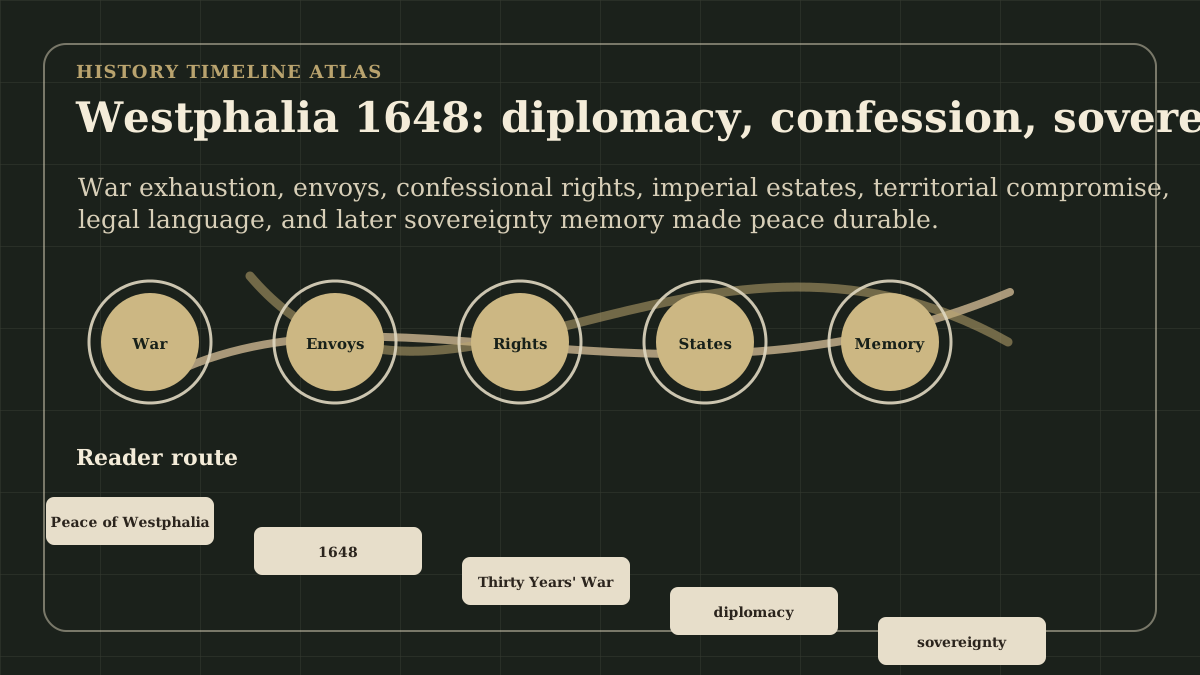
The Peace of Westphalia should not be reduced to the slogan 'birth of the modern state.' The settlements of 1648 were concrete answers to exhausted war: who held territory, how imperial estates related to the emperor, what rights Catholic and Protestant communities could claim, and how envoys could turn conflict into documents others would recognize. The negotiations were unusually complex because there was no single table with one simple war to end. Munster and Osnabruck, imperial law, French and Swedish interests, the Holy Roman Empire, confessional rights, dynastic claims, military occupation, and local devastation all overlapped. Diplomacy had to manage a crowded map of powers. The later myth matters too.
Westphalia became a reference point for sovereignty, nonintervention, diplomacy, and the European state system, but historians debate whether 1648 invented those principles or later readers projected them backward. A rich page should let readers see both the settlement and its afterlife.
The Turning Point
In 1648, in Westphalia, European diplomats converted war exhaustion into negotiated terms. They met as representatives of states and confessions with the authority to agree on political compromises. The crucial change was procedural as well as substantive: instead of attempting to settle all disputes by further campaigning, principals accepted binding agreements that adjusted who held power and which religious practices were protected. Diplomats weighed territorial claims and confessional rights against the practical goal of stopping recurrent violence. The settlement ended the major phases of the Thirty Years' War by translating battlefield stalemate and war-weariness into written arrangements that reconfigured political and religious relationships across the continent.
Choices made at the negotiating table—what to concede, which rights to recognize, which claims to set aside—shaped the settlement’s texture. Some historians emphasize the decisive agency of these negotiators; others point to deeper forces—military exhaustion, fiscal limits, and shifting institutional norms—that made compromise the likely outcome. This page keeps that dispute visible: Westphalia mattered because diplomats forged concrete compromises, but those compromises also reflected broader structural pressures that constrained what was possible. Negotiators' decisions were deliberate and often incremental; small concessions accumulated into a settlement capable of surviving immediate postwar turbulence. The turning point was the conversion of war exhaustion into a negotiated bundle of legal and political compromises.
Rather than letting armies alone decide authority, envoys codified arrangements that rulers, estates, cities, and confessional communities could use. Another turning point was recognition that durable peace required procedural order. Representation, written guarantees, ratification, and the balancing of multiple parties made Westphalia a lesson in diplomatic architecture, not only a list of treaty terms.
Consequences
In the near term the Peace of Westphalia stopped the major phases of the Thirty Years' War and created a framework in which political and religious arrangements were codified as practical compromises. Those compromises eased immediate pressures by delineating which authorities could exercise power and which confessional rights would be acknowledged in particular places. Because the settlement contained negotiated trade-offs rather than absolute victors' terms, it permitted a fragile peace in regions exhausted by prolonged conflict. Over the longer term Westphalia acquired symbolic and analytical weight: later generations and scholars treated it as a turning point in conversations about sovereignty, the practice of diplomacy, the management of religious conflict, and the shaping of a European state system.
That legacy is not uncontested. Some accounts treat Westphalia as the origin of modern state sovereignty; others see it as one moment among many in gradual state formation. What is clear is that the 1648 settlement became a recurring reference when European and later international actors sought principles to justify political order and diplomatic norms. By keeping the differing interpretations visible, we can see both the concrete compromises of 1648 and the wider debates those compromises helped to frame. The immediate consequence was an end to major phases of the Thirty Years' War and a framework for reorganizing authority inside the Holy Roman Empire and among European powers.
The peace did not erase rivalry, but it made some conflicts more governable. The longer consequence was interpretive power. Later diplomats, legal theorists, international-relations scholars, and politicians used 'Westphalia' as a shorthand for sovereignty and state order, even when the historical settlement was more layered than the shorthand suggests.
Interpretation Notes
The memory of Peace of Westphalia often depends on who tells the story. A court, army, religious community, merchant network, or later nation can emphasize different causes and make Westphalia stand for different lessons.
Why Keep Reading
Read on to follow how the compromises struck in 1648 set patterns for diplomacy and statecraft across Europe. Tracing earlier and later negotiations explains how religious settlement, territorial claims and practices of representation evolved. If you are interested in the lived consequences, timelines of local settlements and the immediate aftermath reveal how communities and rulers tested the new arrangements. If you want to see how the idea of sovereignty traveled, follow diplomatic exchanges and later treaties that invoked Westphalia as precedent. This page points to those threads without declaring a single master explanation, so you can judge how much credit to assign to negotiators' choices versus larger structural forces.
Read Westphalia after the Reformation, the Thirty Years' War, and the English Civil War, then continue to absolutism, balance-of-power diplomacy, the Congress of Vienna, and modern international law. That path shows how religious conflict, state authority, and diplomatic practice changed together.
Reading Path
Follow the story without losing the thread
Before This
- English Civil War Begins1642 CE
- Treaty of Zuhab1639 CE
- Dutch East India Company Founded1602 CE
After This
- Newton Publishes Principia1687 CE
- Glorious Revolution1688 CE
- Treaty of Kucuk Kaynarca1774 CE
Same Period
Wider Timeline
Mind Map
How to think about Peace of Westphalia
Confessional conflict
Prolonged religious divisions made negotiated accommodation necessary to reduce recurring violence.
Map Layer
Where this event sits geographically
Gold pins mark the approximate locations of published event pages. This is a schematic locator map, not a historical border map.
Coordinates are approximate and are used to help readers orient themselves before opening a full event page.
References
Where to Check the Facts
- Encyclopaedia Britannica: Peace of WestphaliaSpecific reference for the 1648 settlements, Thirty Years' War context, diplomacy, and state-system memory.
- Encyclopaedia BritannicaBackground reference for chronology, names, and historical context.
- WikidataStructured reference for dates, places, alternate names, and entity links.