At a Glance
The shape of the event
- Date
- 1521 CE
- Place
- Tenochtitlan
- Type
- Conquest
Spanish forces and Indigenous allies captured Tenochtitlan after conflict, epidemic disease, and political fracture undermined Aztec power.
1521 CE; place the event in Tenochtitlan before comparing causes or consequences.
The conquest remade Mesoamerican politics, religion, demography, and landholding under colonial pressure.
Hernan Cortes / Cuauhtemoc / Malintzin are the first names or groups to compare before widening the story.
The Mexica imperial capital fell, and Spanish colonial rule expanded in central Mexico.
The Mexica imperial capital fell, and Spanish colonial rule expanded in central Mexico.
The conquest remade Mesoamerican politics, religion, demography, and landholding under colonial pressure.
If this account leaves you wanting specific perspectives, follow the threads that clarify who shaped the outcome and how.
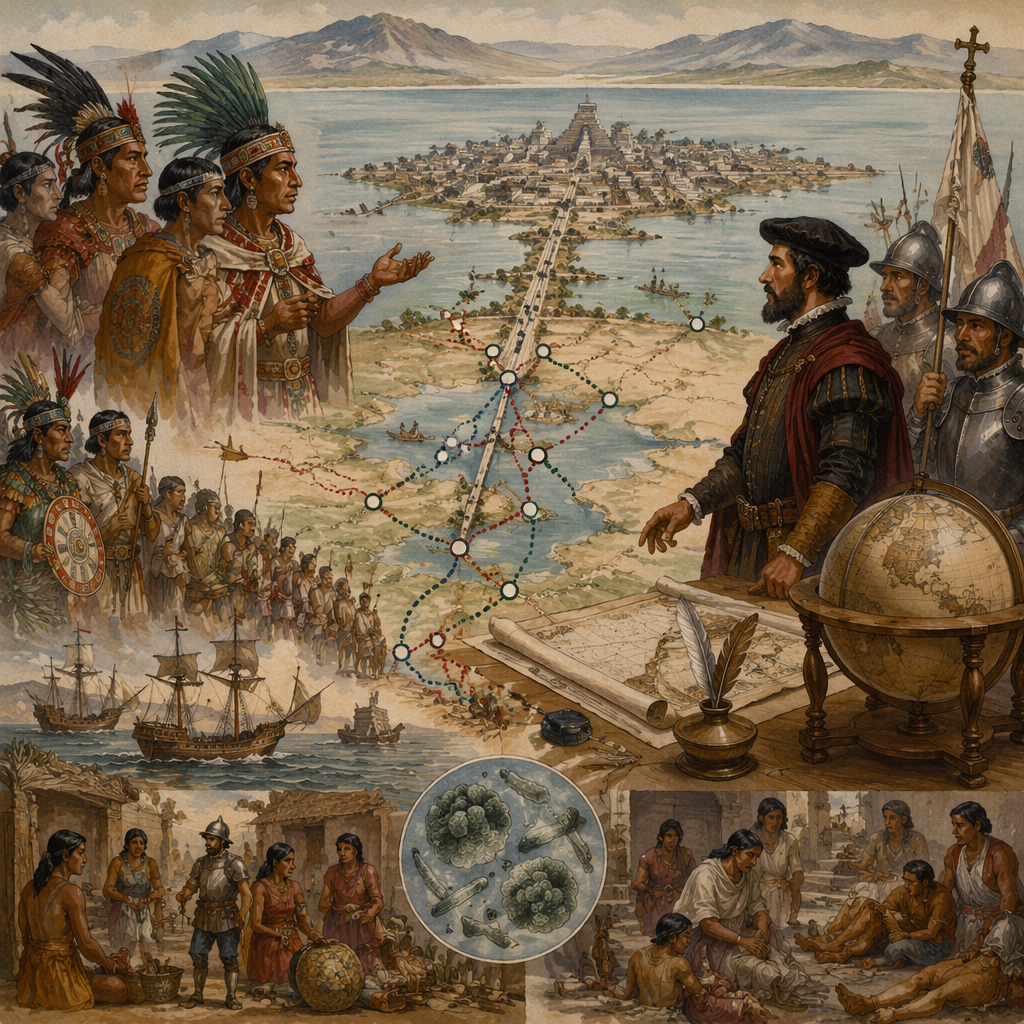
Background
Before 1521 the Mexica empire centered on Tenochtitlan dominated a vast and diverse region of central Mexico through a combination of military power, tribute systems and religious institutions. Spanish interests, represented by Hernan Cortes and men who sailed with him, arrived with ambitions tied to the expanding Spanish Empire. They entered a political landscape already riven by rivalries: subject city-states, resentful allies and local leaders who weighed accommodation against resistance. At the same time, epidemic disease moved through populations in ways that historians recognize as decisive but are debated in scale and timing. These pressures intersected: the Spanish sought allies among Indigenous groups opposed to Mexica hegemony; those allies found political opportunity in the conflict.
Interpretations differ about whether the fall of the capital was chiefly the product of strategic choices by figures like Cortes and Cuauhtemoc, the impact of disease, or long-term structural shifts in Mesoamerican society. This account keeps those disputes visible, describing multiple strands that together eroded Aztec power without treating any single explanation as final. The fall of the Aztec Empire is often misread as a story of a few Spaniards defeating a vast empire by technology alone. A stronger reading begins with the Mexica imperial system itself. Tribute demands, military pressure, and political hierarchy had created enemies as well as allies. Tlaxcalans and other Indigenous groups made strategic choices within that landscape; they were not background helpers.
Smallpox devastated communities and leadership structures. Lake Texcoco, causeways, canals, brigantines, food supply, and water access shaped the siege of Tenochtitlan. Spanish steel and horses mattered, but they mattered inside a wider Indigenous political and ecological crisis.
The Turning Point
The decisive change came during the campaign that led to the capture of Tenochtitlan, when military action, shifting alliances and non-military shocks combined to overturn the balance of power. Hernan Cortes led the Spanish forces, and he secured crucial support from Indigenous allies who had their own grievances against Mexica rule. Malintzin acted as an intermediary whose language skills and local knowledge shaped negotiations and tactical decisions; she is often cited as a pivotal actor in the chain of communications that made alliances possible. Cuauhtemoc, the Mexica leader during the final defense, embodied the last organized resistance inside the city.
At the same time an epidemic disease swept through the region, reducing the population available for defense and complicating leadership decisions. Together these elements transformed a series of contested engagements into a final collapse of organized Mexica control. The capture of the capital did not happen on a single day of fate; it followed a sequence of choices—alliances formed, sieges pressed, supplies cut—within an environment already weakened by political fracture and disease. The result was the surrender and capture of the imperial center, after which military occupation could be consolidated. The siege of 1521 turned alliance politics into urban catastrophe. Cortes relied on Indigenous allies for numbers, intelligence, labor, and legitimacy.
Tenochtitlan's defenders, led by Cuauhtemoc in the final phase, fought through hunger, disease, and the destruction of the city's water and movement systems. The campaign was slow and material: causeways cut and retaken, canals contested, houses destroyed, boats built and launched, and neighborhoods isolated. The turning point came when the city could no longer sustain defense as a functioning urban organism. This is why maps matter for the page. The conquest was not a single clash but the dismantling of a lake city by coalition warfare.
Consequences
In the immediate aftermath, the Mexica imperial capital ceased to function as the center of its preexisting polity and Spanish colonial authority expanded across central Mexico. The fall of Tenochtitlan allowed colonial administrators and settlers to impose new legal, fiscal and ecclesiastical frameworks that reshaped governance in the region. Indigenous political orders were remade: some local leaders found new roles under colonial rule, while others lost status and autonomy. Religion and ritual life were profoundly affected as colonial institutions promoted Christian practices and suppressed or repurposed elements of preexisting cults. Demographically, the region experienced major upheaval—epidemic disease continued to alter population numbers and settlement patterns, compounding the social dislocations of conquest.
Over the longer term these changes produced a colonial society in which landholding, labor arrangements and legal rights were contested and transformed under Spanish rule. Historians debate how quickly and completely these transformations took hold and to what degree they were driven by individual agency or broader structural forces, but the consensus view acknowledges that the conquest remade Mesoamerican politics, religion, demography and landholding under sustained colonial pressure. The consequences were enormous but not simple replacement. New Spain emerged through colonial institutions, Christian missions, forced labor, tribute adaptation, epidemics, legal struggles, and Indigenous survival. Many Indigenous allies expected rewards and autonomy; Spanish authorities increasingly tried to fold them into colonial rule. Mexica memory did not vanish.
Nahua scribes, local nobles, communities, and artists continued to record claims and histories under new conditions. The event therefore has two afterlives: the collapse of an imperial capital and the persistence of Indigenous political life inside a colonial order. It is more accurate to read 1521 as a transformation of power than as the disappearance of a people.
Interpretation Notes
Fall of the Aztec Empire raises a debate about scale: did the decisive change come from the visible conquest, or from older pressures around Spanish Empire and Indigenous History that had already narrowed what people could do?
Why Keep Reading
If this account leaves you wanting specific perspectives, follow the threads that clarify who shaped the outcome and how. Read biographies of Hernan Cortes, Cuauhtemoc and Malintzin to see how different actors made consequential choices. Trace timelines of the siege and the epidemic to compare sequences of events. Explore pages on Indigenous allies and colonial institutions to understand how local politics intersected with imperial ambitions. Each route offers a different angle on the same rupture: a fallen capital that became the foundation for a new colonial order. Read next into Tenochtitlan's founding, Moctezuma, Spanish colonial rule, smallpox, and Indigenous allies. The key question is not how Europe conquered alone, but how local rivalries, disease, siege logistics, and imperial ambition converged.
Reading Path
Follow the story without losing the thread
Before This
- Protestant Reformation Begins1517 CE
- Vasco da Gama Reaches India1498 CE
- Treaty of Tordesillas1494 CE
After This
Same Period
- Columbus's First Atlantic Voyage1492 CE
- Protestant Reformation Begins1517 CE
- Battle of LepantoOctober 7, 1571
Wider Timeline
Mind Map
How to think about Fall of the Aztec Empire
Epidemic
An epidemic disease reduced urban populations and undermined the Mexica capacity to sustain long-term defense.
Map Layer
Where this event sits geographically
Gold pins mark the approximate locations of published event pages. This is a schematic locator map, not a historical border map.
Coordinates are approximate and are used to help readers orient themselves before opening a full event page.
References
Where to Check the Facts
- The Metropolitan Museum of Art: TenochtitlanMuseum reference for Mexica urban power, Tenochtitlan, and pre-Columbian imperial context.
- Encyclopaedia Britannica: The Spanish Conquest of the AztecsReference for the Spanish conquest, alliances, Tenochtitlan siege, and Indigenous context.
- Library of Congress: U.S. History Primary Source TimelinePrimary-source timeline reference for Atlantic settlement, colonial expansion, reform, and later U.S. history paths.