Historical Role
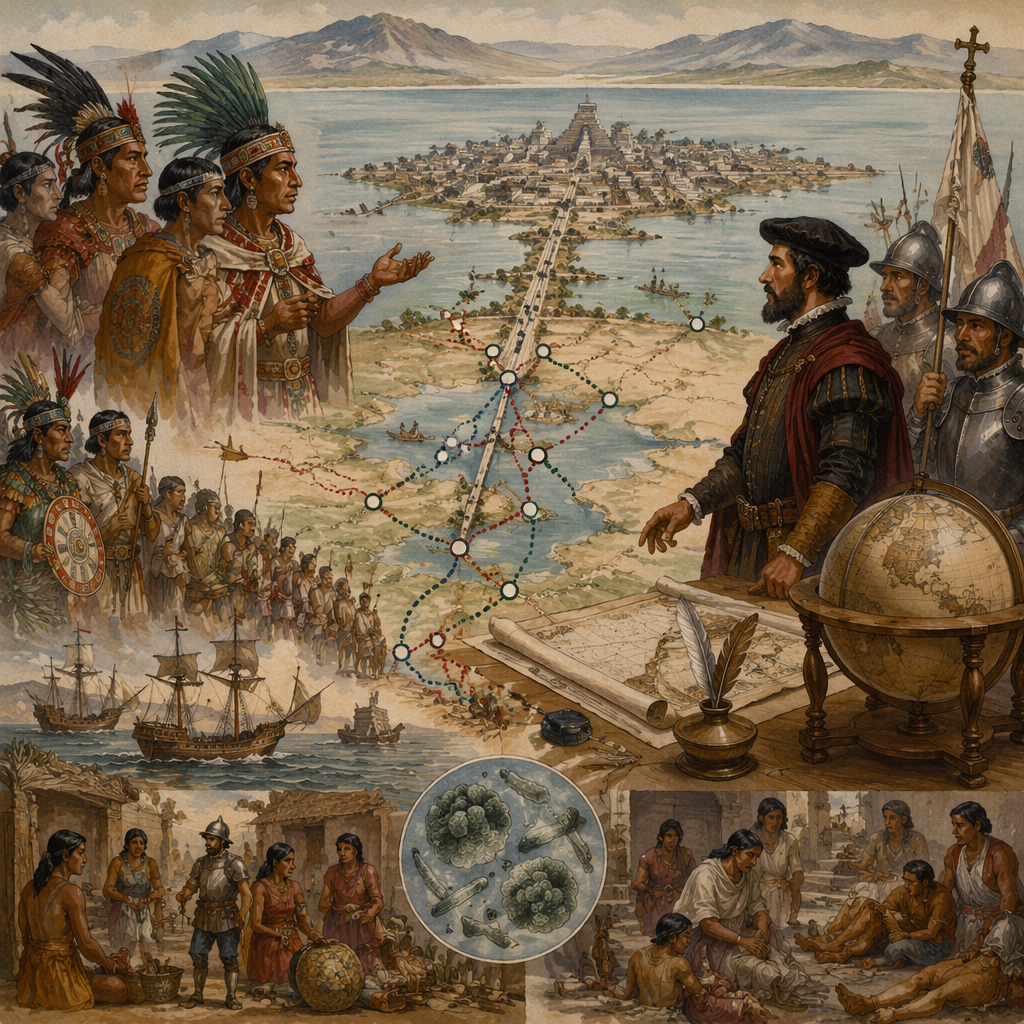
Hernan Cortes belongs in the atlas as an agent of conquest, alliance politics, violence, and colonial state formation. His expedition did not defeat the Mexica world by Spanish force alone. It moved through Indigenous rivalries, translators, coastal footholds, disease disruption, military opportunism, gunpowder weapons, horses, ships, tribute grievances, and the political intelligence of communities that chose, resisted, or recalculated under extreme pressure.
The fall of Tenochtitlan should be the hinge rather than the whole biography. Cortes acted as commander, negotiator, letter-writer, rebel against instructions, and colonial governor. Those roles show how conquest became a legal and administrative project: reports to the crown, grants, Christian language, forced labor, tribute collection, city rebuilding, and disputes among Spaniards all followed the fighting.
A stronger page avoids the lone-conquistador myth. Cortes mattered because his choices intensified a crisis, but Indigenous allies carried much of the military burden and Indigenous communities paid much of the cost. Malintzin's mediation, Tlaxcalan strategy, Mexica politics, smallpox, siege warfare, and postconquest institutions must stay visible if the page is going to explain conquest rather than repeat legend.
Malintzin's role makes translation a form of power rather than a side note. Speech, warning, diplomacy, threat, conversion language, and legal performance moved through interpreters. Cortes could not command the political field simply by force; he needed information about tribute grievances, rivalries, roads, rulers, and the meanings of public gestures. Translation made conquest possible while placing Indigenous intermediaries under impossible pressure.
The siege of Tenochtitlan also deserves material detail. Causeways, canals, brigantines, water supplies, hunger, disease, house-to-house violence, and the participation of Indigenous allies turned an imperial capital into a battlefield. The destruction was not only military. It broke neighborhoods, ritual spaces, food systems, families, and a city whose scale had astonished its enemies.
Cortes's later career shows the instability of conquest rewards. He received honors and land, but he also faced crown suspicion, legal disputes, rivals, and limits on his authority. The Spanish monarchy wanted the benefits of conquest without letting a conquistador become too independent. That tension helps readers see colonial rule as an argument among Spaniards as well as violence against Indigenous societies.
Hernan Cortes helps connect individual action with wider historical change in Spanish Empire. The biography works best when it keeps the surrounding world visible: authority, conflict, belief, reform, or discovery moved through decisions made under pressure.
The related events show how roles such as Spanish conquistador, Colonial governor can be read through dates, places, institutions, and consequences rather than through reputation alone. The biography explains why this person matters, while the linked events explain what changed around them.
A richer reading starts with the limits around the person. Some figures acted through offices, armies, courts, laboratories, churches, parties, ships, trade networks, or protest movements; others became important because later communities turned their lives into symbols. The page therefore asks what this person could actually change, what was already moving before them, and which consequences later readers attached to the name.
Read the biography against absence as well. Many lives around Hernan Cortes are less visible in the record: opponents, collaborators, family members, workers, soldiers, students, subjects, victims, translators, scribes, or local communities. Keeping those surrounding people in view makes the page less like a name card and more like an entry point into historical systems.
Hernan Cortes also works as a navigation point. Open the linked event pages to see where the biography becomes chronology, then use the topic routes to test whether the same pattern appears beyond one life. That extra step matters because historical importance is rarely contained inside a single decision; it usually spreads through institutions, witnesses, opponents, imitators, and later arguments over memory.
Sources and Method
Source method: read Cortes through the fall of the Aztec Empire, Mesoamerican civilization, and Spanish colonial routes. The biography treats Spanish letters and conquest narratives as evidence with political motives, then checks them against Indigenous presence, alliance-making, disease, and later colonial institutions.
Evidence Notes
How Sensitive Claims Are Sourced
- 1
Conquest through alliance and siege
The page frames Cortes's campaign through coalition warfare, Tlaxcalan and other Indigenous participation, siege logistics, disease disruption, and the political vulnerability of Mexica imperial tribute networks.
- 2
From expedition to colonial rule
Cortes's importance continues after battle because conquest became paperwork, city rebuilding, land claims, labor coercion, missionary activity, and legal argument before the Spanish crown.
Why This Person Matters
Hernan Cortes matters because the connected events make a larger historical pattern easier to follow. The page links biography to consequences so readers can move from a life story into the wider atlas, compare the person with contemporaries, and understand why later memory kept returning to this figure. Hernan Cortes matters because his life shows how conquest worked as a process: expedition, alliance, siege, disease, legal claim, urban rebuilding, labor coercion, and colonial memory all met in central Mexico. The page helps readers replace the shortcut of one conqueror with a harder explanation of how an imperial world was violently made.
What changes when Cortes is read not as a lone conqueror, but as one actor inside Indigenous alliance politics, epidemic crisis, siege warfare, and colonial institution-building?
How to Read This Life
Hernan Cortes is easiest to understand when the biography is read beside Fall of the Aztec Empire. Those events show the historical setting in motion: dates, places, institutions, conflict, and consequences give the life a structure that a short biography alone cannot provide.
The surrounding route crosses Early Modern World and locations such as Tenochtitlan. That matters because influence rarely stays inside one person. It moves through offices, armies, movements, laws, texts, speeches, institutions, and later memory.
A useful reading path starts with the role labels, then opens the event pages to see what changed, and finally compares this person with other actors facing similar pressures.
For readers who arrive on a biography first, this page is meant to become a doorway rather than a stop. Read one paragraph for the answer, then use the turning points, topic routes, and event links to test whether the person's reputation matches the wider evidence.
Read Cortes beside Moctezuma II, the fall of the Aztec Empire, Columbus, the Inca conquest, and Atlantic exchange pages. That route keeps conquest inside a wider history of disease, alliance, extraction, and imperial law.
Then compare him with Pizarro, Columbus, Vasco da Gama, and James Cook where available. The comparison asks how travel, armed commerce, mapping, translation, and violence became different forms of empire.
Read Hernan Cortes through the roles of Spanish conquistador, Colonial governor rather than as reputation alone.
Place the biography inside Spanish Empire and the wider events linked below.
Ask which choices were personal and which were constrained by institutions or crisis.
Follow how later memory simplified, contested, or reused this person's role.
Track Indigenous allies, rivals, translators, and local political choices rather than only Spanish weapons.
Read Tenochtitlan through causeways, water, hunger, disease, boats, and urban destruction.
Follow how victory became claims to land, labor, religion, law, and crown recognition.
Legacy, Limits, and Memory
A useful biography keeps scale in view. Hernan Cortes mattered because individual choices met a wider structure: institutions, enemies, allies, audiences, technologies, beliefs, and inherited conflicts. The related event pages help separate personal agency from conditions that no single person controlled.
Memory is part of the biography too. Later readers often simplify a figure into a hero, villain, founder, reformer, conqueror, prophet, scientist, or symbol. Those labels can be helpful, but they become misleading when they hide conflict, compromise, exclusion, uncertainty, or the experiences of people outside the main biography.
For the next step, compare this life with a topic route rather than stopping at the name. If the same pattern appears across several figures, the reader has found a historical structure; if this person breaks the pattern, the contrast is usually where the most interesting question begins.
The main risk is making conquest look like Spanish inevitability. Cortes's expedition depended on Indigenous allies, local knowledge, political fractures, epidemic shock, and decisions made by many actors who were not Spanish.
A second risk is treating Indigenous people as background. The biography should keep Mexica, Tlaxcalan, Totonac, Maya, and other communities visible as political actors, victims, negotiators, and memory keepers.
Turning Points to Read Next
Fall of the Aztec Empire
Spanish forces and Indigenous allies captured Tenochtitlan after conflict, epidemic disease, and political fracture undermined Aztec power.
Related Timeline
- 1521 CEFall of the Aztec Empire
Spanish forces and Indigenous allies captured Tenochtitlan after conflict, epidemic disease, and political fracture undermined Aztec power.
References
Where to Check the Facts
- Encyclopaedia Britannica: Mesoamerican civilizationReference for Mesoamerican chronology, cities, religion, trade, and political systems.
- Encyclopaedia Britannica: AztecReference for Aztec political expansion, Tenochtitlan, and the Triple Alliance.