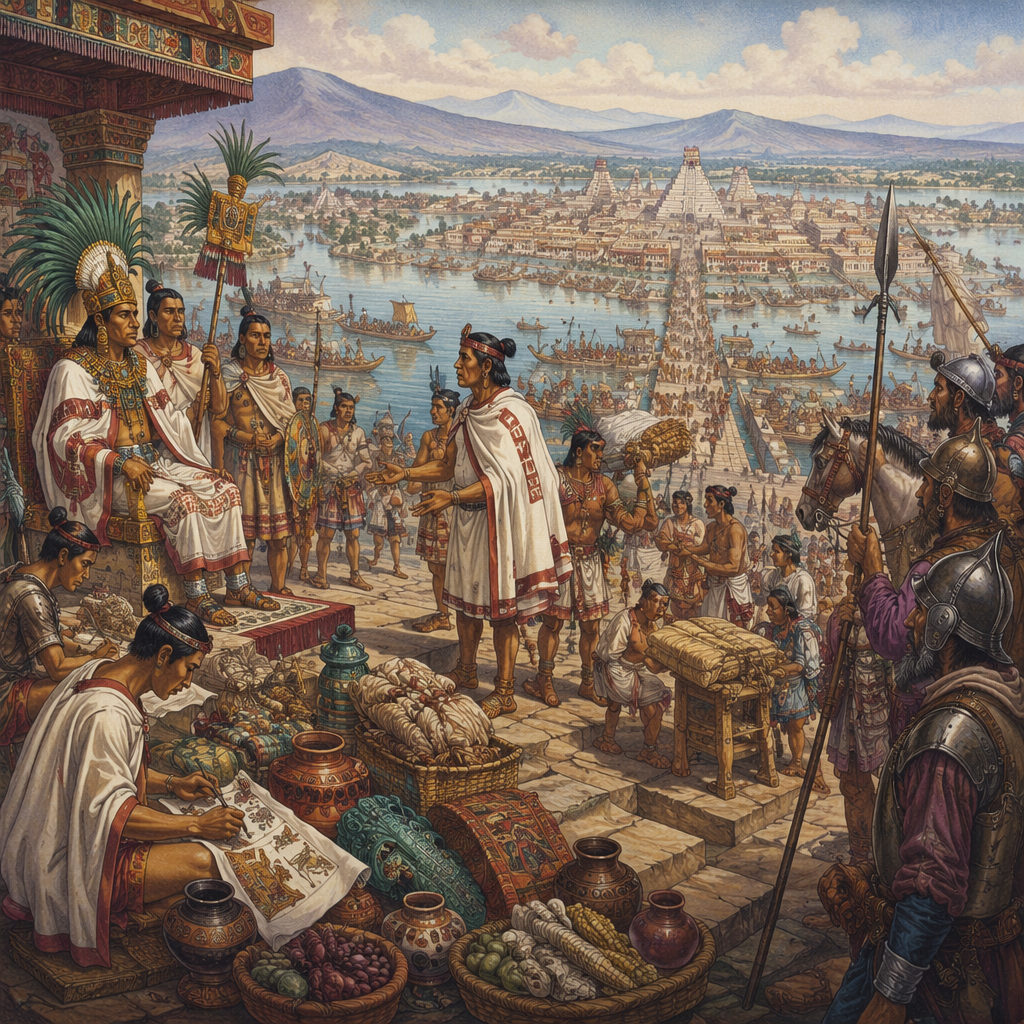
Historical Role
Moctezuma II should be read as a ruler inside a powerful but pressured imperial system, not as a passive figure waiting for conquest. The Mexica empire drew tribute, labor, goods, military service, and ritual legitimacy from many communities. That system made Tenochtitlan formidable, but it also created grievances that Spanish arrival could exploit.
The encounter with Cortes matters because it turned diplomacy into crisis. Moctezuma had to judge unknown armed outsiders, coastal reports, tributary unrest, religious interpretation, court politics, and the danger of provoking or misreading a small but disruptive force. The evidence is difficult because many narratives were written after conquest and shaped by Spanish justification, Indigenous memory, and later moral explanation.
Moctezuma's captivity and death should not become a morality tale about weakness. They reveal how quickly imperial authority can become trapped when legitimacy, violence, hostage politics, epidemic disease, and city resistance collide. The biography is strongest when it treats Moctezuma as a political actor in a collapsing field of options rather than as a symbol of fatalism.
Tenochtitlan gives the biography its scale. Causeways, canals, markets, temples, tribute stores, warrior orders, palace spaces, and ritual calendars made Mexica rule visible before Spaniards arrived. A ruler in that city had to manage not only enemies outside the empire, but nobles, priests, messengers, merchants, subject communities, and the public theater of authority at the center.
Indigenous allies and rivals are essential to the story. Tlaxcalans, Totonacs, and other communities made choices under pressure from Mexica tribute demands and Spanish violence. Cortes could not have forced the crisis into the same shape alone. Moctezuma's options were narrowed by a coalition politics that conquest narratives often hide behind a Spanish-centered drama.
The source problem deserves patient reading. Spanish accounts could turn Moctezuma into a convenient figure for explaining victory, while later Indigenous and mestizo traditions preserved grief, blame, adaptation, and memory in different ways. The biography therefore asks readers to separate what happened, what conquerors claimed, and how later communities tried to make sense of catastrophe.
Moctezuma II helps connect individual action with wider historical change in Aztec Empire. The biography works best when it keeps the surrounding world visible: authority, conflict, belief, reform, or discovery moved through decisions made under pressure.
The related events show how roles such as Aztec ruler, Imperial leader can be read through dates, places, institutions, and consequences rather than through reputation alone. The biography explains why this person matters, while the linked events explain what changed around them.
A richer reading starts with the limits around the person. Some figures acted through offices, armies, courts, laboratories, churches, parties, ships, trade networks, or protest movements; others became important because later communities turned their lives into symbols. The page therefore asks what this person could actually change, what was already moving before them, and which consequences later readers attached to the name.
Read the biography against absence as well. Many lives around Moctezuma II are less visible in the record: opponents, collaborators, family members, workers, soldiers, students, subjects, victims, translators, scribes, or local communities. Keeping those surrounding people in view makes the page less like a name card and more like an entry point into historical systems.
Moctezuma II also works as a navigation point. Open the linked event pages to see where the biography becomes chronology, then use the topic routes to test whether the same pattern appears beyond one life. That extra step matters because historical importance is rarely contained inside a single decision; it usually spreads through institutions, witnesses, opponents, imitators, and later arguments over memory.
Sources and Method
Source method: read Moctezuma through Mesoamerican source trails, the fall of the Aztec Empire, and Cortes's biography while marking the limits of conquest-era testimony. The page separates what sources claim, why they claim it, and what the broader imperial context can explain.
Evidence Notes
How Sensitive Claims Are Sourced
- 1
Mexica power and tribute pressure
The biography keeps the structure of Mexica imperial rule visible because tribute networks, subject communities, military pressure, and ritual authority shaped both strength and vulnerability.
- 2
Conquest narratives as contested evidence
Moctezuma's choices are filtered through Spanish and later Indigenous accounts, so the page treats certainty carefully and avoids turning later explanation into simple psychology.
Why This Person Matters
Moctezuma II matters because the connected events make a larger historical pattern easier to follow. The page links biography to consequences so readers can move from a life story into the wider atlas, compare the person with contemporaries, and understand why later memory kept returning to this figure. Moctezuma II matters because his reign lets readers see the fall of the Aztec Empire from inside Mexica power rather than only from the Spanish expedition. The biography connects tribute empire, urban authority, diplomacy, captivity, contested sources, and the violence of colonial memory.
How should Moctezuma be understood when the evidence is filtered through conquest narratives and the crisis involved empire, alliance, disease, and violence at once?
How to Read This Life
Moctezuma II is easiest to understand when the biography is read beside Fall of the Aztec Empire. Those events show the historical setting in motion: dates, places, institutions, conflict, and consequences give the life a structure that a short biography alone cannot provide.
The surrounding route crosses Early Modern World and locations such as Tenochtitlan. That matters because influence rarely stays inside one person. It moves through offices, armies, movements, laws, texts, speeches, institutions, and later memory.
A useful reading path starts with the role labels, then opens the event pages to see what changed, and finally compares this person with other actors facing similar pressures.
For readers who arrive on a biography first, this page is meant to become a doorway rather than a stop. Read one paragraph for the answer, then use the turning points, topic routes, and event links to test whether the person's reputation matches the wider evidence.
Read Moctezuma beside Cortes, Tenochtitlan, the fall of the Aztec Empire, Inca conquest, and Indigenous Americas routes. That path keeps state power, city life, alliance politics, and catastrophe connected.
Then compare him with Atahualpa, Constantine XI, Louis XVI, and other rulers facing systemic crisis where available. The comparison asks what leaders can still control when institutions around them begin to fracture.
Read Moctezuma II through the roles of Aztec ruler, Imperial leader rather than as reputation alone.
Place the biography inside Aztec Empire and the wider events linked below.
Ask which choices were personal and which were constrained by institutions or crisis.
Follow how later memory simplified, contested, or reused this person's role.
Ask how tribute, warfare, ritual authority, and subject communities made Mexica power both strong and vulnerable.
Notice when Spanish justification, Indigenous memory, and later interpretation shape what can be known.
Read captivity and city resistance as a collapse of options, not a simple personal failure.
Legacy, Limits, and Memory
A useful biography keeps scale in view. Moctezuma II mattered because individual choices met a wider structure: institutions, enemies, allies, audiences, technologies, beliefs, and inherited conflicts. The related event pages help separate personal agency from conditions that no single person controlled.
Memory is part of the biography too. Later readers often simplify a figure into a hero, villain, founder, reformer, conqueror, prophet, scientist, or symbol. Those labels can be helpful, but they become misleading when they hide conflict, compromise, exclusion, uncertainty, or the experiences of people outside the main biography.
For the next step, compare this life with a topic route rather than stopping at the name. If the same pattern appears across several figures, the reader has found a historical structure; if this person breaks the pattern, the contrast is usually where the most interesting question begins.
The main risk is a blame-the-victim story in which conquest becomes Moctezuma's failure. A better reading asks how Mexica imperial structure, Spanish aggression, Indigenous rivalries, and disease created a crisis no ruler could easily master.
A second risk is treating prophecy or omen language as a complete explanation. Religious interpretation mattered, but so did intelligence reports, diplomacy, military calculation, tribute politics, and city resistance.
Turning Points to Read Next
Fall of the Aztec Empire
Spanish forces and Indigenous allies captured Tenochtitlan after conflict, epidemic disease, and political fracture undermined Aztec power.
Related Timeline
- 1521 CEFall of the Aztec Empire
Spanish forces and Indigenous allies captured Tenochtitlan after conflict, epidemic disease, and political fracture undermined Aztec power.
References
Where to Check the Facts
- Encyclopaedia Britannica: Mesoamerican civilizationReference for Mesoamerican chronology, cities, religion, trade, and political systems.
- Encyclopaedia Britannica: AztecReference for Aztec political expansion, Tenochtitlan, and the Triple Alliance.