At a Glance
The shape of the event
- Date
- 1543 CE
- Place
- Europe
- Type
- Intellectual Change
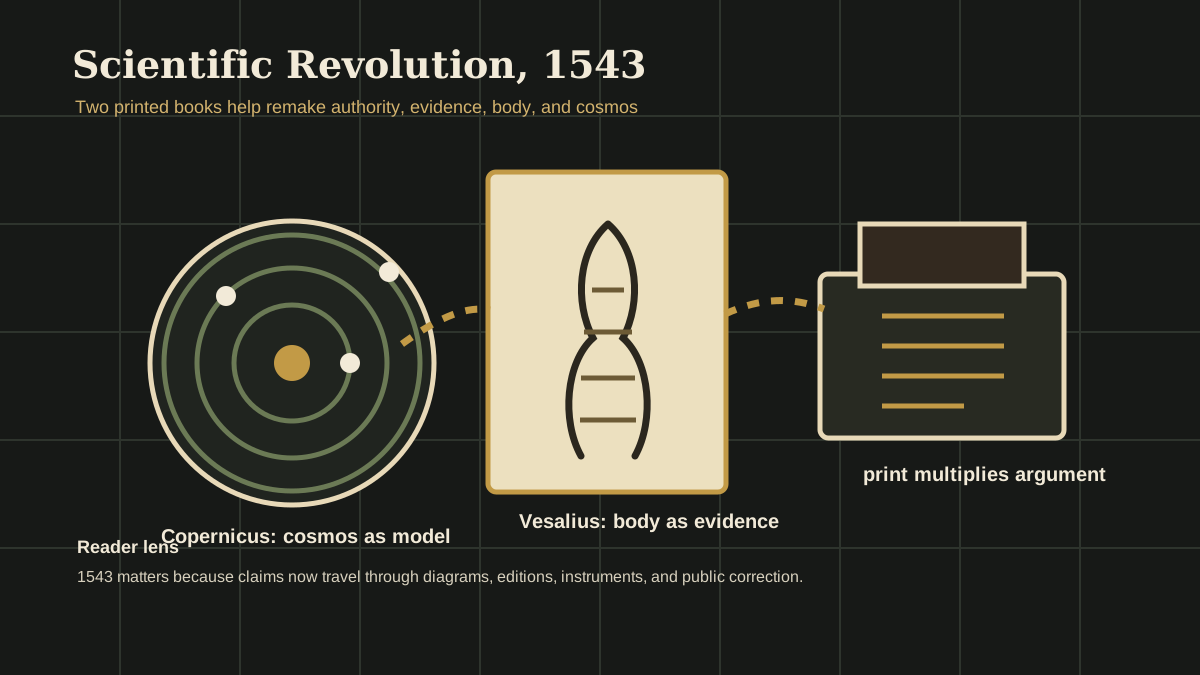
Publications by Copernicus and Vesalius helped mark a new phase in European inquiry about astronomy, anatomy, evidence, and method.
1543 CE; place the event in Europe before comparing causes or consequences.
The Scientific Revolution changed knowledge-making and later shaped technology, education, religion, and state power.
Nicolaus Copernicus / Andreas Vesalius are the first names or groups to compare before widening the story.
Older authorities were increasingly tested against observation, mathematics, experiment, and revised models.
Older authorities were increasingly tested against observation, mathematics, experiment, and revised models.
The Scientific Revolution changed knowledge-making and later shaped technology, education, religion, and state power.
Read next to Copernicus, Vesalius, Galileo, Newton's Principia, printing, navigation, and the Industrial Revolution.
Background
By the early 1500s European learned life rested on long-standing bodies of authority, routines of teaching, and inherited methods. Scholars trained in cathedral and university settings often reached back to ancient writers rather than testing claims against repeated observation. At the same time, practical pressures were growing: longer voyages, closer attention to human bodies in surgery and medicine, and broader circulation of printed books made knowledge more visible and more contestable. Instruments, calculation, and travel pushed some observers to record precise positions, measurements, and anatomical details. Those pressures did not produce a single cause; they created a climate in which new approaches could take hold. Some individuals seized those openings, while institutions adapted more slowly or resisted.
Religious and political authorities had an interest in maintaining coherent intellectual orders, and learned debates therefore carried social consequence. Historians still debate how much of the change came from decisive acts by figures like Copernicus and Vesalius versus long-term shifts in economy, communication, and institutions; both elements were in play. The year 1543 concentrates these tensions without resolving them. The year 1543 is a useful marker because Copernicus and Vesalius published works that challenged inherited ways of seeing the heavens and the body. It was not the birth of science from darkness. Medieval universities, Islamic astronomy, craft knowledge, printing, navigation, anatomy, mathematics, and patronage all mattered.
The Scientific Revolution is best understood as a long transformation in evidence, instruments, authority, and communication rather than a single European awakening. The two landmark books need to be named without making Europe intellectually isolated. Copernicus's De revolutionibus and Vesalius's Fabrica mattered because print, diagrams, calculation, dissection, patronage, universities, and instruments gave readers new ways to argue. They also drew on older classical, Islamic, and other learned traditions, so the point is not that evidence suddenly appeared in Europe, but that particular institutions made new disputes portable and cumulative.
The Turning Point
In 1543 two publications crystallized practices that pushed inquiry in new directions. Nicolaus Copernicus presented an approach to astronomy that emphasized mathematical description and the use of calculation to interpret the sky; his choice to commit ideas to print invited readers to compare models against observations. Andreas Vesalius did something parallel in medicine, foregrounding direct dissection and detailed anatomical description rather than relying solely on received texts. These were not solitary acts of genius detached from context; they were deliberate moves to privilege measurement, illustration, and repeatable procedure. The immediate change was methodological: claims once accepted because they came from ancient authorities were increasingly tested against observations, numbers, and hands-on demonstration.
That shift altered the criteria for credibility in learned conversation — from citation of ancient texts toward demonstrable fit between model and measurement. Editors, printers, and teachers then decided which illustrations, tables, and practical demonstrations would circulate; those editorial choices shaped reception. Historians debate how far the movement depended on singular publications versus gradual institutional change, but in 1543 those publications forced readers to choose methods and standards. The turning point lay in publication and method. Copernicus placed the sun near the center of mathematical astronomy, while Vesalius used dissection and visual evidence to challenge parts of Galenic anatomy. Printing allowed diagrams, tables, criticism, and replication to travel more widely.
Scholars still worked inside religious, classical, and patronage structures, but the balance between textual authority and observed evidence began to shift in visible ways.
Consequences
The immediate consequence of the 1543 publications was a change in how credibility was built in learned circles: older authorities increasingly found themselves confronted by counted observations, mathematical arguments, and experiments. Over the following decades that meant more frequent correction, emendation, and the gradual production of revised models for understanding the sky and the body. This did not produce uniform agreement; change spread unevenly across Western Europe and met intellectual and institutional resistance. In the longer run, however, the shift in method seeded broader transformations. Practices that prioritized measurement and demonstration influenced instrument-making and navigation, reshaped medical training and curricula, and entered discussions about the authority of religious and political institutions that had rested on received knowledge.
Because ways of making knowledge affect what states and churches could claim as legitimate, the Scientific Revolution contributed—over time—to new relationships between expertise, education, and governance. By changing classroom syllabuses and privileging demonstration, the new practices gradually altered who trained as a scientist or physician and what counted as professional expertise. The legacy is procedural as much as conceptual: standards of evidence and modes of argument that began to circulate in the mid-16th century still influence how modern institutions test claims. The long consequences included new astronomy, mechanics, anatomy, experimental culture, scientific societies, and changing relationships between knowledge and state power. The story also has limits.
It can become too Eurocentric if it ignores earlier and parallel knowledge traditions, or too heroic if it reduces change to a few geniuses. The event matters because it opens a route into how knowledge systems change: through books, instruments, networks, arguments, and institutions.
Interpretation Notes
The year 1543 is a marker, not a clean starting line. Copernicus's De revolutionibus and Vesalius's Fabrica mattered because print, diagrams, anatomy, instruments, and institutions changed standards of proof while drawing on older classical, Islamic, and other learned traditions.
Why Keep Reading
Read next to Copernicus, Vesalius, Galileo, Newton's Principia, printing, navigation, and the Industrial Revolution. The route treats 1543 as an entry point into changing standards of proof: books, instruments, diagrams, experiments, and institutions gradually altered how learned claims were tested and trusted.
Reading Path
Follow the story without losing the thread
Before This
After This
- Council of Trent1545-1563
- Battle of LepantoOctober 7, 1571
- Dutch East India Company Founded1602 CE
Same Period
Wider Timeline
Mind Map
How to think about Scientific Revolution Begins
Methodological shift
Publications in 1543 favored measurement, calculation, and direct observation over sole reliance on older authorities.
Map Layer
Where this event sits geographically
Gold pins mark the approximate locations of published event pages. This is a schematic locator map, not a historical border map.
Coordinates are approximate and are used to help readers orient themselves before opening a full event page.
References
Where to Check the Facts
- Science Museum: Objects and StoriesMuseum reference hub for science, technology, medicine, invention, and public understanding.
- Encyclopaedia BritannicaBackground reference for chronology, names, and historical context.
- WikidataStructured reference for dates, places, alternate names, and entity links.