Historical Role
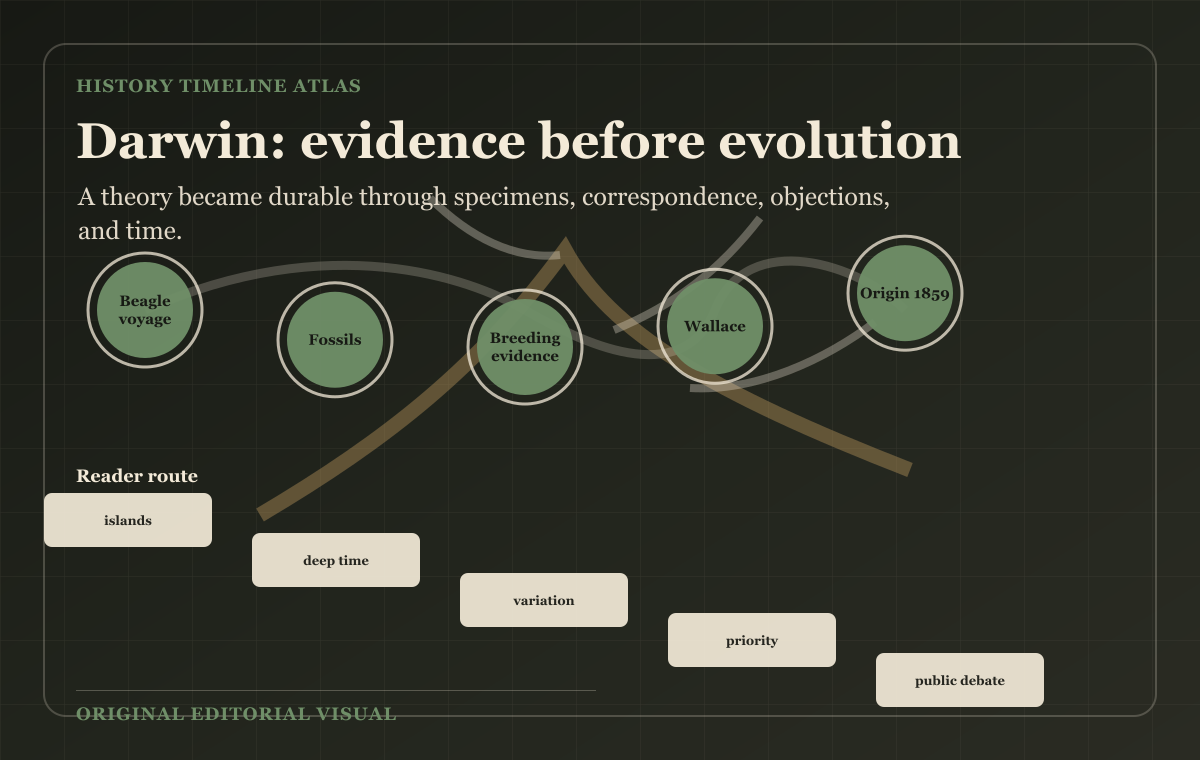
Darwin's biography is strongest when it follows evidence slowly. The Beagle voyage, Galapagos observations, fossils, barnacle study, notebooks, correspondence with breeders and naturalists, and years of delay all mattered before On the Origin of Species appeared in 1859.
Natural selection changed the question of life history. Species no longer had to be explained as fixed categories. Variation, inheritance, struggle, selection, extinction, and deep time could produce adaptation without a designer's direct intervention in each case. That shift made biology historical.
Alfred Russel Wallace also belongs in the story. Wallace's independent work pushed Darwin toward publication and reminds readers that scientific change often happens inside networks, not only inside one mind. Priority, correspondence, and presentation shaped how the theory entered public debate.
Darwin's argument landed in a Victorian world already debating geology, biblical interpretation, empire, collection, race, industry, and progress. Some readers saw a threat to religious authority; others used evolution for ideas Darwin did not control. Reception is part of the history.
A responsible page distinguishes Darwin's biological theory from later social Darwinist claims. Natural selection was repeatedly borrowed into politics, empire, race theory, and economics in ways that require separate scrutiny. The biography should not let later misuse disappear, but it should also not confuse it with the evidence Darwin assembled.
Darwin's domestic and working routines also deserve attention because they make the theory less mythical. Illness, family life, Down House experiments, pigeon breeding, plant studies, letters from collectors, and repeated revision turned observation into a long discipline. The page becomes more readable when readers can see science being assembled at a desk, in a garden, through the post, and across imperial collecting networks.
The Beagle voyage is only the opening act. Its importance lies in the way travel produced problems that Darwin kept reworking for decades: why islands carried related but distinct species, how fossils connected living forms to vanished worlds, and how small variations could matter over immense time. The biography gains momentum when those observations reappear later as arguments rather than travel memories.
Publication in 1859 also belongs to a public world of reviews, sermons, lectures, classrooms, museums, and family debates. Readers looking for Darwin's importance need to see how a scientific book moved through Victorian society, changing education and argument long after the first edition sold out.
Darwin's page can connect science to empire without making empire the only explanation. Specimens, ships, collectors, colonial stations, and global correspondence helped evidence move, while the theory itself unsettled European assumptions about fixed hierarchy and design. That tension gives the page historical texture beyond a simple discovery story.
The strongest reader path follows how Darwin handled objections. He anticipated gaps in the fossil record, difficulties with complex organs, uncertainty about inheritance, and the emotional shock of human kinship with other life. That makes the biography a page about argument under pressure: not simply having an idea, but making it durable enough to survive skeptical readers, rival theories, religious criticism, and new evidence.
Charles Darwin helps connect individual action with wider historical change in United Kingdom. The biography works best when it keeps the surrounding world visible: authority, conflict, belief, reform, or discovery moved through decisions made under pressure.
The related events show how roles such as Naturalist can be read through dates, places, institutions, and consequences rather than through reputation alone. The biography explains why this person matters, while the linked events explain what changed around them.
A richer reading starts with the limits around the person. Some figures acted through offices, armies, courts, laboratories, churches, parties, ships, trade networks, or protest movements; others became important because later communities turned their lives into symbols. The page therefore asks what this person could actually change, what was already moving before them, and which consequences later readers attached to the name.
Read the biography against absence as well. Many lives around Charles Darwin are less visible in the record: opponents, collaborators, family members, workers, soldiers, students, subjects, victims, translators, scribes, or local communities. Keeping those surrounding people in view makes the page less like a name card and more like an entry point into historical systems.
Charles Darwin also works as a navigation point. Open the linked event pages to see where the biography becomes chronology, then use the topic routes to test whether the same pattern appears beyond one life. That extra step matters because historical importance is rarely contained inside a single decision; it usually spreads through institutions, witnesses, opponents, imitators, and later arguments over memory.
Sources and Method
Source trail: the page uses Britannica, the Origin of Species event, and the science route. It separates Darwin's evidence, Wallace's parallel work, Victorian reception, and later political misuse.
Evidence Notes
How Sensitive Claims Are Sourced
- 1
Slow evidence before publication
Darwin is framed through collection, notebooks, breeding evidence, correspondence, and delay. The theory appears as accumulated argument rather than sudden inspiration.
Why This Person Matters
Charles Darwin matters because the connected events make a larger historical pattern easier to follow. The page links biography to consequences so readers can move from a life story into the wider atlas, compare the person with contemporaries, and understand why later memory kept returning to this figure. Charles Darwin matters because he changed how readers explain the history of life. His page links observation, collection, correspondence, publication, controversy, and misuse, making evolution a historical process rather than a slogan. It also shows why careful evidence can transform public imagination long after a book leaves the author's desk.
For students, the route is especially useful because it separates discovery from reception: the evidence for natural selection, the shock of public debate, and the later ideological borrowing are related but not identical stories.
How did Darwin turn scattered observations from travel, breeding, fossils, and correspondence into an argument strong enough to reorder biology?
How to Read This Life
Charles Darwin is easiest to understand when the biography is read beside Darwin Publishes On the Origin of Species. Those events show the historical setting in motion: dates, places, institutions, conflict, and consequences give the life a structure that a short biography alone cannot provide.
The surrounding route crosses Nineteenth Century and locations such as London. That matters because influence rarely stays inside one person. It moves through offices, armies, movements, laws, texts, speeches, institutions, and later memory.
A useful reading path starts with the role labels, then opens the event pages to see what changed, and finally compares this person with other actors facing similar pressures.
For readers who arrive on a biography first, this page is meant to become a doorway rather than a stop. Read one paragraph for the answer, then use the turning points, topic routes, and event links to test whether the person's reputation matches the wider evidence.
Read Darwin beside On the Origin of Species, Newton, the Scientific Revolution, imperial collecting, Victorian religion, and modern biology routes. That path turns a famous book into a wider story about evidence, publication, reception, and public argument.
Then compare Darwin with Wallace and Newton. Wallace keeps networks and priority visible; Newton helps readers contrast mathematical law with historical explanation through population, variation, inheritance, selection, extinction, and deep time.
Read Charles Darwin through the roles of Naturalist rather than as reputation alone.
Place the biography inside United Kingdom and the wider events linked below.
Ask which choices were personal and which were constrained by institutions or crisis.
Follow how later memory simplified, contested, or reused this person's role.
Track specimens, fossils, breeding, notebooks, and correspondence before reading the theory.
Ask why long timescales made gradual natural change imaginable.
Separate biological evolution from later political uses of evolutionary language.
Legacy, Limits, and Memory
A useful biography keeps scale in view. Charles Darwin mattered because individual choices met a wider structure: institutions, enemies, allies, audiences, technologies, beliefs, and inherited conflicts. The related event pages help separate personal agency from conditions that no single person controlled.
Memory is part of the biography too. Later readers often simplify a figure into a hero, villain, founder, reformer, conqueror, prophet, scientist, or symbol. Those labels can be helpful, but they become misleading when they hide conflict, compromise, exclusion, uncertainty, or the experiences of people outside the main biography.
For the next step, compare this life with a topic route rather than stopping at the name. If the same pattern appears across several figures, the reader has found a historical structure; if this person breaks the pattern, the contrast is usually where the most interesting question begins.
Darwin's page should keep awe and caution together. The theory transformed biology, but its public afterlife also shows how scientific language can be stretched into ideological claims.
The reading path from Darwin to Newton helps readers compare two forms of scientific revolution: one mathematical and law-like, the other historical, evidentiary, and population-based.
The biography should also keep patience visible. Darwin's importance rests partly on the discipline of waiting, revising, testing objections, and letting evidence accumulate before making a public claim.
Darwin also works as a page about evidence ethics: careful comparison, acknowledgment of rival claims, and attention to objections made the argument more durable than a dramatic announcement would have been.
Turning Points to Read Next
Darwin Publishes On the Origin of Species
Charles Darwin published On the Origin of Species, arguing for evolution by natural selection and reshaping biology.
Related Timeline
- 1859 CEDarwin Publishes On the Origin of Species
Charles Darwin published On the Origin of Species, arguing for evolution by natural selection and reshaping biology.
References
Where to Check the Facts
- Encyclopaedia Britannica: Charles DarwinBiographical reference for Charles Darwin's life dates, roles, institutions, and historical setting.
- Encyclopaedia BritannicaBackground reference for chronology, names, and historical context.
- WikidataStructured reference for dates, places, alternate names, and entity links.