At a Glance
The shape of the event
- Date
- October 4, 1957
- Place
- Baikonur Cosmodrome
- Type
- Space Launch
The Soviet Union launched Sputnik 1, the first artificial satellite, surprising the world and intensifying competition over science, education, and military technology.
October 4, 1957; place the event in Baikonur Cosmodrome before comparing causes or consequences.
The launch accelerated the Space Race, changed U.S. science policy, and made space a visible arena of Cold War rivalry.
Soviet space program are the first names or groups to compare before widening the story.
Sputnik orbited Earth and demonstrated Soviet capability in rocketry and space technology.
Sputnik orbited Earth and demonstrated Soviet capability in rocketry and space technology.
The launch accelerated the Space Race, changed U.S. science policy, and made space a visible arena of Cold War rivalry.
Follow the subsequent launches and policy reactions to see how a brief, visible event created a cascade of institutional changes.
Background
By 1957 the Cold War had long moved beyond isolated crises into a competition over scientific prestige, technological mastery, and strategic advantage. The Soviet space program, operating within a centralized political system that prioritized high-profile technological successes, had invested years in rocketry and payload testing. At the same time, Western governments watched developments in missile technology as both a military challenge and a symbol of educational and industrial strength. Science and engineering capacity were now public policy concerns: who educated engineers, who funded laboratories, who coordinated research all mattered. But explanations for Sputnik 1’s emergence are contested.
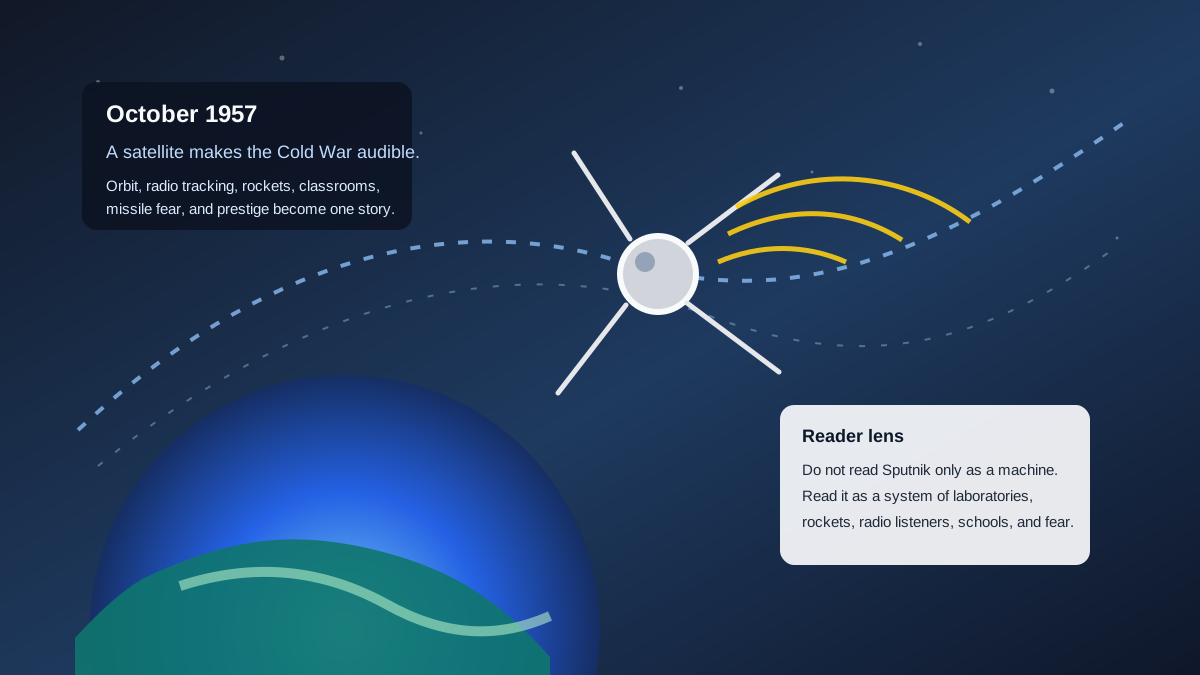
Some historians emphasize the decisions of engineers and political leaders who chose to demonstrate capability; others locate the launch in broader structural pressures — resource allocation, military doctrine, institutional incentives — that made such a demonstration both possible and likely. This page does not settle that debate; it describes the pressures and choices that converged in Baikonur on that autumn day. Sputnik is stronger as a page about systems than as a single satellite. The small beeping sphere depended on Soviet rocketry, military research, radio tracking, engineering institutions, and Cold War rivalry over prestige. Its orbit also made the sky political: people could hear a signal passing above them and imagine both scientific achievement and missile vulnerability. The U. S.
reaction matters because surprise turned into institution-building. Public anxiety, school debates, defense planning, and congressional funding helped produce NASA, stronger science education, and a wider language of technological competition. Sputnik did not by itself create the space race, but it made the race visible to ordinary listeners.
The Turning Point
The launch itself redirected attention and recalibrated priorities in a single concrete act. At Baikonur Cosmodrome, the Soviet space program completed preparations and placed Sputnik 1 on an orbital trajectory: a technical sequence that converted years of testing and organizational effort into a visible result. That choice — to place a small, unmistakable satellite into orbit and to broadcast its signal — transformed a laboratory achievement into a public demonstration. The immediate change was tangible: the satellite orbited Earth and produced an audible sign that could be confirmed by radio listeners worldwide, turning abstract claims about rocketry into verifiable fact. Politically, the launch shifted dialogues from hypothetical future capabilities to present realities.
Military planners, education officials, and politicians in other countries reacted to a demonstrable ability to deliver payloads into space. The actors involved ranged from engineers and program managers making technical decisions, to political leaders who chose to prioritize and publicize a successful launch. The moment crystallized a transition from secret program to global spectacle, making space an explicit field of competition rather than a distant frontier. The turning point was the conversion of orbital success into geopolitical proof. A satellite became evidence that rockets, laboratories, schools, and state planning could compete for global legitimacy in the Cold War.
Consequences
The immediate consequence of Sputnik 1 was to accelerate competition in multiple arenas. In the near term, governments treated the launch as evidence that rocket technology had crossed a threshold with military and strategic implications, prompting reviews of defense posture and investments in missile detection and response. In education and science policy, the launch prompted urgent calls in some countries to expand training, research funding, and coordination of scientific institutions. Over the longer term, Sputnik 1 helped reframe space as a visible arena of the Cold War rather than a peripheral technical curiosity: orbital capability became linked to national prestige, military reach, and technological modernity.
This reframing produced concrete institutions and programs — from expanded national research laboratories to dedicated space agencies and new funding patterns for science and engineering education — although the timing and shape of those responses varied across states. Interpretations remain contested: some emphasize decisive individual choices that seized a political moment; others emphasize structural forces — competition, resource flows, and institutional incentives — that made such a demonstration likely. What is clear is that a single satellite altered public expectations and policy conversations about technology, security, and education for decades to come. Its consequences ran through the International Geophysical Year, lunar ambitions, surveillance satellites, missile debates, and education policy.
The event belongs with Apollo, ARPANET, nuclear strategy, and decolonizing nations watching superpowers promise futures from above.
Interpretation Notes
Sputnik is debated as both scientific achievement and military warning. The satellite's radio signal was small, but it made Soviet rocketry, missile anxiety, education policy, prestige politics, and public faith in technology visible across the Cold War world.
Why Keep Reading
Follow the subsequent launches and policy reactions to see how a brief, visible event created a cascade of institutional changes. Read on to trace how governments translated the shock of Sputnik into programs, budgets, and new organizations, and to compare different national responses. Understanding the steps that followed — from accelerated testing schedules to shifts in school curricula — reveals whether the Sputnik moment was an isolated shock or a catalyst that reorganized priorities across science and security. Read Sputnik before Apollo 11, the Cuban Missile Crisis, and the Cold War timeline to see how science, fear, prestige, and military technology became one public story.
Reading Path
Follow the story without losing the thread
Before This
- Suez Crisis1956 CE
- Hungarian RevolutionOctober-November 1956
- Warsaw Pact FoundedMay 1955
After This
- Cuban Revolution Triumphs1959
- Congo Independence and Crisis1960 CE
- Berlin Wall BuiltAugust 1961
Same Period
- Cuban Missile CrisisOctober 1962
- Apollo 11 Moon LandingJuly 20, 1969
- Fall of the Berlin WallNovember 9, 1989
Wider Timeline
Mind Map
How to think about Sputnik 1 Launched
institutional pressure
Centralized funding and political appetite for high‑visibility technological success encouraged rapid development of rocketry programs.
Map Layer
Where this event sits geographically
Gold pins mark the approximate locations of published event pages. This is a schematic locator map, not a historical border map.
Coordinates are approximate and are used to help readers orient themselves before opening a full event page.
References
Where to Check the Facts
- U.S. National Archives: The Cold WarArchive reference hub for Cold War records, federal documentation, and research guidance.
- Office of the Historian: The Early Cold War, 1945-1952Official diplomatic history reference for early Cold War foreign-policy context.
- Science Museum: Objects and StoriesMuseum reference hub for science, technology, medicine, invention, and public understanding.
- NASA: Apollo 11Official NASA reference for Apollo 11, the lunar landing objective, crewed mission, and space-race context.