At a Glance
The shape of the event
- Date
- 1959
- Place
- Havana
- Type
- Revolution
Cuban revolutionaries overthrew Fulgencio Batista, creating a revolutionary government that soon became central to Cold War politics.
1959; place the event in Havana before comparing causes or consequences.
The event reshaped Latin American revolutionary imagination and Cold War strategy.
Fidel Castro / Cuban revolutionaries are the first names or groups to compare before widening the story.
Cuba moved toward socialist alignment and long confrontation with the United States.
Cuba moved toward socialist alignment and long confrontation with the United States.
The event reshaped Latin American revolutionary imagination and Cold War strategy.
Follow the subsequent threads to understand how a city takeover came to matter to presidents, diplomats, and activists around the world.
Background
By 1959, Cuba’s future had been subject to intense domestic and international scrutiny. The island’s politics, economy, and social life were entwined with regional interests and worldwide tensions that historians now place in the sweep of Cold War rivalry. Against that background, a group of armed and political actors mobilized to overthrow the existing regime; their success did not arrive in a vacuum but followed years of organized opposition, public grievance, and international attention. Interpretations of Cuban Revolution Triumphs depend on whose evidence is centered: rulers and official records, affected communities, oral memory, archaeology, law, diplomacy, labor, and later public memory do not always tell the same story.
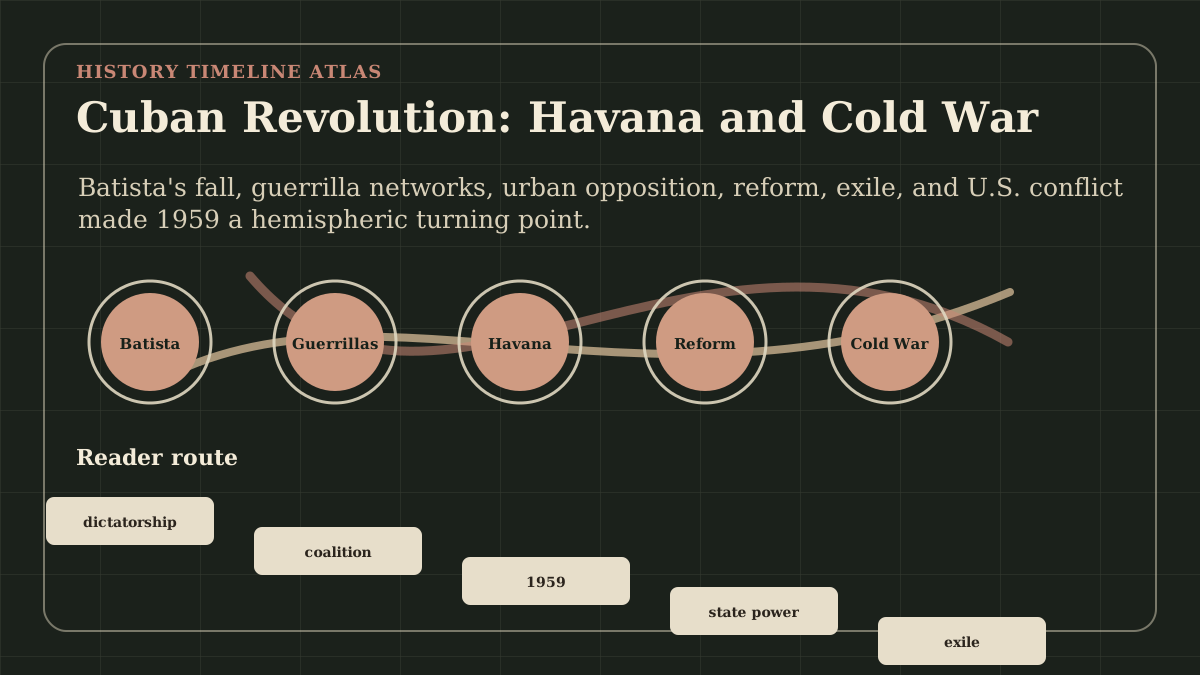
The uprising must therefore be read as both an internal seizure of power in Havana and as an event immediately legible to capitals in the Caribbean, the Americas, and beyond. The Cuban Revolution is often remembered through a few iconic images, but the page is richer when it begins with Batista's state. The dictatorship depended on army loyalty, police violence, patronage, inequality, U. S. -linked economic power, and the exhaustion of constitutional politics. Opposition came from more than one place: guerrillas in the Sierra Maestra, urban underground networks, students, labor activists, professionals, and ordinary Cubans who wanted an end to corruption and repression. That broad anti-Batista coalition matters because 1959 was not yet a finished ideological script.
Many supporters expected democracy, reform, accountability, or national dignity rather than a predetermined Cold War alignment. The revolution's later direction emerged through conflict over land, property, political power, U. S. pressure, internal dissent, exile, and the consolidation of a new state. Reading the event only backward from the missile crisis makes the revolutionary moment look simpler than it was. Havana also needs to stay on the map. Batista's departure, rebel entry, crowds, trials, newspapers, radio, and public ceremonies turned military victory into political legitimacy. The capital did not merely receive events from the mountains. It helped stage the meaning of the revolution for Cuba, Latin America, Washington, and a world already organizing events through Cold War categories.
The Turning Point
The decisive change in 1959 was concrete and immediate: Cuban revolutionaries seized control of Havana and dismantled the authority of Fulgencio Batista, replacing it with a revolutionary government that presented itself as an alternative political order. Fidel Castro emerged as a principal figure among those revolutionaries, and the new leadership confronted urgent choices about governance, foreign relations, and economic direction. Those choices—about alliance, ideology, and policy direction—were not predetermined; they were made in the pressure of state collapse, popular expectation, and international scrutiny. Within months the revolution’s leaders signaled a new trajectory that observers interpreted as moving Cuba toward socialist alignment.
That interpretation, and the actual decisions behind it, transformed a domestic change of government into a turning point that would draw sustained attention from the United States and other global powers and reframe Cuba’s role in the Cold War. The turning point came when Batista's regime lost the ability to present itself as durable. Military setbacks, defections, economic disruption, public opposition, and the symbolic momentum of the rebels combined until flight became more plausible than control. The rebel victory then opened a second struggle: who would define the revolution's aims, institutions, enemies, and limits? This second struggle is why the event belongs in both a revolution timeline and a Cold War timeline. Land reform and sovereignty claims collided with U.
S. property interests and anti-communist policy. Domestic transformation and international confrontation fed each other, turning a national revolution into a hemispheric crisis.
Consequences
In the near term, the overthrow produced a revolutionary government that reconfigured political power in Havana and began to re-orient Cuba’s external relationships. In the longer run, the event pushed the island toward socialist alignment and set the stage for a prolonged confrontation with the United States; it also made Cuba an emblematic actor in Cold War strategy. Regionally, the revolution became a touchstone for activists and movements who saw in Cuba a model—or a warning—for political change across Latin America. These consequences were uneven and contested: different communities experienced and recorded the aftermath in contrasting terms, and international actors translated Havana’s choices into policies of engagement, containment, or hostility.
Over decades this single moment produced legal disputes, diplomatic crises, cultural initiatives, and competing public memories. Historians and participants continue to weigh what happened then against the evidence of archives, testimony, material remains, and law. The immediate consequences included a new revolutionary government, trials of Batista officials, land reform, political mobilization, expanding conflict with the United States, and the growth of exile politics. Those changes did not unfold as one neat sequence. They overlapped, producing hope, fear, participation, repression, and departure at the same time. The longer consequences reached far beyond Cuba. The Bay of Pigs, the Cuban Missile Crisis, Latin American guerrilla movements, U. S.
containment policy, Soviet alliance, embargo politics, and debates over health, education, authoritarianism, and sovereignty all draw meaning from 1959. The revolution therefore functions as a hub page: it connects dictatorship, decolonization, social reform, Cold War intervention, and contested memory.
Interpretation Notes
Interpretations of Cuban Revolution Triumphs depend on whose evidence is centered: rulers and official records, affected communities, oral memory, archaeology, law, diplomacy, labor, and later public memory do not always tell the same story.
Why Keep Reading
Follow the subsequent threads to understand how a city takeover came to matter to presidents, diplomats, and activists around the world. Tracking the revolution’s aftermath reveals how decisions by Cuban revolutionaries reshaped hemispheric strategy, provoked sustained U. S. attention, and inspired political movements across Latin America. It also opens a methodological question: comparing archival records, oral memory, and public commemoration teaches readers how the same event can produce multiple, sometimes conflicting, histories. Reading the next chapters helps you see not just what changed in 1959, but how that change was recorded, opposed, and remembered. Read the Cuban Revolution before the Bay of Pigs and the Cuban Missile Crisis, then connect it backward to Guatemalan reform and forward to Sandinista Nicaragua.
That route shows how Latin American sovereignty, U. S. power, revolution, and counterrevolution became one of the Cold War's most emotionally charged storylines.
Reading Path
Follow the story without losing the thread
Before This
- Sputnik 1 LaunchedOctober 4, 1957
- Suez Crisis1956 CE
- Hungarian RevolutionOctober-November 1956
After This
- Congo Independence and Crisis1960 CE
- Berlin Wall BuiltAugust 1961
- Bay of Pigs InvasionApril 17-20, 1961
Same Period
- Guatemalan Coup1954
- Chilean Coup1973
- Sandinista Revolution1979
Wider Timeline
Mind Map
How to think about Cuban Revolution Triumphs
Contested rule
Opposition to the government of Fulgencio Batista culminated in 1959 when Cuban revolutionaries overthrew his regime in Havana.
Map Layer
Where this event sits geographically
Gold pins mark the approximate locations of published event pages. This is a schematic locator map, not a historical border map.
Coordinates are approximate and are used to help readers orient themselves before opening a full event page.
References
Where to Check the Facts
- Encyclopaedia Britannica: Cuban RevolutionReference for the Cuban Revolution, Batista's overthrow, revolutionary government, and Cold War significance.
- Encyclopaedia Britannica: Fidel CastroBiographical reference for Castro's revolutionary leadership, Cuban government, and Cold War role.
- U.S. National Archives: The Cold WarArchive reference hub for Cold War records, federal documentation, and research guidance.
- Office of the Historian: The Early Cold War, 1945-1952Official diplomatic history reference for early Cold War foreign-policy context.