At a Glance
The shape of the event
- Date
- December 1991
- Place
- Moscow
- Type
- State Collapse
The Soviet Union formally dissolved after political reform, economic strain, nationalist movements, and failed attempts to preserve central authority.
December 1991; place the event in Moscow before comparing causes or consequences.
The collapse ended the Cold War order and left lasting questions over borders, security, markets, and identity.
Mikhail Gorbachev / Boris Yeltsin are the first names or groups to compare before widening the story.
Fifteen independent states emerged from the former Soviet Union.
Fifteen independent states emerged from the former Soviet Union.
The collapse ended the Cold War order and left lasting questions over borders, security, markets, and identity.
Follow the people and institutions that tried to hold the Soviet project together, and you will find the immediate dramas that shaped the post-Soviet world: political biographies of key figures, the unraveling of cent...
Background
Throughout the late twentieth century the Soviet Union faced pressures that built on one another rather than converged in a single cause. Political reform at the centre introduced new expectations of openness and accountability; at the same time economic performance lagged, producing shortages and eroding confidence in the system’s capacity to provide. Across the union republics, nationalist movements that had long existed in different forms found new voice and organization, pressing for autonomy or independence. Internationally, the Cold War framework that had defined rival blocs for decades was changing, reshaping alliances and economic possibilities.
Leaders in Moscow attempted a range of responses—institutional reforms, experiments in political pluralism, and efforts to retain a common centre—but those measures interacted with local dynamics in ways that sometimes accelerated disintegration. Historians and commentators have since debated emphasis: were recent decisions by prominent leaders decisive, or were they the culmination of deeper structural trends? This page does not settle that debate; it lays out the pressures on politics, economy and identity that together made dissolution a plausible outcome by December 1991. The dissolution of the Soviet Union should not read as one dramatic resignation speech.
It was the end of a union state under pressure from economic stagnation, political reform, shortages, public argument, republic sovereignty movements, elite bargaining, military uncertainty, and a failed attempt by hardliners to stop the process. Gorbachev's reforms opened space for criticism and competition, but they also weakened the party's ability to impose a single answer. Baltic independence movements, nationalist mobilization in several republics, debates over a new union treaty, and the rivalry between Soviet and Russian institutions turned constitutional language into a struggle over who held authority. The human scale matters. Readers should see queues, savings, workplaces, soldiers, pensioners, border communities, families spread across republic lines, nuclear personnel, and people who woke up inside new states without moving home.
The end of the Cold War was also a change in passports, currencies, property, archives, armies, and memory.
The Turning Point
What changed in December 1991 was the formal recognition that the Soviet state no longer operated as a single sovereign entity. In Moscow, political actors confronted the practical limits of preserving centralized authority in the face of republic-level assertions of independence and a public weary of economic uncertainty. Mikhail Gorbachev, who had presided over political reforms earlier in the decade, faced the collapse of the institutional framework he had tried to reinvent; Boris Yeltsin emerged as a decisive voice in the Russian republic whose choices shifted balances of power. Rather than one decisive battle or one moment of violence, the dissolution unfolded through a series of negotiated retreats, declarations, and political accommodations that acknowledged new realities on the ground.
Attempts to devise a constitutional or political arrangement that would preserve a common state failed to bind enough of the republics or their leaders. By the end of that month the legal and political machinery of Soviet authority had been superseded by agreements and recognitions among the constituent republics and their leaders. The change was as much administrative and diplomatic as it was symbolic: where a single legal order had once asserted primacy, multiple sovereign authorities now claimed the right to govern territory, people and resources. That transition reframed what was possible for regional security, economic exchange and the identities of millions. The turning point was the August 1991 coup attempt and its failure.
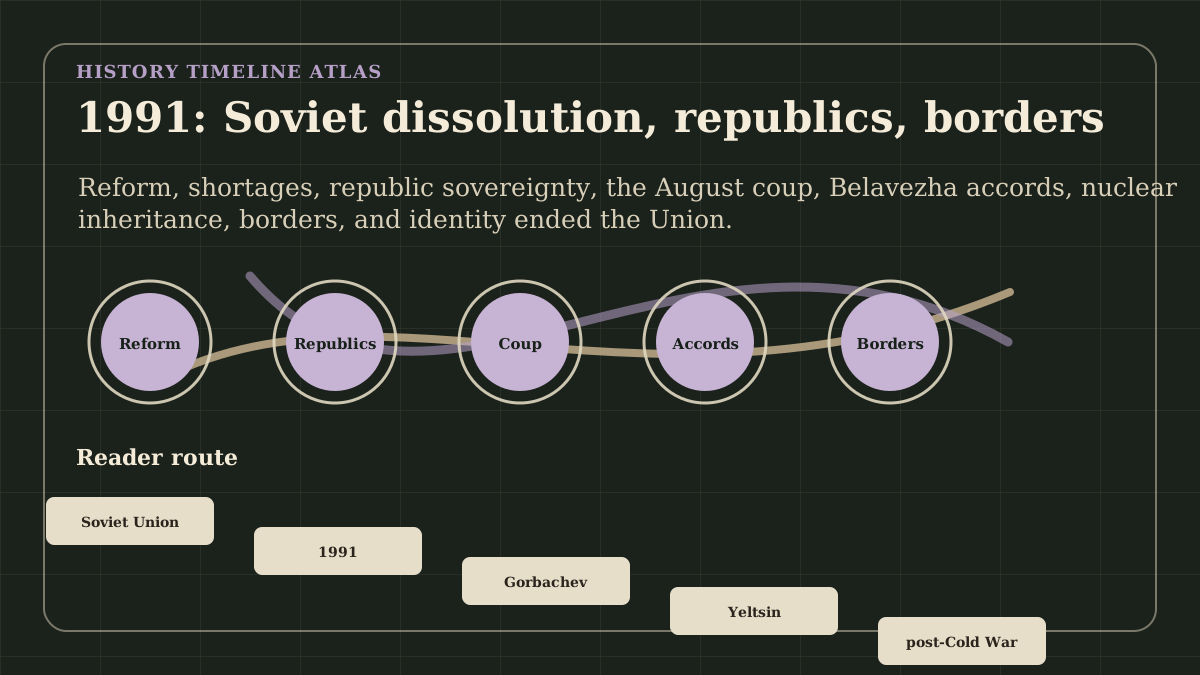
The coup showed that hardline restoration could not simply rewind reform, while Yeltsin's resistance and the weakening of central authority accelerated the shift of power toward the Russian republic and other republican governments. A second turning point came with the Belavezha agreements and the creation of the Commonwealth of Independent States. The Soviet Union ended through documents, declarations, and institutional transfer, not through one battlefield defeat, which is why the legal sequence matters as much as the symbolism.
Consequences
The near-term consequence was unmistakable: fifteen independent states emerged from the territory that had been the Soviet Union. That reconfiguration altered maps, citizenship, international recognition and governance almost overnight. In practical terms it meant new borders, newly sovereign institutions, and the scramble to convert centrally administered systems—pensions, trade networks, military structures—into national arrangements. Diplomacies shifted as emerging states sought recognition and new alignments; the international order that had been structured around Cold War blocs was transformed. Longer-term consequences have proven uneven and contested. Economies adapted at different speeds: some moved quickly toward market institutions, others retained substantial state roles; some communities experienced social dislocation and contested property claims. Security questions persisted where borders and minority populations left ambiguous claims.
The collapse also prompted an intense negotiation of identity—how people named themselves and their loyalties in post-Soviet space. Across these outcomes historians and policymakers continue to debate the balance of responsibility between particular leaders’ decisions and systemic strains that preceded them. That unresolved debate matters because it shapes how countries remember the past and plan for the future, and because it influences contemporary disputes over borders, markets, and security arrangements that trace their roots to 1991. The immediate consequence was the emergence of fifteen independent states and the transfer of institutions, borders, military assets, debts, diplomatic seats, and nuclear responsibilities into a new post-Soviet landscape. Independence did not make every problem new; it reorganized older tensions under new flags.
The longer consequence was a reshaped world order. NATO, the European Union, Russia, Ukraine, the Baltic states, Central Asia, the Caucasus, arms control, energy politics, market reform, oligarchic wealth, and memory of empire all became part of the dissolution's afterlife.
Interpretation Notes
The hardest question around Dissolution of the Soviet Union is causation. The event had immediate actors, but its meaning also came from institutions, geography, resources, and expectations already present in Eastern Europe.
Why Keep Reading
Follow the people and institutions that tried to hold the Soviet project together, and you will find the immediate dramas that shaped the post-Soviet world: political biographies of key figures, the unraveling of centrally planned markets, and the emergence of new diplomatic realities. Reading on will show how local choices in constituent republics met with policies from Moscow; how new states handled citizenship and property; and how the international system adapted to the end of the Cold War order. If you want to understand why some borders remained contested or why economic transitions followed different trajectories, the next pages—on leadership decisions, republican declarations, and the first years of independence—explain the concrete, often messy steps that followed December 1991.
Read this page after the Berlin Wall and German reunification, then continue to post-Soviet states, NATO expansion, Ukraine, Central Asia, and contemporary geopolitics. That route shows why 1991 was both an ending and the beginning of unresolved border, security, and identity questions.
Reading Path
Follow the story without losing the thread
Before This
- German ReunificationOctober 3, 1990
- Nelson Mandela ReleasedFebruary 11, 1990
- Fall of the Berlin WallNovember 9, 1989
After This
- Oslo Accords1993 CE
- Fall of Apartheid1994
Same Period
- German ReunificationOctober 3, 1990
- Nelson Mandela ReleasedFebruary 11, 1990
- Fall of Apartheid1994
Wider Timeline
Mind Map
How to think about Dissolution of the Soviet Union
economic strain
Chronic shortages and fiscal pressures that weakened central capacity to govern effectively
Map Layer
Where this event sits geographically
Gold pins mark the approximate locations of published event pages. This is a schematic locator map, not a historical border map.
Coordinates are approximate and are used to help readers orient themselves before opening a full event page.
References
Where to Check the Facts
- U.S. National Archives: The Cold WarArchive reference hub for Cold War records, federal documentation, and research guidance.
- Office of the Historian: The Early Cold War, 1945-1952Official diplomatic history reference for early Cold War foreign-policy context.