At a Glance
The shape of the event
- Date
- October 3, 1990
- Place
- Berlin
- Type
- State Unification
East and West Germany reunified less than a year after the Berlin Wall opened, turning Cold War collapse into a new European political reality.
October 3, 1990; place the event in Berlin before comparing causes or consequences.
Reunification reshaped Europe, raised questions about memory and economic integration, and symbolized the Cold War's end.
Helmut Kohl / Mikhail Gorbachev are the first names or groups to compare before widening the story.
Germany became one state again within NATO and the European political order.
Germany became one state again within NATO and the European political order.
Reunification reshaped Europe, raised questions about memory and economic integration, and symbolized the Cold War's end.
If you want to understand how a sudden collapse of a political barrier translated into a lasting constitutional change, follow the related timelines on diplomatic negotiation, economic integration and memory politics.
Background
The late 1980s transformed a continent that had grown used to frozen lines. Economic strains, political dissent inside East Germany, and reforms in the Soviet Union created a climate in which barriers that once felt permanent suddenly did not. The opening of the Berlin Wall became the most visible signal that the Cold War order was unraveling; it also accelerated questions about sovereignty, identity and security. West Germany offered a constitutional and economic model that many East Germans found attractive; at the same time, their daily survival and civic protests pushed events forward. Internationally, leaders watched closely: any change in Germany’s status would ripple through alliances and the European political order.
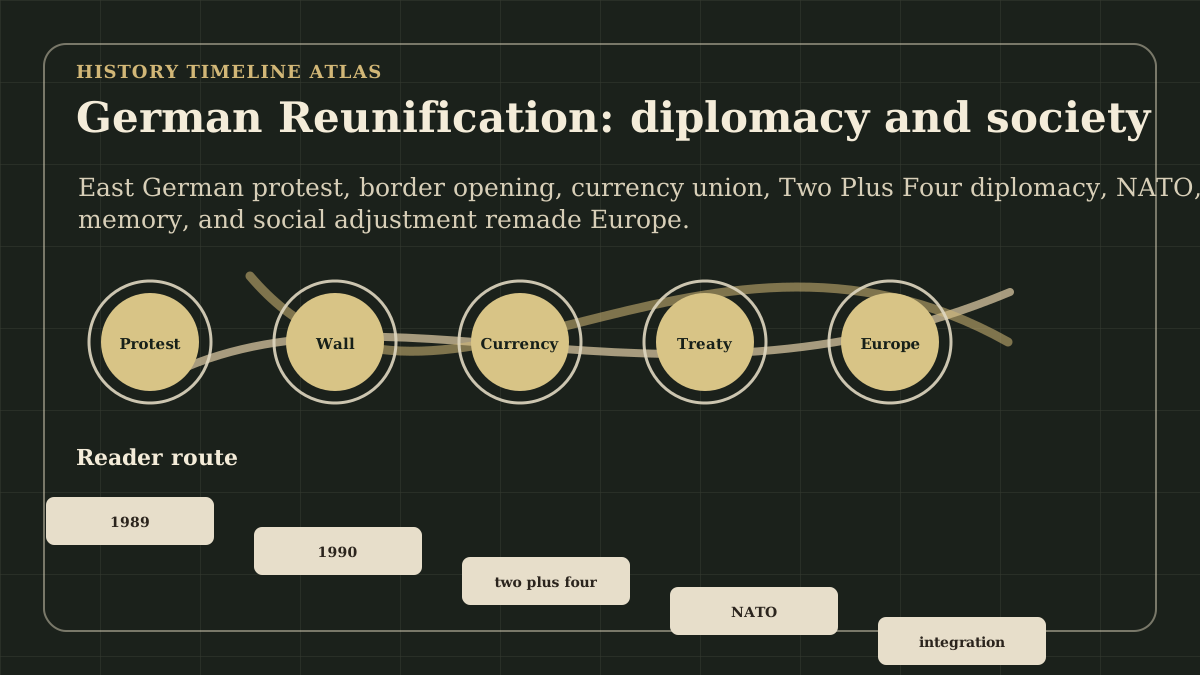
Interpretations differ about emphasis — whether the decisive force was mass public mobilization, a chain of elite decisions, or deeper structural shifts in the Soviet bloc — and this account presents those pressures alongside one another rather than insisting on a single cause. German reunification should not be reduced to a happy ending after the Berlin Wall fell. The Wall's opening created possibility, but reunification required East German protest, collapsing Socialist Unity Party authority, West German political strategy, currency choices, Soviet consent, Allied legal rights, European reassurance, and public debate over what unity would mean in daily life. The page needs both diplomacy and society. Two Plus Four negotiations addressed borders, NATO, sovereignty, troops, and international recognition.
Meanwhile people faced currency conversion, factory closures, property claims, migration, school and legal changes, unemployment, new parties, and arguments over memory. Reunification was a diplomatic settlement and a social transformation happening at once. European context matters because Germany's neighbors had historical reasons to care. Polish border recognition, French and British caution, U. S. support, Soviet bargaining, and European integration all shaped the terms. The event therefore belongs not only to German national history but also to the making of the post-Cold War order.
The Turning Point
The decisive months before 3 October 1990 combined rapid political choices with broader structural collapse. East–West movement and public demonstrations had set the stage, but state-level decisions turned possibility into policy. Helmut Kohl, as West Germany’s leader, pushed for fast unification under the West German constitution; his political calculations and offers of integration framed the available options. At the same time, Mikhail Gorbachev’s Soviet leadership was preoccupied with domestic reform and reluctant to reassert former controls, which reduced the likelihood of military intervention and made accommodation more feasible. Diplomacy and negotiation among German politicians and international partners converted a popular uprising and the fall of barriers into the legal act of unification.
Yet the moment was not a single, inevitable stroke: it depended on choices about timing, legal mechanisms and international acceptance. By 3 October 1990 those choices converged so that a reunited Germany emerged as a single state within NATO and the broader European political order — a result that both settled questions and raised new ones about who had shaped history: leaders, publics, or structural transformation. The turning point was the move from open borders to a negotiated state settlement. Once people could cross freely, the political question changed from whether the GDR could reform itself to whether and how the two German states would join. Elections, currency union, and treaty negotiations made that shift concrete.
Two Plus Four diplomacy was decisive because it connected German unity to European security. The settlement made reunification acceptable to the former occupying powers and Germany's neighbors by addressing sovereignty, borders, alliance membership, and troop arrangements.
Consequences
In the near term, reunification altered governance, security and economic arrangements. Germany’s institutions expanded to encompass new territories and citizens, and the country’s foreign alignments — including membership within NATO and participation in European political structures — carried immediate diplomatic weight across the continent. Economically, integrating two very different systems produced difficult trade-offs: investment, job shifts and regional disparities demanded years of policy attention. Culturally and politically, reunification prompted urgent debates about memory — how to remember the Cold War, how to incorporate different life experiences into a single national narrative — and about who would benefit from the new order. Over the longer term, the event reshaped European geopolitics and symbolized the end of Cold War binaries.
It also left unresolved tensions: questions about economic convergence, regional identity and how to interpret the recent past persisted, creating political currents in the decades that followed. Scholars and citizens continue to argue over how much of the outcome reflected the will of leaders like Kohl or the permissive international circumstances created by Soviet policy under Gorbachev, and those debates shape how reunification is taught and remembered. The immediate consequence was the end of the German Democratic Republic and the incorporation of its territory into a unified Federal Republic. The longer consequences included economic restructuring, regional inequality, new memory debates, and Germany's strengthened role inside Europe. Reunification also became a model and a warning.
It showed that Cold War borders could change peacefully through protest, elections, diplomacy, and consent. It also showed that political unity does not instantly solve social, economic, and psychological division.
Interpretation Notes
The hardest question around German Reunification is causation. The event had immediate actors, but its meaning also came from institutions, geography, resources, and expectations already present in Central Europe.
Why Keep Reading
If you want to understand how a sudden collapse of a political barrier translated into a lasting constitutional change, follow the related timelines on diplomatic negotiation, economic integration and memory politics. Read next about the opening of the Berlin Wall, the domestic protests and migration that pressured East German institutions, and the international conversations that decided whether and how a reunited Germany would join existing security and European structures. Those threads explain not just what happened on 3 October 1990, but how that date rippled through politics, economies and public memory across Europe. Read reunification after the Berlin Wall Built and Fall of the Berlin Wall pages, then continue to the dissolution of the Soviet Union and European Union routes.
That sequence turns one national milestone into a wider story about protest, diplomacy, sovereignty, and post-Cold War Europe.
Reading Path
Follow the story without losing the thread
Before This
- Nelson Mandela ReleasedFebruary 11, 1990
- Fall of the Berlin WallNovember 9, 1989
- INF Treaty SignedDecember 8, 1987
After This
- Dissolution of the Soviet UnionDecember 1991
- Oslo Accords1993 CE
- Fall of Apartheid1994
Same Period
- Dissolution of the Soviet UnionDecember 1991
- Nelson Mandela ReleasedFebruary 11, 1990
- Fall of Apartheid1994
Wider Timeline
Mind Map
How to think about German Reunification
Wall opens
The opening of the Berlin Wall accelerated public movement and political options, creating momentum toward state unification.
Map Layer
Where this event sits geographically
Gold pins mark the approximate locations of published event pages. This is a schematic locator map, not a historical border map.
Coordinates are approximate and are used to help readers orient themselves before opening a full event page.
References
Where to Check the Facts
- U.S. National Archives: The Cold WarArchive reference hub for Cold War records, federal documentation, and research guidance.
- Office of the Historian: The Early Cold War, 1945-1952Official diplomatic history reference for early Cold War foreign-policy context.