Historical Role
Mikhail Gorbachev belongs in the atlas because his reforms changed the final phase of the Cold War and loosened the structures that held the Soviet Union together. Perestroika and glasnost were not single events, but they created political openings, expectations, conflicts, and institutional uncertainty that moved faster than the system could absorb.
The Berlin Wall and Soviet dissolution pages show the double movement of his historical role. Abroad, he helped make negotiated de-escalation possible. At home, reform revealed pressures that central authority could no longer contain.
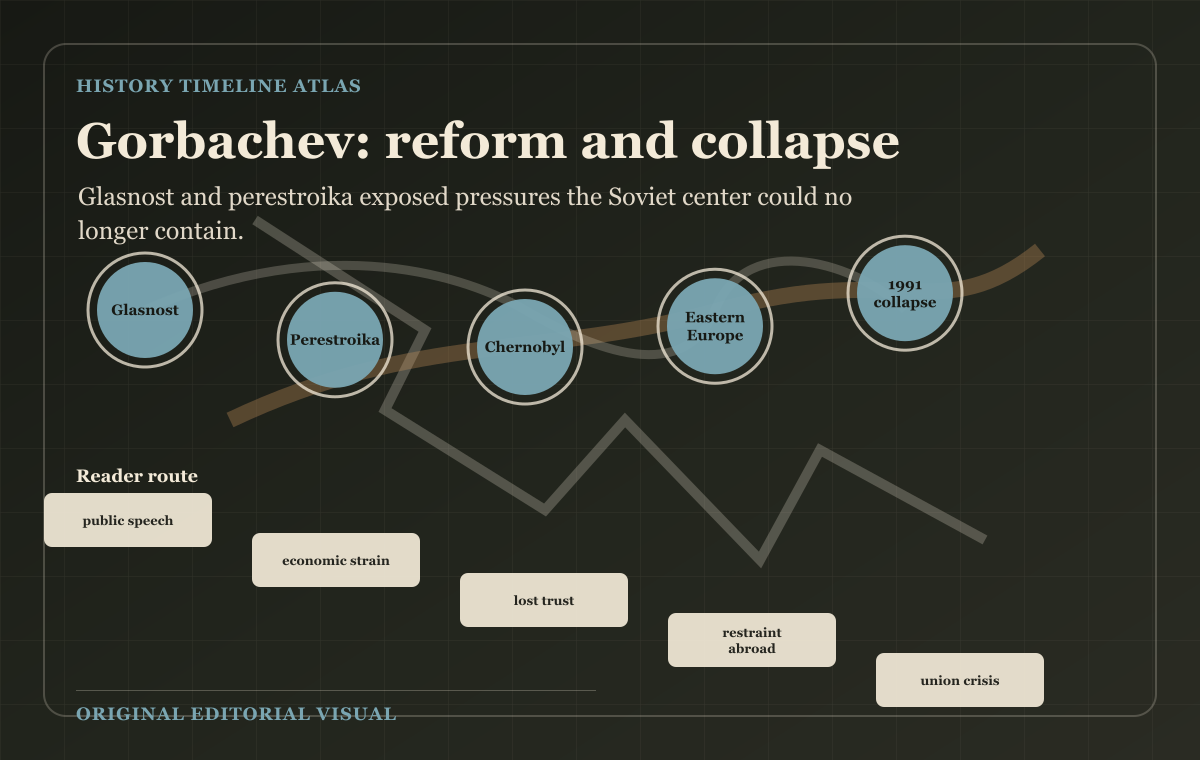
Gorbachev becomes more interesting when reform is read as a gamble inside a strained system. By the mid-1980s, the Soviet Union faced economic stagnation, bureaucratic rigidity, war in Afghanistan, technological pressure, national grievances, environmental disaster after Chernobyl, and a Cold War arms race that made the old model costly to maintain. Perestroika and glasnost were attempts to revive socialism, not a plan to dissolve the state.
Glasnost changed the emotional weather of politics. Public discussion, investigative journalism, historical criticism, and exposure of corruption gave people language for grievances that had long been managed through silence or fear. Once speech widened, the state could no longer control which questions stayed inside approved boundaries. Reform produced audiences as well as policies.
Perestroika was harder because economic reform had to work through ministries, planners, factories, shortages, price signals, informal networks, and party officials who had incentives to resist or distort change. That friction matters. Reform was not a smooth road from command economy to prosperity; it created uncertainty, scarcity, argument, and disappointment while political expectations rose.
The foreign-policy layer gives Gorbachev a different legacy. Arms-control talks, reduced ideological confrontation, acceptance of change in Eastern Europe, and refusal to use Soviet force on the old scale helped make the Cold War end less violently than many feared. The Berlin Wall fell in a setting shaped by East German protest and wider Soviet restraint, not by one leader alone.
Nationalism turned reform into something more explosive. The Baltic states, Caucasus, Ukraine, Russia, Central Asia, and other republics did not experience glasnost as the same story. Some used new openness to press for sovereignty, language rights, historical recognition, or independence. Soviet federal structure, long managed by party discipline, became a field of political conflict once discipline weakened.
Chernobyl gives the biography a human and institutional test. The disaster exposed technical failure, secrecy, delayed communication, environmental fear, and public distrust just as glasnost was beginning to matter. Readers should see why a nuclear accident became a political event: it made official silence look dangerous, and it turned truth-telling from an abstract reform promise into a demand about bodies, towns, soldiers, doctors, scientists, and families.
The August 1991 coup attempt should be read as a final stress test rather than a sudden ending. Hard-liners feared that the Union Treaty would drain authority from the center, while reformers and republican leaders saw the old party-state as exhausted. Yeltsin's stand in Moscow, public resistance, military hesitation, and the rapid collapse of Communist Party authority showed how little command remained once legitimacy had shifted away from the old institutions.
A richer page also keeps ordinary expectations visible. Reform was experienced through television debates, long lines, workplace uncertainty, soldiers coming home from Afghanistan, families hearing forbidden history, and republics arguing over sovereignty. That texture matters because the end of the Soviet Union was not only a diplomatic transition. It was a collapse of inherited routines about truth, wages, status, borders, and what the future was supposed to mean.
Foreign admiration and domestic anger should be placed side by side. Many outside observers remember Gorbachev for reducing nuclear danger and allowing Eastern Europe to change without a Soviet invasion. Many former Soviet citizens remember uncertainty, shortages, humiliation, and the sudden loss of a state framework. Holding both memories together makes the page more honest than a simple victory narrative.
Gorbachev's legacy remains contested because several truths sit together. He helped reduce Cold War danger and opened Soviet public life. He also presided over economic disruption, political collapse, and the end of a superpower many citizens associated with security, status, or social guarantees. That tension is why the biography should resist both savior and destroyer labels.
Mikhail Gorbachev also works as a navigation point. Open the linked event pages to see where the biography becomes chronology, then use the topic routes to test whether the same pattern appears beyond one life. That extra step matters because historical importance is rarely contained inside a single decision; it usually spreads through institutions, witnesses, opponents, imitators, and later arguments over memory.
Sources and Method
Source trail: the biography uses Gorbachev references, the Berlin Wall and Soviet dissolution events, and Cold War route sources. It treats reform, foreign policy, nationalism, and collapse as connected but not identical processes.
Method note: the page separates Gorbachev's intentions from the consequences of reform. The Soviet Union did not fall simply because one leader chose openness; openness exposed pressures that had already accumulated.
Evidence Notes
How Sensitive Claims Are Sourced
- 1
Reform that outgrew reformers
Gorbachev is presented through perestroika, glasnost, arms control, Eastern Europe, national movements, economic strain, and Soviet institutional weakness rather than through a single end-of-Cold-War label.
Why This Person Matters
Gorbachev matters because he shows how reform can become revolutionary without being designed as revolution. His legacy is debated because peaceful Cold War change, Soviet collapse, economic pain, national independence, and geopolitical loss are all tied to the same period. Gorbachev matters because he lets readers study reform as a historical risk. His career links the end of the Cold War, Soviet public speech, economic restructuring, national independence movements, and the problem of changing a system whose stability depended on control.
What happens when a reformer tries to save a system by weakening the tools that once kept it obedient?
How to Read This Life
Mikhail Gorbachev is easiest to understand when the biography is read beside Fall of the Berlin Wall, Dissolution of the Soviet Union. Those events show the historical setting in motion: dates, places, institutions, conflict, and consequences give the life a structure that a short biography alone cannot provide.
The surrounding route crosses Cold War, Post-Cold War and locations such as Berlin, Moscow. That matters because influence rarely stays inside one person. It moves through offices, armies, movements, laws, texts, speeches, institutions, and later memory.
A useful reading path starts with the role labels, then opens the event pages to see what changed, and finally compares this person with other actors facing similar pressures.
For readers who arrive on a biography first, this page is meant to become a doorway rather than a stop. Read one paragraph for the answer, then use the turning points, topic routes, and event links to test whether the person's reputation matches the wider evidence.
Read Gorbachev beside the Berlin Wall and Soviet dissolution pages. The first highlights restraint and protest; the second shows how reform fed into sovereignty struggles and institutional collapse.
Then compare Gorbachev with Deng Xiaoping. The contrast is one of the atlas's strongest routes: both faced socialist systems under pressure, but reform, party control, markets, nationalism, and state survival moved differently.
Read Mikhail Gorbachev through the roles of Soviet leader, Reformer rather than as reputation alone.
Place the biography inside Soviet Union and the wider events linked below.
Ask which choices were personal and which were constrained by institutions or crisis.
Follow how later memory simplified, contested, or reused this person's role.
Ask how glasnost changed what citizens, journalists, and republics could say in public.
Track which institutions lost authority as reform moved faster than command structures.
Compare Soviet reform with Chinese reform to see different relationships between markets, party rule, and state survival.
Legacy, Limits, and Memory
A useful biography keeps scale in view. Mikhail Gorbachev mattered because individual choices met a wider structure: institutions, enemies, allies, audiences, technologies, beliefs, and inherited conflicts. The related event pages help separate personal agency from conditions that no single person controlled.
Memory is part of the biography too. Later readers often simplify a figure into a hero, villain, founder, reformer, conqueror, prophet, scientist, or symbol. Those labels can be helpful, but they become misleading when they hide conflict, compromise, exclusion, uncertainty, or the experiences of people outside the main biography.
For the next step, compare this life with a topic route rather than stopping at the name. If the same pattern appears across several figures, the reader has found a historical structure; if this person breaks the pattern, the contrast is usually where the most interesting question begins.
Gorbachev is often judged by outcome alone. A better reading asks what he intended, what the Soviet system could absorb, and which forces became uncontrollable once censorship and coercion loosened.
Peaceful Cold War change should not erase domestic hardship. Many people remember the period through shortages, lost savings, uncertain status, political confusion, and later nostalgia for order.
The biography also shows that empires can dissolve from the center outward. Collapse was not only an external defeat; it was a crisis of legitimacy, economy, nationality, and institutional command.
Turning Points to Read Next
Fall of the Berlin Wall
East German authorities opened border crossings in Berlin after months of protest and pressure, allowing people to cross the wall freely.
Dissolution of the Soviet Union
The Soviet Union formally dissolved after political reform, economic strain, nationalist movements, and failed attempts to preserve central authority.
Related Timeline
- November 9, 1989Fall of the Berlin Wall
East German authorities opened border crossings in Berlin after months of protest and pressure, allowing people to cross the wall freely.
- December 1991Dissolution of the Soviet Union
The Soviet Union formally dissolved after political reform, economic strain, nationalist movements, and failed attempts to preserve central authority.
References
Where to Check the Facts
- Encyclopaedia Britannica: Mikhail GorbachevBiographical reference for Mikhail Gorbachev's life dates, roles, institutions, and historical setting.
- Encyclopaedia BritannicaBackground reference for chronology, names, and historical context.
- WikidataStructured reference for dates, places, alternate names, and entity links.