At a Glance
The shape of the event
- Date
- c. 830 CE
- Place
- Baghdad
- Type
- Scholarly institution
The Abbasid court's Bayt al-Hikmah, or House of Wisdom, became a symbol of translation, scholarship, and mathematical and scientific work in Baghdad.
c. 830 CE; place the event in Baghdad before comparing causes or consequences.
The event links Islamic-world history to global histories of science because knowledge crossed languages, courts, libraries, religious communities, and trade routes.
Al-Ma'mun / Al-Khwarizmi / Hunayn ibn Ishaq are the first names or groups to compare before widening the story.
Baghdad became associated with translation movements and scholarship that shaped mathematics, astronomy, medicine, philosophy, and later intellectual exchange.
Baghdad became associated with translation movements and scholarship that shaped mathematics, astronomy, medicine, philosophy, and later intellectual exchange.
The event links Islamic-world history to global histories of science because knowledge crossed languages, courts, libraries, religious communities, and trade routes.
If this moment in Baghdad interests you, the nearby pages trace how those translations and methods travelled: follow threads to the translators who worked from Syriac and Greek, to the mathematicians developing calcul...
Background
The Abbasid Caliphate in the early ninth century presided over a multilingual, multi-religious realm that stretched from the Mediterranean to the edges of South Asia. Baghdad, founded a century earlier, sat astride caravan routes and riverine traffic; people, books and ideas flowed through courts, monasteries, market-places and caravanserais. Administrative demands—accurate calendars, reliable accounts and trained physicians—created incentives to collect and systematize technical knowledge from Greek, Syriac, Persian and other sources. Patronage mattered: rulers and court officials who valued utility and prestige supported scholarly work. At the same time, translation was not a neutral act; it required choices about what to copy, how to render technical terms, and which texts were worth preserving.
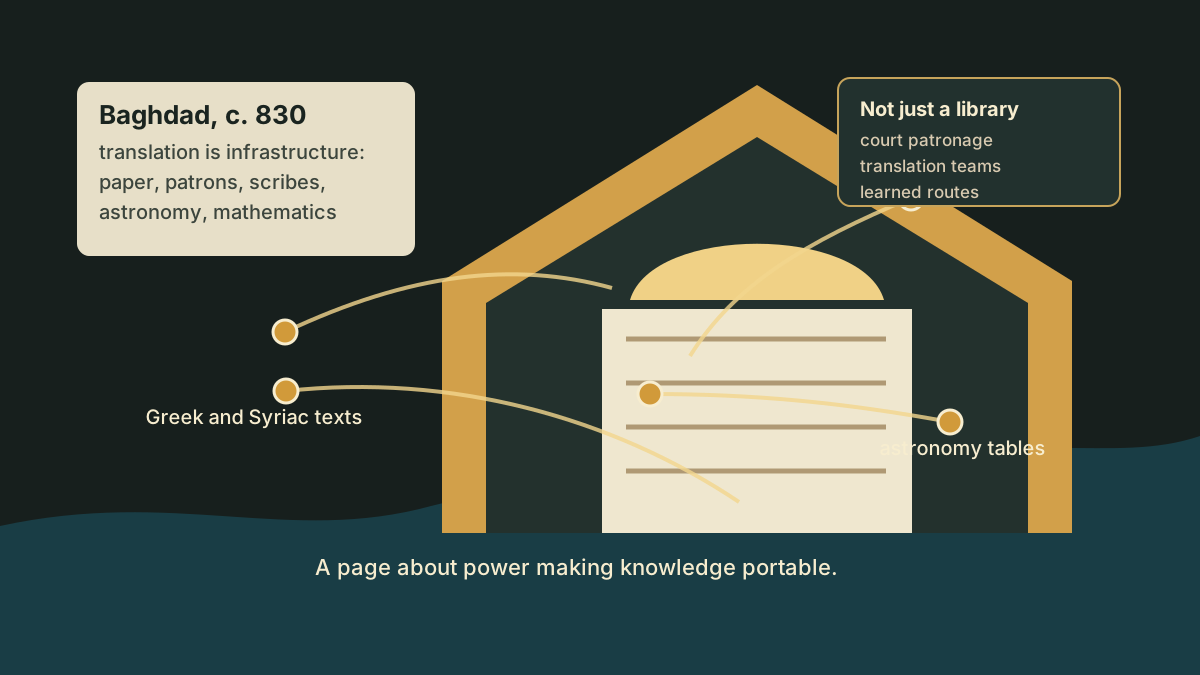
Historians debate whether Bayt al-Hikmah was a single, centralized academy or a looser constellation of workshops, libraries and court-sponsored projects. This page treats the House of Wisdom as a historically important symbol of a broader translation and learning movement rather than as an uncontested, monolithic institution. The House of Wisdom is best read less as a single modern-style institution and more as a court-centered ecosystem of books, patrons, translators, copyists, astronomers, mathematicians, physicians, and administrators. Abbasid Baghdad sat at the meeting point of tax revenue, paper technology, imperial ambition, and long-distance scholarly exchange. Greek works often moved through Syriac intermediaries; Persian and Indian materials also shaped astronomy, mathematics, medicine, and administration. Translation was expensive labor.
It required manuscripts, bilingual scholars, scribes, commentary, revision, and patrons who believed that knowledge enhanced prestige and governance. That makes the House of Wisdom a story about infrastructure as much as genius.
The Turning Point
What changed around c. 830 CE was not a single decree but a set of conscious decisions and visible practices. The Abbasid court intensified support for the collection, copying and translation of scientific and philosophical texts—work that required funding, scribes, patrons and access to manuscripts. Al-Ma'mun figures prominently in accounts of this period as a caliphal sponsor whose court helped create space for scholars to work. Translators such as Hunayn ibn Ishaq organized and rendered medical and philosophical texts into Arabic, creating clearer technical vocabularies and making previously inaccessible material available to new readers.
Mathematicians like Al-Khwarizmi worked where those translated texts and practical problems met: numerical methods, astronomical tables and procedures for calculation gained renewed attention because they solved pressing needs in taxation, surveying and navigation. The change was practical as well as intellectual: a shift from isolated copying to an active program of translation, annotation and synthesis that linked courts, libraries and scholars. Even as the precise institutional shape of Bayt al-Hikmah is debated, the visible effect was a denser network of books, skilled translators and mathematicians operating under courtly patronage. Around the age of al-Ma'mun, translation and scholarly patronage gained unusual intensity. Court interest in astronomy, calendars, geography, theology, and logic made learned work useful for administration, debate, and imperial image.
The turning point was not simply that texts were translated, but that translation became organized, rewarded, and connected to public authority. Scholars compared versions, corrected tables, argued over meanings, and created new work out of inherited materials. The process was creative rather than mechanical. A mathematical text could become the basis for new calculation; an astronomical table could be tested; a philosophical vocabulary could change theological argument. Baghdad's learned culture turned movement across languages into a source of intellectual power.
Consequences
In the near term, Baghdad became synonymous with translation activity and scholarly exchange. The concentrated work of translators and mathematicians helped to stabilize technical vocabularies in Arabic and to produce reference works—astronomical tables, medical compendia, mathematical procedures—that could be copied and used across the Islamic world. That practical output supported governance, commerce and medicine in ways that mattered to peoples beyond elite circles. Over the longer term the association of Baghdad with these intellectual practices linked the Islamic world to wider histories of science: ideas and texts moved outwards as well as inwards, crossing language boundaries, religious communities and trade routes. The legacy is complex.
The House of Wisdom serves as a powerful symbol of cross-cultural intellectual exchange, but historians caution against romanticizing a single, centralized academy. Scholarship arising from this period influenced later medieval learning in multiple regions, not by simple transmission from one perfect source, but through layered conversations, translations and adaptations spanning centuries. The consequences stretched across languages and centuries. Works associated with Abbasid translation helped shape later Arabic scholarship and, through later translation into Latin and other languages, influenced medieval and early modern learning far beyond Iraq. The story also complicates simple civilizational narratives. Knowledge did not move in one direction from Greece to Islam to Europe as if people were merely passing a package.
It was edited, debated, expanded, criticized, forgotten, recovered, and repurposed. Baghdad's scholars were active makers of knowledge. The House of Wisdom therefore helps readers understand history as circulation: paper, wages, libraries, routes, courts, and arguments all mattered.
Interpretation Notes
The institution's exact form and scope are debated; the page treats it as a historically important symbol while avoiding unsupported myths about a single centralized academy.
Why Keep Reading
If this moment in Baghdad interests you, the nearby pages trace how those translations and methods travelled: follow threads to the translators who worked from Syriac and Greek, to the mathematicians developing calculation and astronomical tables, and to the physicians who reassembled ancient medical knowledge for new audiences. You can also explore how courts and trade routes shaped what texts survived and why certain works were copied more often than others. Each subsequent event reveals how knowledge moved—not as a single progress line, but as a chain of choices, losses and reinventions that connect Baghdad to medieval libraries in many languages. Follow this page into al-Khwarizmi, Abbasid Baghdad, Islamic science, paper technology, and translation routes into medieval Europe.
The richer question is how power makes knowledge portable, and how translation changes the thing being translated.
Reading Path
Follow the story without losing the thread
Before This
After This
- Swahili Coast City-States Risec. 900 CE
- Fatimid Cairo Founded969 CE
- Delhi Sultanate Founded1206 CE
Same Period
Wider Timeline
Mind Map
How to think about House of Wisdom Flourishes
trade routes
Caravan and river networks that carried manuscripts, people and ideas into Baghdad
Map Layer
Where this event sits geographically
Gold pins mark the approximate locations of published event pages. This is a schematic locator map, not a historical border map.
Coordinates are approximate and are used to help readers orient themselves before opening a full event page.
References
Where to Check the Facts
- Encyclopaedia Britannica: Bayt al-HikmahReference for the House of Wisdom, Abbasid patronage, translation, and Baghdad setting.
- Encyclopaedia Britannica: Abbasid caliphateReference for Abbasid chronology and cultural context.
- Science Museum: Objects and StoriesMuseum reference hub for science, technology, medicine, invention, and public understanding.