At a Glance
The shape of the event
- Date
- 762 CE
- Place
- Baghdad
- Type
- Capital foundation
In 762, Abbasid caliph al-Mansur founded Baghdad as the Round City near the Tigris. What happened was a capital-building project; the main side was the Abbasid court; why it matters is that the city became a political and scholarly center with a long aftermath.
762 CE; place the event in Baghdad before comparing causes or consequences.
The city anchored caliphal administration, trade, translation, intellectual life, and later memory of the Abbasid golden age.
Al-Mansur are the first names or groups to compare before widening the story.
Baghdad became the Abbasid capital, while the city rapidly expanded beyond al-Mansur's Round City on the Tigris.
Baghdad became the Abbasid capital, while the city rapidly expanded beyond al-Mansur's Round City on the Tigris.
The city anchored caliphal administration, trade, translation, intellectual life, and later memory of the Abbasid golden age.
Read from Baghdad's foundation to the Abbasid Revolution, House of Wisdom, Islamic world trade, and Mongol sack of Baghdad.
Background
By the mid-eighth century the Abbasid dynasty had displaced the Umayyads and sought to consolidate authority across a vast, diverse empire. Caliphal power depended not only on armies and lineage but on administration: efficient tax collection, message networks, legal adjudication, and the presence of a court that could bind elite interests. Cities were instruments of rule as much as markets. The Tigris valley already supported urban life and riverine commerce, and controlling a centrally placed capital offered strategic advantages for mobility, communication, and projection of power.
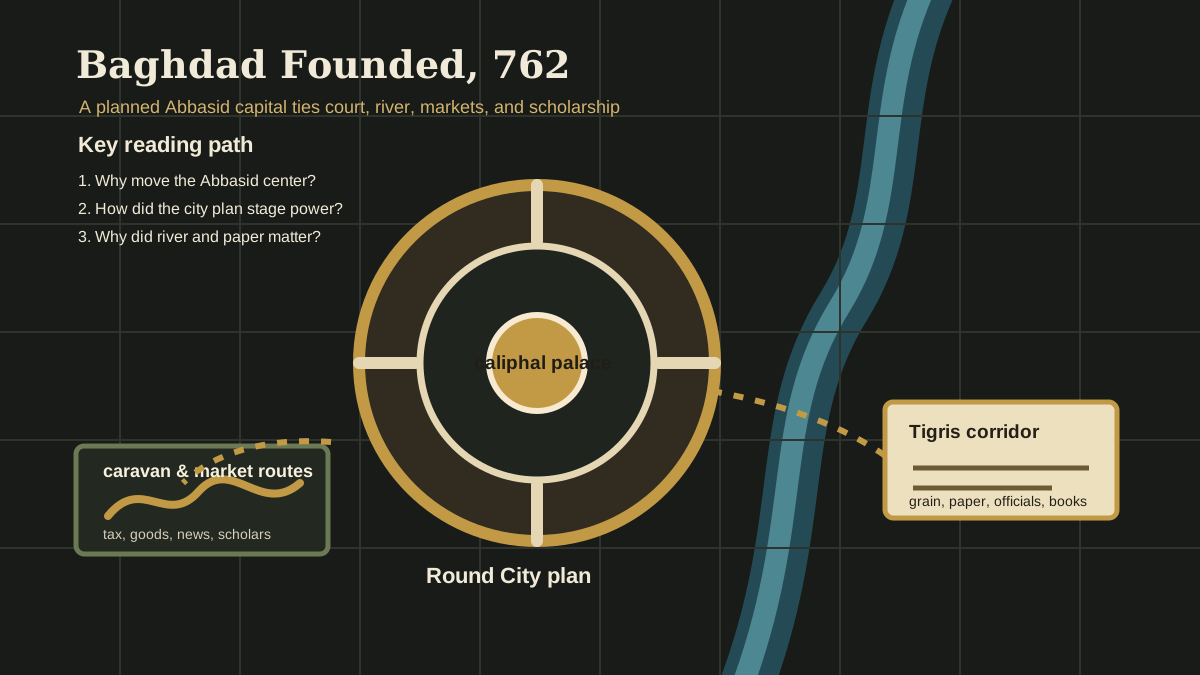
Al-Mansur’s decision to found a new seat of government reflected pressures common to emerging empires—need for a secure administrative hub, a focal point for economic exchange, and a setting where patronage could attract scribes, judges, and religious authorities. Those pressures did not produce a single cause; political calculation, economic opportunity, and cultural ambition converged in a choice to create a city intended to be the heart of Abbasid rule and a magnet for talent from across the Islamic world. Baghdad's foundation was an act of Abbasid statecraft. Al-Mansur did not merely choose a convenient settlement on the Tigris; he built a capital that could organize soldiers, officials, taxes, markets, scholars, and ceremony around a new dynasty.
The city sat near older Mesopotamian routes and close to irrigation, agriculture, and long-distance trade. Its famous round-city plan made hierarchy visible: the caliph and state offices occupied the center, while movement through gates and markets connected imperial space to the wider world. The founding moment should be separated from the later golden-age shorthand. In 762 the key story is al-Mansur's planned capital, Madinat al-Salam, the Round City, the Tigris corridor, court security, tax administration, and a new Abbasid political center. Later institutions and scholarly legends matter, but they should not be projected backward as if the House of Wisdom already explains the first act of city building.
The Turning Point
The founding of Baghdad in 762 marked a concrete shift from inherited centres of power to a purpose-built capital under Abbasid control. Al-Mansur acted as the decisive agent: he chose a site on the Tigris, dedicated resources to establish administrative institutions there, and called officials, merchants, and artisans to populate the new city. That choice centralized caliphal authority in a location conceived to host imperial bureaucracy and court life. The immediate change was administrative consolidation—records, fiscal offices, and the caliphal chancery now had a single locus. Commercially, merchants found a large, river-linked market where goods could be pooled and redistributed across the region.
Intellectually, the court’s patronage attracted teachers, translators, and scholars who could meet and work in proximity to the political center. This was not an instantaneous utopia: establishing infrastructure, social hierarchies, and court culture required sustained investment and ongoing management. Yet the foundation shifted the axis of the Islamic world, turning a riverside site into a capital whose institutions and networks would shape politics, economy, and learning for decades. The turning point was the Abbasid decision to give the caliphate a new spatial center after revolution. Moving power into Baghdad allowed the dynasty to distance itself from Umayyad Damascus while drawing on Iraq's fiscal and intellectual resources.
The city became a tool for governing a vast empire, not only a backdrop for court life. Officials, translators, merchants, jurists, soldiers, and artisans all helped convert the capital from a plan into a living institution.
Consequences
In the near term Baghdad became the seat of Abbasid governance, concentrating fiscal authority and bureaucratic talent in one place and enabling more coordinated imperial administration. Its riverside position amplified commercial activity: goods, coinage, and people moved through the city, making it a regional marketplace and a hub for long-distance trade. The court’s patronage fostered translation, scholarship, and legal activity, embedding intellectual pursuits into urban life and helping to draw minds from varied regions into closer conversation. Over the longer term Baghdad’s status as capital anchored a memory of an Abbasid ‘golden age’—a retrospective label that later chroniclers and readers would emphasize.
At the same time, the new capital embodied the complexities implicit in imperial centers: court culture and social hierarchies concentrated wealth and influence, sectarian tensions and political rivalries surfaced in a dense urban setting, and the city’s prominence made it a focal point for later contestation and vulnerability. The foundation therefore created both a durable administrative and cultural core for the Islamic world and a set of structural tensions—about power, inequality, and security—that would shape its fortunes in centuries to come. Baghdad grew into one of the great cities of the medieval world, a center of administration, commerce, translation, learning, and cosmopolitan exchange.
Its rise later supported the scholarly culture associated with the House of Wisdom, though the city's importance was broader than any one institution. The foundation also shows how capitals can outgrow their founders. Built to secure Abbasid legitimacy, Baghdad became a place where many languages, faiths, professions, and routes met. Its later destruction and memory only increased the symbolic weight of the original founding.
Interpretation Notes
The foundation is often collapsed into a later golden-age story. The Round City is reconstructed mainly from written descriptions because little of its fabric survives, and institutions associated with later Abbasid scholarship should not be projected fully formed into 762.
Why Keep Reading
Read from Baghdad's foundation to the Abbasid Revolution, House of Wisdom, Islamic world trade, and Mongol sack of Baghdad. That route keeps sequence clear: first a planned capital and administrative center, then a long urban history of scholarship, hierarchy, conflict, prosperity, and vulnerability. Read backward to the Abbasid Revolution to see why the dynasty shifted power toward Iraq. Continue to the House of Wisdom to separate the city's 762 foundation from later translation and scholarly patronage, then follow the Mongol sack of Baghdad to understand why the capital's long history cannot be reduced to a single golden age.
Reading Path
Follow the story without losing the thread
Before This
- Battle of Talas751 CE
- Abbasid Revolution750 CE
- Battle of Karbala680 CE
After This
- House of Wisdom Flourishesc. 830 CE
- Swahili Coast City-States Risec. 900 CE
- Fatimid Cairo Founded969 CE
Same Period
- House of Wisdom Flourishesc. 830 CE
- Abbasid Revolution750 CE
- Mongol Sack of BaghdadFebruary 1258
Wider Timeline
Mind Map
How to think about Baghdad Founded in 762: Al-Mansur, Round City, and Abbasid Aftermath
Administrative hub
Baghdad’s foundation concentrated fiscal offices and the caliphal chancery in one purpose-built capital.
Map Layer
Where this event sits geographically
Gold pins mark the approximate locations of published event pages. This is a schematic locator map, not a historical border map.
Coordinates are approximate and are used to help readers orient themselves before opening a full event page.
References
Where to Check the Facts
- Encyclopaedia Britannica: Abbasid caliphateReference for the Abbasid takeover, Baghdad capital, political chronology, and later Mongol destruction.
- Encyclopaedia Britannica: Baghdad, Abbasid historyReference for the founding of Baghdad and its Abbasid urban setting.
- The Metropolitan Museum of Art: The Art of the Abbasid Period (750-1258)Museum synthesis confirming Baghdad's 762 foundation as the circular City of Peace and the new Abbasid capital in Iraq.
- Encyclopaedia Iranica: Baghdad before the Mongol invasionScholarly reference for al-Mansur's foundation of Madinat al-Salam in 145 AH/762 CE, the Round City's court core, and Baghdad's role as the Abbasid capital.
- Encyclopaedia Britannica: al-MansurBiographical reference for al-Mansur and Abbasid state consolidation.