Historical Role
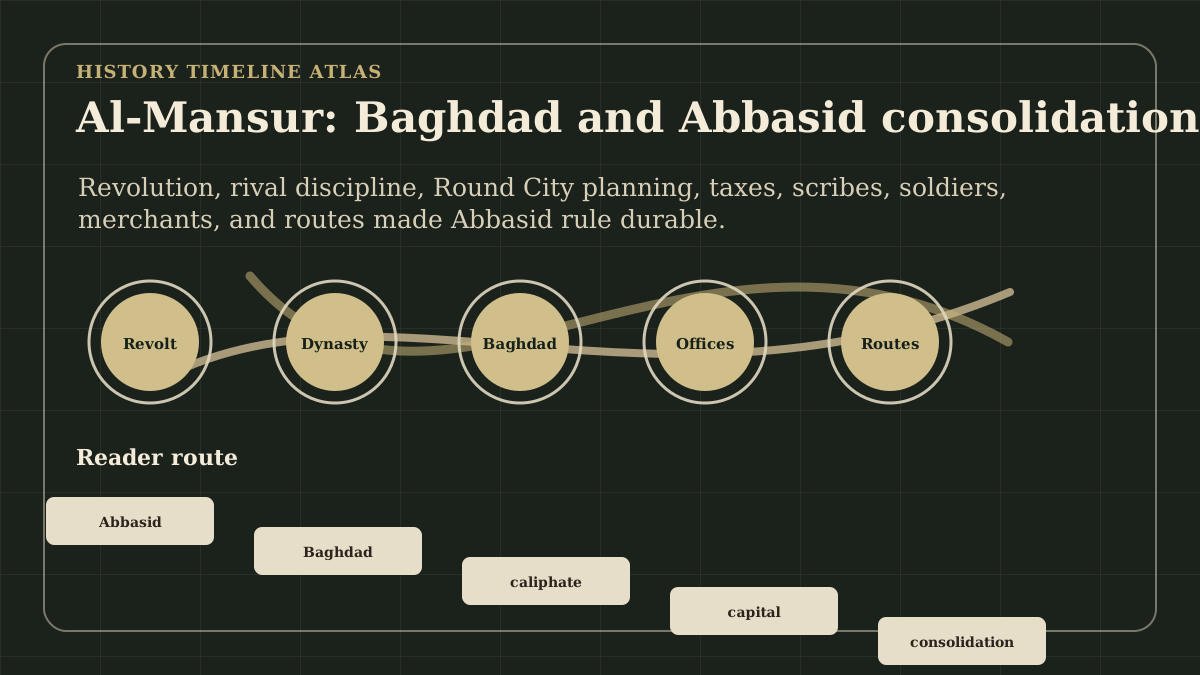
Al-Mansur's biography is a capital-building story as much as a caliphal one. The Abbasids had won power in the revolution of 750, but victory did not automatically create durable rule. Al-Mansur's task was to consolidate a dynasty, discipline rivals, manage provincial politics, and build a capital that could make Abbasid authority visible from Iraq outward.
Baghdad gives the page a concrete center. Founded in 762, the Round City gathered court administration, military presence, scribal labor, tax flow, petitioners, merchants, scholars, and symbolic geography near the Tigris. The city was not only beautiful or famous. It was a machine for making a new caliphate governable.
His role also belongs inside the longer story of Abbasid legitimacy. The dynasty claimed a different relationship to the Prophet's family, to eastern support, to non-Arab Muslim constituencies, and to imperial administration than the Umayyads had. Al-Mansur's consolidation shows how revolutionary language had to become pay, offices, surveillance, buildings, appointments, and routes of communication.
The page becomes more useful when it keeps ordinary urban users near the caliph. A tax official, translator, merchant, guard, petitioner, or scholar experienced Abbasid power through the city's offices, gates, stipends, markets, and routes. Baghdad made rule visible because many kinds of people had to pass through it.
Consolidation also meant danger. Abbasid victory had depended on networks of support, but once the dynasty held power, rivals, claimants, provincial commanders, and revolutionary allies could become threats. Al-Mansur's rule shows the hard turn from movement politics to surveillance, discipline, and dynastic survival.
The Round City is useful because its shape made authority spatial. Gates, walls, palace, mosque, guard zones, roads, and administrative access organized who could approach power and how information moved. Urban design becomes a political source, not decoration.
Baghdad's later fame for translation and scholarship should not erase this earlier state-building. The city that later housed scholars also depended on tax extraction, military protection, paper, scribal offices, and patronage. Intellectual history needed political infrastructure.
A reader can follow al-Mansur into three routes: Abbasid revolution, capital formation, and House of Wisdom scholarship. The biography is the hinge between those stories because it explains how a dynasty created the setting in which later culture could flourish.
Provincial politics keep the page from becoming only a Baghdad story. The Abbasid caliphate needed revenue, loyalty, military support, and communication across Iraq, Iran, Syria, Arabia, Egypt, Central Asia, and beyond. A capital could concentrate authority, but it also had to reach outward through governors, roads, postal systems, soldiers, and fiscal records.
The biography also helps readers understand why cities become symbols. Baghdad later stands for learning, luxury, and translation, but al-Mansur's Baghdad first solved a political problem: where should a new dynasty place itself so that it could see, tax, command, impress, and survive?
That question makes al-Mansur useful for comparison with Constantine, Abd al-Malik, Akbar, and Zhu Yuanzhang. Each ruler used buildings, capitals, offices, ritual, and coercion to turn unstable power into something that looked orderly.
Al-Mansur helps connect individual action with wider historical change in Abbasid Caliphate. The biography works best when it keeps the surrounding world visible: authority, conflict, belief, reform, or discovery moved through decisions made under pressure.
The related events show how roles such as Abbasid caliph, Capital founder can be read through dates, places, institutions, and consequences rather than through reputation alone. The biography explains why this person matters, while the linked events explain what changed around them.
A richer reading starts with the limits around the person. Some figures acted through offices, armies, courts, laboratories, churches, parties, ships, trade networks, or protest movements; others became important because later communities turned their lives into symbols. The page therefore asks what this person could actually change, what was already moving before them, and which consequences later readers attached to the name.
Read the biography against absence as well. Many lives around Al-Mansur are less visible in the record: opponents, collaborators, family members, workers, soldiers, students, subjects, victims, translators, scribes, or local communities. Keeping those surrounding people in view makes the page less like a name card and more like an entry point into historical systems.
Al-Mansur also works as a navigation point. Open the linked event pages to see where the biography becomes chronology, then use the topic routes to test whether the same pattern appears beyond one life. That extra step matters because historical importance is rarely contained inside a single decision; it usually spreads through institutions, witnesses, opponents, imitators, and later arguments over memory.
Sources and Method
Source method: this page reads al-Mansur through Britannica's biography, Baghdad history, Abbasid chronology, and the existing Baghdad founding event. The prose keeps Baghdad's later scholarly fame connected to an earlier political act of capital formation.
Why This Person Matters
Al-Mansur matters because the connected events make a larger historical pattern easier to follow. The page links biography to consequences so readers can move from a life story into the wider atlas, compare the person with contemporaries, and understand why later memory kept returning to this figure. Al-Mansur matters because he makes the Abbasid Caliphate easier to understand as a government. His career connects revolution, dynasty, capital design, administrative consolidation, discipline, patronage, and the urban setting that later supported Baghdad's intellectual reputation.
What changes when a revolutionary dynasty has to become a government with offices, routes, walls, soldiers, and taxes?
How to Read This Life
Al-Mansur is easiest to understand when the biography is read beside Baghdad Founded in 762: Al-Mansur, Round City, and Abbasid Aftermath, Abbasid Revolution. Those events show the historical setting in motion: dates, places, institutions, conflict, and consequences give the life a structure that a short biography alone cannot provide.
The surrounding route crosses Abbasid Caliphate, Early Islamic World and locations such as Baghdad, Kufa and the eastern caliphate. That matters because influence rarely stays inside one person. It moves through offices, armies, movements, laws, texts, speeches, institutions, and later memory.
A useful reading path starts with the role labels, then opens the event pages to see what changed, and finally compares this person with other actors facing similar pressures.
For readers who arrive on a biography first, this page is meant to become a doorway rather than a stop. Read one paragraph for the answer, then use the turning points, topic routes, and event links to test whether the person's reputation matches the wider evidence.
Read al-Mansur beside Abbasid Revolution, Baghdad Founded, and House of Wisdom Flourishes. That sequence moves from seizure of power to capital building to scholarly ecology.
Compare Baghdad with Damascus, Cairo, Constantinople, Chang'an, and Nanjing. A capital city is a historical argument: it tells subjects where authority gathers, how petitions move, and which routes matter.
Read Al-Mansur through the roles of Abbasid caliph, Capital founder rather than as reputation alone.
Place the biography inside Abbasid Caliphate and the wider events linked below.
Ask which choices were personal and which were constrained by institutions or crisis.
Follow how later memory simplified, contested, or reused this person's role.
Read Baghdad as administration, route control, ceremony, and information flow rather than as a famous name.
Ask how revolutionary victory became dynastic rule through offices, pay, force, and legitimacy.
Follow how the city al-Mansur founded became the setting for later translation and scholarship.
Legacy, Limits, and Memory
A useful biography keeps scale in view. Al-Mansur mattered because individual choices met a wider structure: institutions, enemies, allies, audiences, technologies, beliefs, and inherited conflicts. The related event pages help separate personal agency from conditions that no single person controlled.
Memory is part of the biography too. Later readers often simplify a figure into a hero, villain, founder, reformer, conqueror, prophet, scientist, or symbol. Those labels can be helpful, but they become misleading when they hide conflict, compromise, exclusion, uncertainty, or the experiences of people outside the main biography.
For the next step, compare this life with a topic route rather than stopping at the name. If the same pattern appears across several figures, the reader has found a historical structure; if this person breaks the pattern, the contrast is usually where the most interesting question begins.
Al-Mansur can disappear behind the romance of Abbasid Baghdad. The better reading puts the founder of the capital before the golden-age image: institutions, money, coercion, patronage, and urban planning made later cultural brilliance possible.
The biography also shows the cost of revolution becoming government. A dynasty born from opposition had to decide how much openness it could tolerate once it held power.
Turning Points to Read Next
Baghdad Founded in 762: Al-Mansur, Round City, and Abbasid Aftermath
In 762, Abbasid caliph al-Mansur founded Baghdad as the Round City near the Tigris. What happened was a capital-building project; the main side was the Abbasid court; why it matters is that the city became a political and scholarly center with a long aftermath.
Abbasid Revolution
The Abbasid movement overthrew the Umayyad dynasty and reoriented caliphal power toward Iraq and the eastern Islamic world.
Related Timeline
- 762 CEBaghdad Founded in 762: Al-Mansur, Round City, and Abbasid Aftermath
In 762, Abbasid caliph al-Mansur founded Baghdad as the Round City near the Tigris. What happened was a capital-building project; the main side was the Abbasid court; why it matters is that the city became a political and scholarly center with a long aftermath.
- 750 CEAbbasid Revolution
The Abbasid movement overthrew the Umayyad dynasty and reoriented caliphal power toward Iraq and the eastern Islamic world.
References
Where to Check the Facts
- Encyclopaedia Britannica: Al-MansurBiographical reference for al-Mansur and Abbasid consolidation.
- Encyclopaedia Britannica: Baghdad, Abbasid historyReference for the founding of Baghdad in 762.