At a Glance
The shape of the event
- Date
- 969 CE
- Place
- Cairo
- Type
- Capital foundation
The Fatimids founded Cairo after taking Egypt, creating a new capital that competed with Abbasid authority and reshaped Islamic North Africa and the eastern Mediterranean.
969 CE; place the event in Cairo before comparing causes or consequences.
The city anchored Egypt's medieval importance and gave the atlas a bridge between North Africa, the eastern Mediterranean, Red Sea trade, and Islamic political rivalry.
Fatimid rulers / Jawhar al-Siqilli are the first names or groups to compare before widening the story.
Cairo became the Fatimid capital and later one of the major cities of the Islamic world.
Cairo became the Fatimid capital and later one of the major cities of the Islamic world.
The city anchored Egypt's medieval importance and gave the atlas a bridge between North Africa, the eastern Mediterranean, Red Sea trade, and Islamic political rivalry.
Continue to the Abbasid, Crusade, Saladin, and Mamluk pages to see how Cairo's foundation created a platform for later Mediterranean power.
Background
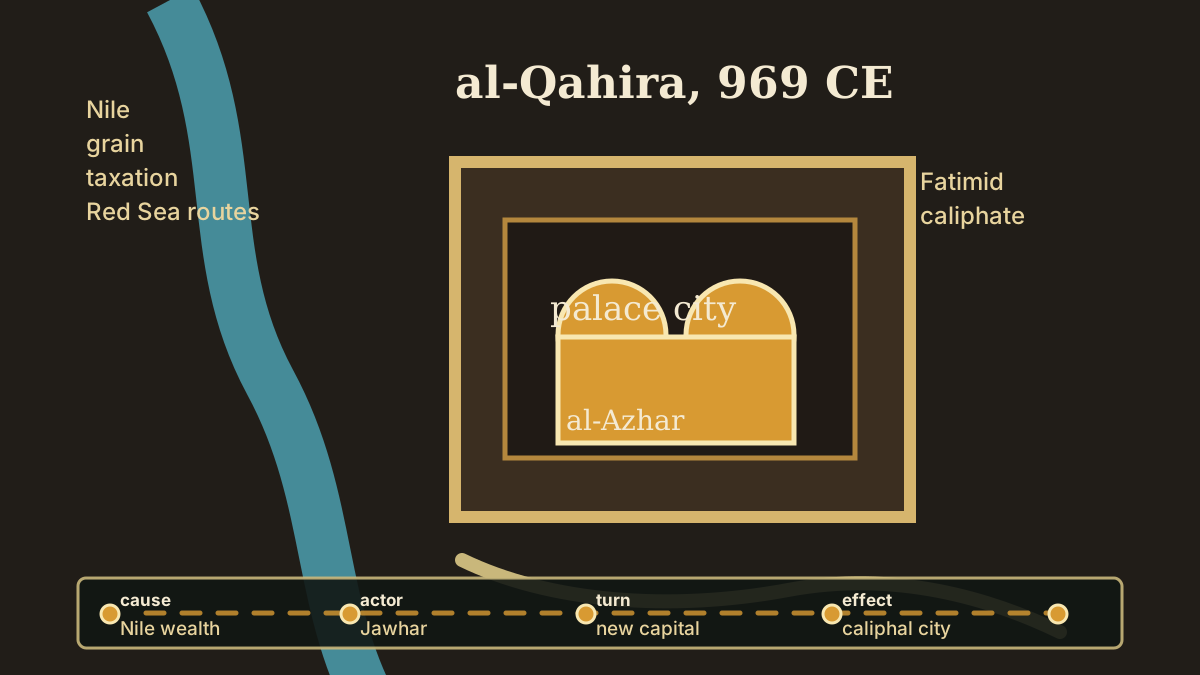
Before Cairo, Egypt already had dense urban life, especially around Fustat, and a long history of administration tied to the Nile. The Fatimids entered this world from North Africa as a dynasty with religious ambition, military organization, and Mediterranean reach. Their general Jawhar al-Siqilli captured Egypt and laid out al-Qahira near older settlements, creating a court and garrison city that could serve the caliph when al-Mu'izz arrived. The decision to build beside, rather than simply inside, Fustat mattered. It protected the new ruling household, concentrated military and administrative space, and allowed the dynasty to project a controlled ceremonial image. Al-Azhar, founded soon after, linked the new capital to teaching, law, and religious authority. Egypt's value made the foundation urgent.
The Nile valley could feed armies and cities; Alexandria and Red Sea routes connected the Mediterranean, Africa, Arabia, and the Indian Ocean; and older urban communities around Fustat already held tax, craft, and commercial knowledge. The Fatimids could not simply arrive as outsiders and expect Egypt to function. They needed local administrators, fiscal continuity, soldiers, religious scholars, and a protected court. Building Cairo beside older urban life let them use what Egypt already possessed while marking a visible break in authority. This dual movement, continuity and assertion, is what makes the foundation more than architecture.
The Turning Point
The turning point was the move from occupation to urban institution. A conquered province can be lost if it remains only a military prize; a capital can reorganize careers, rents, rituals, and routes around the new regime. Jawhar's foundation gave Fatimid rule a visible center from which officials could manage taxation, grain, army pay, and diplomatic traffic. It also made Cairo a symbolic challenger to Baghdad. The Fatimids did not merely say they were caliphs; they built a city where that claim could be performed through palaces, Friday prayers, processions, and patronage. At the same time, Cairo depended on older Egyptian infrastructure. Its rise was a transformation of the urban landscape, not a clean replacement of what came before.
The city plan turned ideology into daily practice. Palaces arranged proximity to the ruler; gates and walls controlled movement; the mosque and teaching institutions helped broadcast Ismaili authority; and official ceremony made the caliphate visible to soldiers, petitioners, envoys, and residents. Jawhar's work should be understood as statecraft through space. A road, a gate, or a palace courtyard could shape who approached power and how power was seen. The Fatimids were not only competing with Abbasid Baghdad in theological argument. They were building a rival urban stage where loyalty, learning, taxation, and military command could be organized around their own court.
Consequences
Cairo's foundation helped anchor Egypt as a major center of Islamic political, commercial, and intellectual life. In the short term it strengthened Fatimid control over a valuable Nile province and linked North Africa, the Red Sea, the eastern Mediterranean, and the Hijaz through a court-centered network. Over time Cairo outgrew its original palace-city purpose and became one of the great cities of the medieval world. The consequences extended beyond architecture: the city shaped patterns of scholarship, sectarian competition, trade, and later Ayyubid and Mamluk rule. The founding also warns against simple origin myths. Cairo was new, but it was built beside older communities, markets, canals, and memories that continued to shape daily life.
Cairo's later history makes the founding look even larger. Under later Ayyubid and Mamluk rule, the city became central to Sunni scholarship, military government, Mediterranean diplomacy, and pilgrimage routes, even though its original Fatimid identity changed. That transformation is part of the point. Capitals often outlive the regimes that build them because their infrastructure, markets, schools, and symbolic geography become useful to successors. Cairo's Fatimid birth therefore set conditions for histories that were not strictly Fatimid: Crusade-era politics, Red Sea commerce, Mamluk military households, and later Ottoman administration all used the urban platform begun in 969. A useful final lens is to ask who benefited from a new capital and who had to adjust to it.
Soldiers gained a protected base, officials gained offices and careers, scholars gained patronage, and merchants gained a court whose demand for goods and information could be profitable. But older residents around Fustat also had to navigate new taxes, ceremonies, and chains of access. Cairo's foundation therefore helps readers see capital-building as a social event, not only a dynastic decision. The city concentrated opportunity and surveillance at the same time, which is why its history belongs equally to rulers, administrators, workers, scholars, and neighborhoods.
Interpretation Notes
A Cairo-centered story can hide older Egyptian and Fustat histories; the page explains the new capital as a transformation, not a blank beginning.
Why Keep Reading
Continue to the Abbasid, Crusade, Saladin, and Mamluk pages to see how Cairo's foundation created a platform for later Mediterranean power. The page also connects naturally to urban-history questions: why rulers build new capitals, how cities convert ideology into space, and how older neighborhoods survive inside supposedly new political orders. The most useful next route is Baghdad founded, Fatimid Cairo, First Crusade, Saladin, and Mamluk Cairo. That sequence lets readers compare how Islamic capitals were built, repurposed, and remembered, and how urban space could carry rival claims to legitimate rule.
Evidence note: the page should invite readers to compare different kinds of sources: chronicles that emphasize dynastic legitimacy, urban archaeology that reveals how space was used, institutional histories of al-Azhar, and trade history that follows grain, soldiers, and merchants. That mix prevents Cairo from becoming a flat origin myth. It also shows why the founding was both symbolic and practical: a caliphate needed ritual authority, but it also needed tax collection, food supply, military housing, and routes to the Red Sea and Mediterranean.
Reading Path
Follow the story without losing the thread
Before This
After This
- Great Zimbabwe Risesc. 1100 CE
- Delhi Sultanate Founded1206 CE
- Ibn Battuta Begins His Travels1325 CE
Same Period
- Ibn Battuta Begins His Travels1325 CE
- Arab Spring BeginsDecember 2010
- Great Zimbabwe Risesc. 1100 CE
Wider Timeline
Mind Map
How to think about Fatimid Cairo Founded
Egypt's wealth
Nile agriculture, trade routes, and tax systems made Egypt a prize worth organizing through a new capital.
Map Layer
Where this event sits geographically
Gold pins mark the approximate locations of published event pages. This is a schematic locator map, not a historical border map.
Coordinates are approximate and are used to help readers orient themselves before opening a full event page.
References
Where to Check the Facts
- Encyclopaedia Britannica: Fatimid dynastyReference for Fatimid chronology, Egypt, Cairo, and caliphal claims.
- Encyclopaedia Britannica: Egypt, the Fatimid dynastyReference for the Fatimid conquest of Egypt and the new palace city of Cairo.