At a Glance
The shape of the event
- Date
- 637 CE
- Place
- Jerusalem
- Type
- Conquest and surrender
Jerusalem surrendered to the Rashidun caliphate after Byzantine control in the Levant weakened, placing one of the eastern Mediterranean's most sacred cities inside the expanding Islamic political world.
637 CE; place the event in Jerusalem before comparing causes or consequences.
The conquest gave early Islamic rule a durable presence in the eastern Mediterranean and made Jerusalem a shared, contested, and layered sacred city across later Muslim, Christian, and Jewish histories.
Umar ibn al-Khattab / Sophronius of Jerusalem are the first names or groups to compare before widening the story.
Jerusalem became part of the Rashidun caliphate and later a central city in Umayyad religious and political imagination.
Jerusalem became part of the Rashidun caliphate and later a central city in Umayyad religious and political imagination.
The conquest gave early Islamic rule a durable presence in the eastern Mediterranean and made Jerusalem a shared, contested, and layered sacred city across later Muslim, Christian, and Jewish histories.
Follow this thread to see how a single political transfer produced visible cultural and architectural changes, administrative experiments, and new pilgrimage patterns.
Background
By the early seventh century the eastern Mediterranean was a zone of strain. The Byzantine Empire, which had long overseen Palestine and Jerusalem, was weakened by decades of warfare, fiscal pressure and administrative demands on distant frontiers. At the same time a new polical force — the Rashidun caliphate — was expanding rapidly out of the Arabian Peninsula, consolidating territory and incorporating diverse peoples and cities. Jerusalem already mattered deeply to Jewish and Christian communities and, increasingly, to Muslim communities emerging under the new political order. Local leaders, clerics and military commanders all faced constrained choices amid shifting supply lines, rival claims and the practical limits of projecting power over a religiously diverse urban population.
No single cause explains the change: imperial overstretch, the momentum of Rashidun advances, and local negotiation all played parts. The city’s sacred status made the decision about its future particularly consequential — not only for governors and generals, but for the worshippers and civic networks whose lives would be touched by the transfer of rule. Jerusalem's surrender to Rashidun rule should be read through sacred geography, imperial exhaustion, and negotiated urban politics. The city had recently moved through Byzantine-Sasanian conflict before Arab Muslim armies arrived, so its handover was not an isolated military episode. It sat inside a wider transformation of the eastern Mediterranean after decades of war. The page also needs to separate later memory from the cautious evidence.
Muslim, Christian, and later political traditions remembered Umar, Sophronius, holy places, protection agreements, and ritual gestures in ways that carried moral meaning. Those memories matter, but they should not erase the practical problems of garrisoning, taxation, worship, and continuity under new rule.
The Turning Point
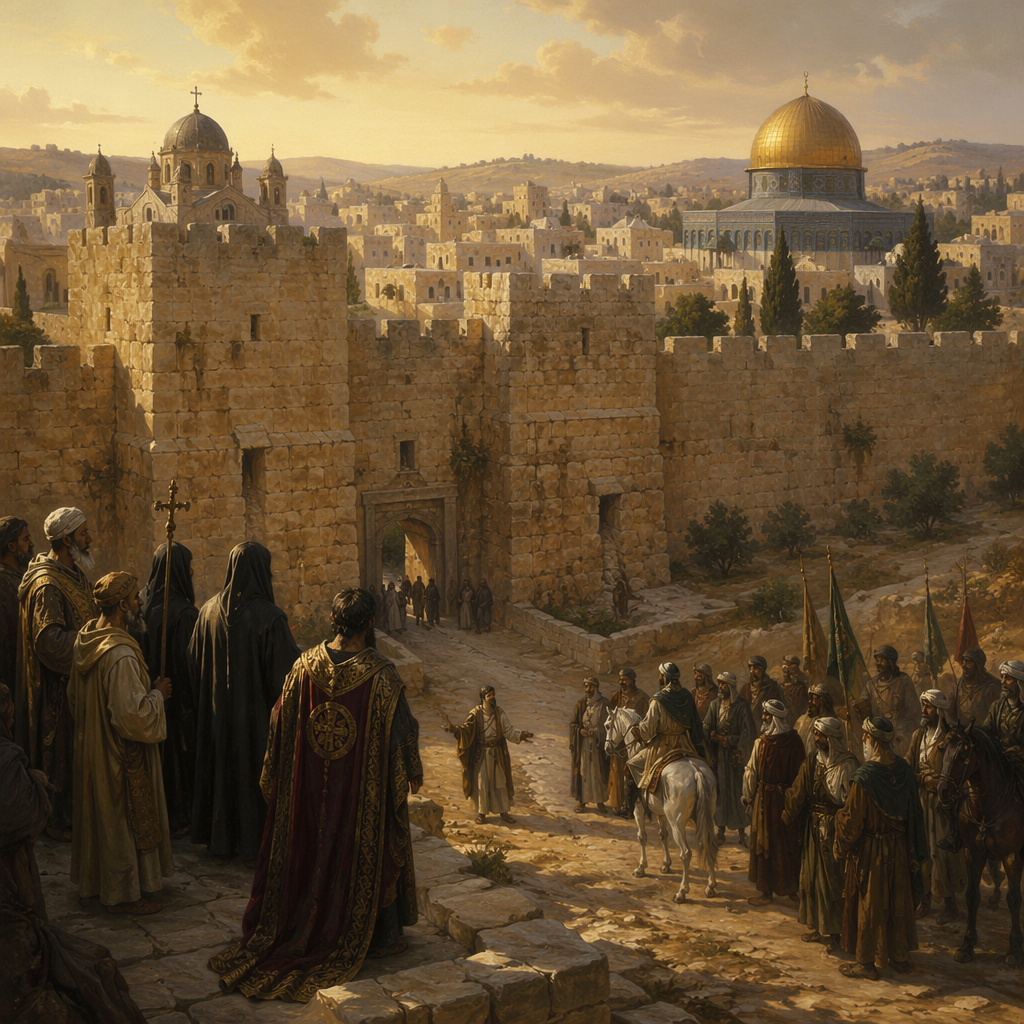
What altered in 637 CE was not a battlefield annihilation but a political decision that reshaped sovereignty. As Byzantine control in the Levant weakened, Jerusalem’s leading figures negotiated the city’s course. Sophronius of Jerusalem, identified as a leading Christian cleric in the accounts that preserve the moment, figures in that surrender. On the Rashidun side, Umar ibn al-Khattab, the caliph who oversaw the early expansion of Islamic rule, became the principal political figure under whose authority the city was incorporated. The core change was formal: Jerusalem ceased to be governed from Constantinople and instead became part of the Rashidun polity.
That transfer reflected choices on all sides — the Byzantine capacity to defend and administer distant provinces, local willingness to seek terms rather than fight to ruin, and the Rashidun leadership’s interest in securing a functioning, sacred city rather than destroying its structures. In practice, the surrender established new relationships of authority and protection that would determine who administered justice, collected revenue, and regulated access to the city’s holy places. The turning point was the conversion of military success into a negotiated sacred-city settlement. Jerusalem became part of an expanding caliphate while retaining Christian communities and becoming more central to Islamic sacred geography.
Consequences
In the near term, the most immediate consequence was administrative and political: Jerusalem became part of the Rashidun caliphate, altering the chain of command and the city’s place within regional governance. That incorporation gave the early Islamic polity a durable foothold in the eastern Mediterranean and a direct stake in a city already central to neighboring empires and faith communities. Over the longer term, Jerusalem’s altered political alignment fed into changing religious and cultural horizons. Under subsequent Muslim dynasties the city acquired renewed religious and political significance — a central place within Umayyad imagination and policy, for example — and its sacred precincts were reframed within Islamic devotional life as well as remaining vital to Christian and Jewish communities.
The surrender also created a template for how conquerors and clerical authorities handled contested sacred space: negotiation, protection agreements and local autonomy shaped everyday experience. Finally, the 637 event has been remembered and reinterpreted in many later contexts; modern memory often pulls it into subsequent religious and national conflicts, but the seventh-century surrender itself is best understood as a distinct political moment whose consequences amplified Jerusalem’s long-standing centrality rather than inventing it. The afterlife leads to Umayyad building, the Dome of the Rock, medieval pilgrimage, Crusader memory, and modern arguments over sovereignty and sacred space. The event matters because one city's handover became a durable reference point for religious coexistence, empire, and contested memory.
Interpretation Notes
Modern memory often pulls the event into later religious and national conflicts; the page separates the seventh-century surrender from later arguments while explaining why the city stayed so powerful.
Why Keep Reading
Follow this thread to see how a single political transfer produced visible cultural and architectural changes, administrative experiments, and new pilgrimage patterns. Readers who continue will trace how Umayyad rulers placed Jerusalem into broader Islamic religious and political frameworks, how Byzantine and later Christian responses adapted, and how medieval and modern actors reworked memories of 637. Exploring those developments reveals how a single surrender could ripple through building projects, liturgical life, and international diplomacy across centuries. Read this page with the Byzantine-Sasanian wars, Dome of the Rock, Umayyad Damascus, the First Crusade, and the Islamic world timeline to follow how sacred cities become political centers.
Reading Path
Follow the story without losing the thread
Before This
- Plague of Justinian541 CE
- Constantinople FoundedMay 11, 330 CE
- Council of Nicaea325 CE
After This
- Umayyad Caliphate Founded661 CE
- Battle of Karbala680 CE
- Dome of the Rock Completed691-692 CE
Same Period
- Umayyad Caliphate Founded661 CE
- Battle of Karbala680 CE
- Dome of the Rock Completed691-692 CE
Wider Timeline
Mind Map
How to think about Rashidun Conquest of Jerusalem
Byzantine weakness
Imperial overstretch and military pressures reduced Byzantine capacity to defend and administer Jerusalem.
Map Layer
Where this event sits geographically
Gold pins mark the approximate locations of published event pages. This is a schematic locator map, not a historical border map.
Coordinates are approximate and are used to help readers orient themselves before opening a full event page.
References
Where to Check the Facts
- Encyclopaedia Britannica: Islamic world, conversion and crystallizationReference for early Islamic expansion, Umayyad-Abbasid transition, conversion, and social change.
- The Metropolitan Museum of Art: Trade and Travel in the Islamic WorldReference for Islamic-world land and sea paths, travel, and exchange with China, the Near East, and Indian Ocean networks.
- Encyclopaedia Britannica: RashidunReference for the first four caliphs and early Islamic expansion beyond Arabia.
- Encyclopaedia Britannica: Jerusalem, HistorySpecific reference for Jerusalem's late antique history, Byzantine rule, Muslim conquest, and sacred urban setting.
- Fordham Internet History Sourcebooks: The Pact of UmarTeaching source for later traditions associated with Umar, protected communities, and the memory of conquest agreements.