At a Glance
The shape of the event
- Date
- 541 CE
- Place
- Eastern Mediterranean
- Type
- Pandemic
A devastating plague struck the Byzantine world during Justinian's reign, spreading through connected trade and urban networks.
541 CE; place the event in Eastern Mediterranean before comparing causes or consequences.
The plague is a major case for understanding disease, empire, climate, trade, and historical uncertainty in late antiquity.
Justinian I are the first names or groups to compare before widening the story.
The disease caused severe mortality and strained imperial resources, cities, armies, and tax systems.
The disease caused severe mortality and strained imperial resources, cities, armies, and tax systems.
The plague is a major case for understanding disease, empire, climate, trade, and historical uncertainty in late antiquity.
Follow the next pages to trace the human and institutional ripple effects: how ports and caravan routes adapted, how municipal governments tried to restore order, and how military logistics coped with fewer recruits.
Background
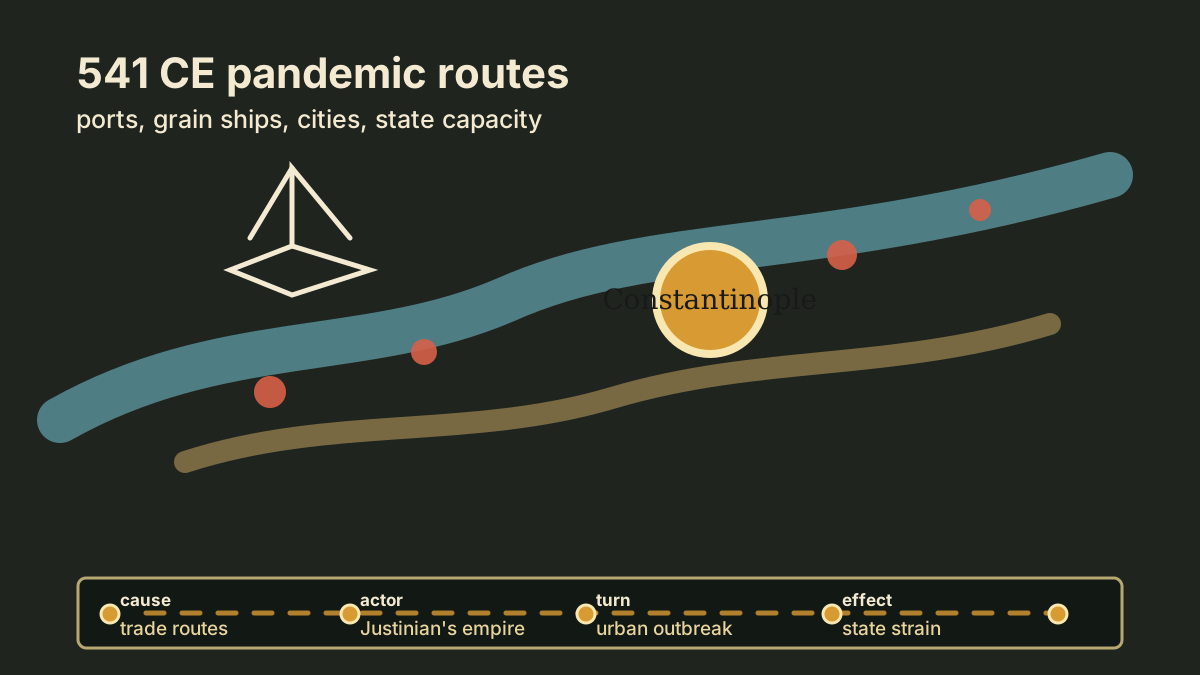
By the mid-sixth century the Eastern Mediterranean pulsed with traffic. Merchant ships linked ports, caravans threaded coastal roads, and cities concentrated artisans, soldiers, administrators and consumers. The Byzantine state depended on that circulation — for customs, tax income and the grain that fed urban populations and armies. Those obligations created steady pressure on imperial coffers and logistical systems. At the same time, urban density and commercial exchange made rapid disease transmission more likely: what moved goods and information also moved contagion. Historians debate additional background influences: climatic fluctuations that altered harvests and movement; demographic trends that shaped labour supply; and institutional choices that determined how resources were raised and deployed. No single factor explains everything.
This context matters because it frames the choices available to people — from merchants deciding whether to sail, to city officials managing markets, to the imperial court balancing revenue and defense — when the epidemic arrived. A deeper reading has to separate the disease event from the later habit of blaming every Byzantine problem on plague. The outbreak moved through grain routes, ports, army movements, and dense urban life around the eastern Mediterranean. Constantinople was vulnerable because it was a huge imperial capital fed by long-distance supply, not because it was uniquely careless or doomed. Evidence comes from written testimony such as Procopius, later chronicles, burial archaeology, paleogenetic work on Yersinia pestis, and comparison with other plague waves.
Each source type has limits: literary writers moralized suffering, bones rarely preserve a full social picture, and genetic evidence can identify pathogen presence without measuring every political consequence.
The Turning Point
In 541 CE the situation shifted from background pressure to acute crisis. The plague, arriving within the Eastern Mediterranean's interconnected urban and maritime networks, transformed everyday commerce into a vector for illness and fear. For individuals the immediate decisions were stark: flee a port or stay and tend the sick; shut a market or risk famine; report deaths and risk quarantine or conceal them and invite further spread. For institutions the dilemmas were strategic: how to keep soldiers supplied when recruitment and levies faltered, how to balance urgent relief against depleted treasuries, and how to sustain civic services as personnel sickened or died.
Justinian I, as emperor, was a focal point for those demands — his court faced requests for emergency funds, logistical support for garrisons, and measures to restore order. Contemporaries made choices under severe uncertainty; historians continue to argue over how much immediate policy decisions shaped outcomes versus how much the empire's underlying economic and social structures determined the crisis's depth. The turning point was the collision between an ambitious imperial restoration project and a biological shock moving through the same networks that made the empire powerful. Justinian's government depended on taxes, troops, shipping, food supply, law, and urban administration.
A pandemic could weaken all of those systems at once by killing workers, frightening markets, interrupting movement, and forcing officials to respond to death at scale. The event did not simply end Byzantine expansion overnight, but it changed the conditions under which imperial recovery had to operate.
Consequences
In the near term the plague produced severe mortality and widespread disruption. Cities lost workers and officials, markets and public services strained, and armies faced recruitment shortfalls — all of which pressed the imperial budget and complicated routine administration. Tax systems, normally calibrated to predictable flows of revenue and labour, were thrown into imbalance as receipts fell and demands rose. Over the longer term the episode has been read in multiple ways: as a catalytic shock that altered population distribution and economic rhythms; as a stress test that accelerated pre-existing trends in urban decline or fiscal reorganization; and as a reminder of the limits of human control in the face of biological forces.
Scholars treat these outcomes cautiously: some highlight measurable institutional adaptations, others emphasize persistent uncertainty in the sources, and many stress that the plague's role varied by place and by the decisions made locally. Ultimately the Plague of Justinian stands as a major case for understanding how disease, empire, climate and trade intersect and for accepting that several plausible, sometimes competing explanations coexist. The consequences were uneven and debated. Some regions recovered faster than others; some fiscal and military pressures had already existed; and later wars with Persia, Lombards, and Arabs cannot be reduced to one outbreak. Still, the plague matters because it made demographic fragility visible inside a connected empire.
It also helps readers understand pandemics as historical actors that work through trade, inequality, state capacity, and memory. The story is therefore not only medical. It is about how an empire built for movement handled a disease that used movement as its road.
Interpretation Notes
Plague of Justinian raises a debate about scale: did the decisive change come from the visible pandemic, or from older pressures around Disease and Byzantine Empire that had already narrowed what people could do?
Why Keep Reading
Follow the next pages to trace the human and institutional ripple effects: how ports and caravan routes adapted, how municipal governments tried to restore order, and how military logistics coped with fewer recruits. Understanding the plague here changes how you read the Byzantine state — not as a static machine, but as a set of choices and vulnerabilities exposed by a pandemic. If you want to see how contested evidence is weighed, or how historians map uncertainty onto maps and tax rolls, continue into timelines of the mid-sixth century and case studies of affected cities and trade hubs. Read next through Justinian, Byzantine survival, Black Death, and trade-disease exchange pages.
The comparison helps distinguish immediate mortality, long-term institutional strain, and later memory of catastrophe.
Reading Path
Follow the story without losing the thread
Before This
- Fall of the Western Roman Empire, 476 AD: What Happened Next476 CE
- Teotihuacan Reaches Its Urban Peakc. 450 CE
- Constantinople FoundedMay 11, 330 CE
After This
- Beginning of Muhammad's Revelationsc. 610 CE
- Hijra to Medina622 CE
- Battle of BadrMarch 624 CE
Same Period
- Beginning of Muhammad's Revelationsc. 610 CE
- Hijra to Medina622 CE
- Battle of BadrMarch 624 CE
Wider Timeline
Mind Map
How to think about Plague of Justinian
Trade networks
Merchants and ships linked ports and cities, creating rapid pathways for contagion across the Eastern Mediterranean.
Map Layer
Where this event sits geographically
Gold pins mark the approximate locations of published event pages. This is a schematic locator map, not a historical border map.
Coordinates are approximate and are used to help readers orient themselves before opening a full event page.
References
Where to Check the Facts
- Encyclopaedia Britannica: Black DeathReference for plague chronology, transmission debates, mortality, and social consequences.
- CDC: 1918 Pandemic H1N1 VirusPublic-health reference for the 1918 influenza pandemic and modern pandemic framing.