At a Glance
The shape of the event
- Date
- May 29, 1453
- Place
- Constantinople
- Type
- Siege
The Fall of Constantinople happened on May 29, 1453, when Mehmed II's Ottoman forces captured the city after a 55-day siege. Read the event through a four-step sequence: Ottoman artillery and blockade pressure on the Bosporus map, Byzantine wall defense, the final assault before dawn, and the aftermath in which Constantinople became an Ottoman imperial capital.
May 29, 1453; place the event in Constantinople before comparing causes or consequences.
The conquest strengthened Ottoman command of the Bosporus and linked its Balkan and Anatolian territories to an imperial capital. It also produced death, captivity, displacement, religious change, repopulation, and rebuilding. The event is a major historical boundary, but it did not single-handedly cause the Renaissance, end all Byzantine political traditions, or force European oceanic exploration.
Mehmed II / Constantine XI Palaiologos are the first names or groups to compare before widening the story.
The Ottoman army took Constantinople on May 29, 1453; Byzantine imperial rule in the city ended, and Mehmed II made the conquered city the center of a new Ottoman imperial project.
The Ottoman army took Constantinople on May 29, 1453; Byzantine imperial rule in the city ended, and Mehmed II made the conquered city the center of a new Ottoman imperial project.
The conquest strengthened Ottoman command of the Bosporus and linked its Balkan and Anatolian territories to an imperial capital. It also produced death, captivity, displacement, religious change, repopulation, and rebuilding. The event is a major historical boundary, but it did not single-handedly cause the Renaissance, end all Byzantine political traditions, or force European oceanic exploration.
Trace the next chapters if you want to see how a single capture rippled outward: follow Mehmed II’s policies as he transformed a conquered city into an imperial capital; watch how European states adjusted their mariti...
Background
By the mid-fifteenth century Constantinople was both an enormously prestigious city and a political state in deep trouble. For generations the Byzantine imperial domain had been reduced to far smaller territory than its ancient reach; it survived by diplomacy, limited resources, and appeals for outside assistance. Across the Bosporus a recently consolidated Ottoman state had expanded in strength and organization, confident in its capacity to project force and to integrate new territories. Constantinople’s position at the junction of sea and land routes made it a prize not only for prestige but for power over trade and regional diplomacy.
Contemporaries understood the stakes differently: some emphasized the immediate decisions of rulers and commanders, others pointed to longer structural trends—economic shifts, demographic pressures, and changing military technologies—that made the city increasingly vulnerable. This account keeps those disputes visible. It treats the fall as the outcome of both deliberate choices and deeper forces, each shaping what could and could not be done in 1453. Constantinople was the capital of the eastern Roman, or Byzantine, Empire and a center of Orthodox Christian memory. By the fifteenth century that inheritance was much larger than the territory and revenue the emperor could command. The city still possessed the Theodosian land walls, access to the sea, experienced defenders, and immense symbolic authority.
It also faced an Ottoman state that controlled much of the surrounding region and could bring a larger army, artillery train, fleet, engineers, supplies, and sustained political attention to one campaign. Mehmed II's objective was strategic as well as ceremonial. Constantinople sat between Ottoman lands in Europe and Anatolia and controlled movement through the Bosporus. Capturing it promised a capital from which the sultan could express both Ottoman-Islamic sovereignty and a claim to universal empire. On the Byzantine side, Constantine XI sought outside help and accepted Latin and Genoese assistance, but aid remained limited and religious union with Rome was contested inside the city. No single machine explains the result.
Large cannon damaged and intimidated, but bombardment required powder, shot, transport, crews, targeting, and repeated work. Walls still had to be attacked, breaches defended or repaired, ships supplied, soldiers rotated, and morale sustained. The siege is therefore evidence for a coordinated Ottoman system rather than a simple tale of new technology making old fortifications obsolete overnight.
The Turning Point
The decisive phase of the fall unfolded in a concentrated campaign led by Mehmed II against the walls and defences of a city commanded by Constantine XI Palaiologos. Ottoman forces imposed a sustained siege that tested every line of supply, every hope for external aid, and every hour of endurance inside the city. Constantine XI and the city's defenders struck bargains, organized what resistance they could, and appealed to potential allies, but the siege gradually reduced those options. Mehmed II, having marshalled men and resources, pressed the blockade and conducted operations meant to overwhelm the defenders’ ability to hold the walls and harbors. On 29 May 1453 this prolonged investment culminated in the Ottoman capture of Constantinople.
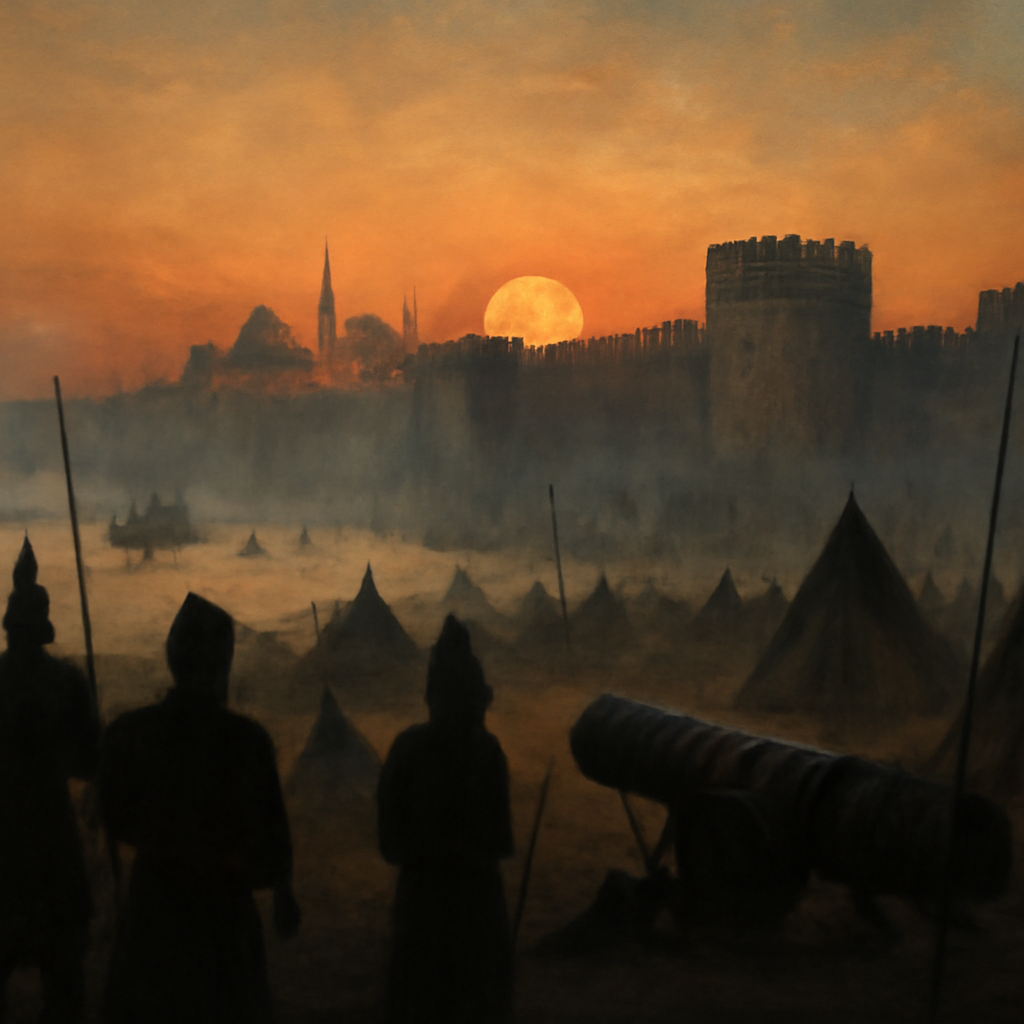
The immediate change was unmistakable: a Byzantine hold on imperial sovereignty ended, and the city’s political allegiance passed to the Ottomans. Yet the turning point is not only a date on a map; it is a moment when the strategic judgments of two leaders intersected with larger material constraints—so that the outcome depended on both personal command and the broader balance of forces that had been shifting for decades. The siege began in early April. Ottoman batteries struck the land walls while Byzantine and allied defenders repaired damaged sections and guarded gates, towers, sea walls, and the harbor chain. A small relief fleet fought through to the city on April 20, showing that the blockade was dangerous but not absolute.
Soon afterward, Ottoman ships were hauled overland into the Golden Horn, bypassing the harbor chain's main protection and increasing pressure on a defensive force already stretched across a wide perimeter. Before dawn on May 29, Mehmed ordered a final assault in waves. Fighting concentrated around the damaged land-wall sector. The wounding and withdrawal of the Genoese commander Giovanni Giustiniani weakened the defense, Ottoman troops gained the walls, and organized resistance collapsed. Constantine XI died in the fighting, but confident stories about his last words, exact position, or the recovery of his body go beyond what the surviving accounts securely establish. For defenders and civilians, the capture meant killing, looting, captivity, ransom, flight, and religious shock.
For Ottoman soldiers and commanders it was a hard-won imperial victory. Naming both experiences is not an attempt to balance suffering against achievement; it is necessary because conquest was simultaneously a military outcome, a transfer of sovereignty, and a violent event lived by unequal groups.
Consequences
In the near term the fall dissolved the Byzantine imperial government that had claimed continuity with Rome. Constantinople became the central capital of Ottoman power, providing a highly visible seat from which the sultans could govern territories on both sides of the Bosporus. That transfer of authority altered immediate patterns of diplomacy: European courts confronted a new, proximate imperial power whose interests and ambitions had to be reckoned with directly. In economic terms the city’s capture contributed to a reconfiguration of eastern Mediterranean trade and the routes that linked Europe and Asia, prompting merchants and states to adjust their strategies.
On religious and cultural lines the conquest changed the balance of authority between Orthodox Christian institutions and the emerging Ottoman order, producing new arrangements and tensions in the region. Over the long term the fall of Constantinople entered European and Ottoman memory as a decisive inflection point. Historians continue to debate the relative weight of contingent decisions versus long-term structural change in producing this outcome; both strands matter for understanding why 1453 reshaped the politics, diplomacy, and commerce of the eastern Mediterranean for centuries. The immediate political result was the end of Byzantine imperial government in Constantinople. Mehmed II made the city an Ottoman capital and pursued repopulation, rebuilding, commercial revival, and the reuse or conversion of major buildings.
Ottoman rule did not erase the population or every Byzantine institution at once; the new regime reorganized communities and sacred spaces while drawing Muslims, Christians, Jews, merchants, artisans, officials, and captives into the capital. The conquest strengthened Ottoman control across the Bosporus and gave the dynasty a center joining Balkan and Anatolian territories. It also changed diplomacy and strategic planning around the eastern Mediterranean. Yet broad claims need limits. Greek scholars had moved west before 1453 as well as after it; Renaissance humanism was already developing; Mediterranean commerce continued under changing agreements; and European Atlantic voyages had multiple political, commercial, and technological causes.
The fall belongs in those histories, but it did not single-handedly cause the Renaissance or force oceanic exploration. Memory divided along different lines. Greek and Orthodox traditions often emphasized loss, exile, and the ending of a Roman-Byzantine world. Ottoman traditions emphasized conquest, legitimacy, restoration, and imperial destiny. Latin Christian writers used the event as warning or a call for action. Modern textbooks often make 1453 a neat border between medieval and early modern history. That period boundary is useful for orientation, not a fact experienced identically by everyone on May 29.
Interpretation Notes
Accounts of 1453 come from Byzantine, Latin, Ottoman, and later writers with different loyalties and purposes. Historians agree on the date, the Ottoman victory, and the end of Byzantine imperial government in Constantinople, but exact troop totals, casualty figures, details of Constantine XI's death, and stories such as the Kerkoporta remain uncertain or disputed. The conquest can be narrated as Byzantine catastrophe, Ottoman victory, or an imperial transfer; a responsible account keeps those memories distinct and does not turn one tradition into the only voice.
Why Keep Reading
Trace the next chapters if you want to see how a single capture rippled outward: follow Mehmed II’s policies as he transformed a conquered city into an imperial capital; watch how European states adjusted their maritime and diplomatic strategies in response; and observe how religious authorities negotiated new authority under Ottoman rule. Reading these sequences illuminates how one dramatic event set in motion political, economic and cultural adjustments whose consequences extended well beyond 1453. Read backward to the founding of Constantinople and the Fourth Crusade, then forward to Mehmed II, Ottoman-Safavid rivalry, and the siege of Vienna.
That route explains why the city carried Roman and Christian memories before 1453, how Ottoman rulers used it afterward, and why one successful siege did not make later Ottoman expansion automatic.
Reading Path
Follow the story without losing the thread
Before This
- Black Death Reaches Europe1347 CE
- Great Schism of 10541054 CE
- Rashidun Conquest of Jerusalem637 CE
After This
- Battle of ChaldiranAugust 23, 1514
- Ottoman Conquest of Egypt1517 CE
- Siege of Vienna1529 CE
Same Period
- Black Death Reaches Europe1347 CE
- Battle of Marathon, 490 BCE: Summary, Sides, Winner, and Significance490 BCE
- Battle of LepantoOctober 7, 1571
Wider Timeline
Mind Map
How to think about Fall of Constantinople, 1453: Siege Timeline, Causes, Aftermath
Contracting empire
Byzantine territory and resources had narrowed while Constantinople retained enormous Roman and Orthodox prestige.
Map Layer
Where this event sits geographically
Gold pins mark the approximate locations of published event pages. This is a schematic locator map, not a historical border map.
Coordinates are approximate and are used to help readers orient themselves before opening a full event page.
References
Where to Check the Facts
- British Library: The Last Day of ConstantinopleInstitutional reference for the 1453 fall, Byzantine memory, and Ottoman Istanbul context.
- Primary Source Index: Fordham Medieval Sourcebook, ByzantiumPrimary-source index reference for late Byzantine and fall-of-Constantinople materials.
- Encyclopaedia Britannica: Fall of ConstantinopleChronology reference for the 55-day siege, the final assault on May 29, 1453, Mehmed II, Constantine XI, and the Ottoman capture of the city.
- The Metropolitan Museum of Art: Constantinople after 1261Museum synthesis for late Byzantine contraction, Constantinople's condition by 1453, and the city's repopulation and reuse under Mehmed II.
- The Metropolitan Museum of Art: The Art of the Ottomans before 1600Museum context for Ottoman expansion, the 1453 capture, and the political and artistic ambitions of Mehmed II's court.