At a Glance
The shape of the event
- Date
- 490 BCE
- Place
- Marathon
- Type
- Battle
The Battle of Marathon happened in 490 BCE on the plain of Marathon near Athens. An Athenian-led force, joined by Plataeans, defeated a Persian expedition sent after the Ionian Revolt and Athenian involvement in it. The battle did not end Persian power, but it gave Athens a powerful memory of citizen defense before later Persian War battles such as Thermopylae and Salamis.
490 BCE; place the event in Marathon before comparing causes or consequences.
Marathon became a lasting symbol of Greek resistance and helped frame later conflicts between Greek city-states and the Persian Empire.
Miltiades / Darius I are the first names or groups to compare before widening the story.
The Persian landing force withdrew, while Athens gained military and political prestige.
The Persian landing force withdrew, while Athens gained military and political prestige.
Marathon became a lasting symbol of Greek resistance and helped frame later conflicts between Greek city-states and the Persian Empire.
If Marathon raises questions about leadership, civic resolve, and the making of historical memory, the next step is to follow those strands forward.
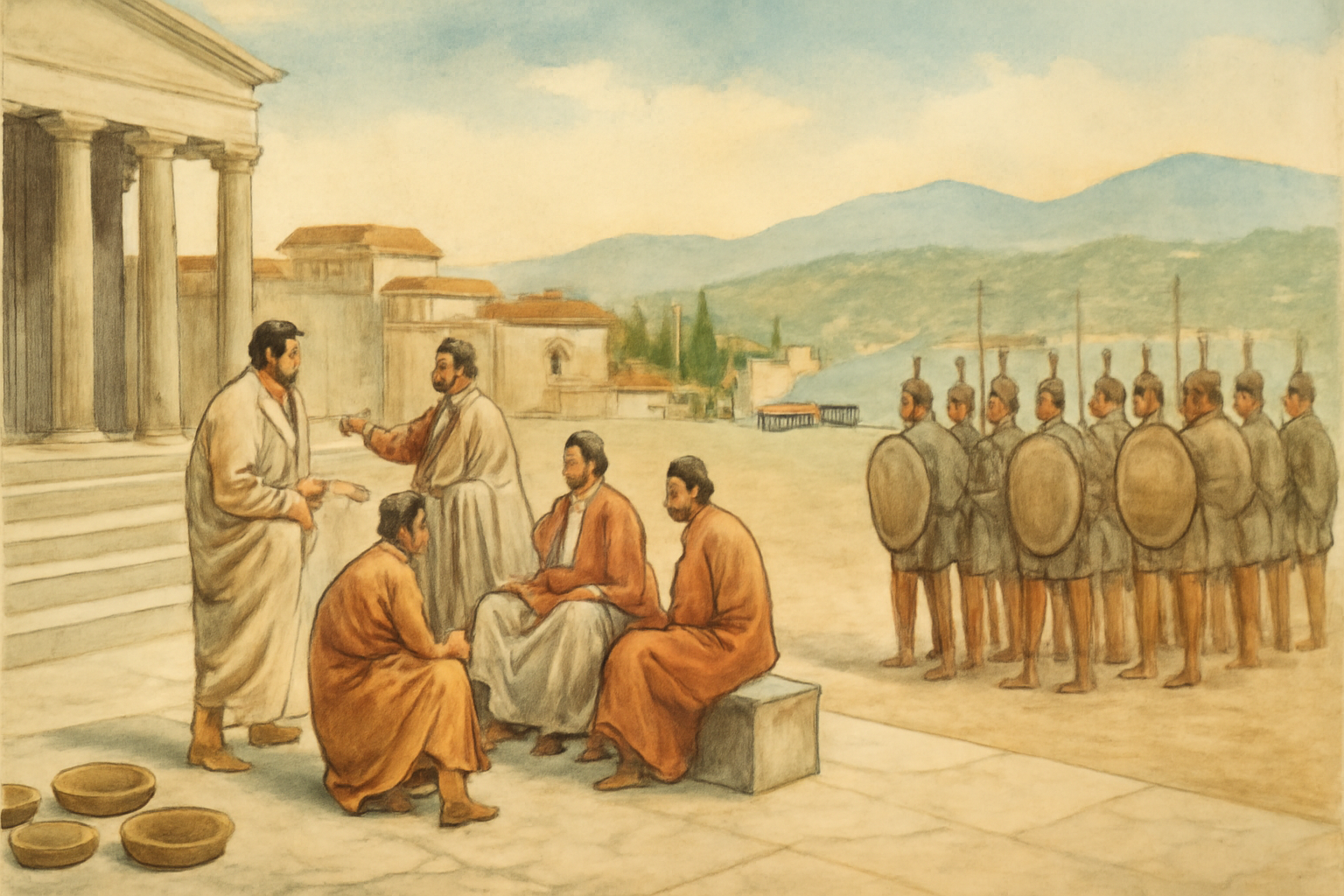
Background
By 490 BCE the eastern Mediterranean was a landscape of imperial ambition and local autonomy. The Persian Empire under Darius I extended its reach across many peoples and islands of the Aegean, and its campaigns brought it into frequent contact with Greek city-states. Athens, still developing democratic institutions and civic identity, found itself in the path of that expansion. Tensions that produced the Greek-Persian Wars were not the product of a single cause: religious, economic, diplomatic, and military pressures converged alongside local quarrels and prior rebellions in the region. The expedition that landed at Marathon represented a Persian attempt to project power beyond the immediate frontier, and for the Athenians it posed an existential threat.
Communities had to weigh immediate survival against longer-term political choices, and battlefield decisions were shaped by troop composition, leadership, and the constraints of the moment. Modern historians continue to debate how much of the outcome should be attributed to contingency—particular leaders and fleeting choices—and how much to strategic position, social organization, and the wider geopolitics of the early fifth century BCE. Marathon is strongest when the reader sees both scales at once. At one scale, it was a battle on the plain of Marathon between an Athenian-led force and a Persian expedition.
At another scale, it was part of a much larger imperial problem: how Achaemenid power answered revolt, punished defiance, secured the Aegean edge, and dealt with independent Greek city-states that did not fit easily into imperial order. The battle is therefore not just a heroic local story. It is a meeting point between a small polis world and an empire that governed through roads, satrapies, tribute, royal command, and negotiated local authority. The Athenian setting matters because Marathon followed recent political change. Cleisthenes' reforms had reorganized citizen identity, tribes, demes, and participation. That did not make Athens a modern democracy, and it did not include everyone, but it gave citizens a sharper stake in the city's defense.
Reading Marathon after the reform page helps readers see why politics and military action belonged together. The men who fought were defending land and city, but they were also defending a civic order still new enough to feel vulnerable. Geography makes the battle less abstract. Marathon was not a symbol floating outside the map. It was a landing zone, a route toward Athens, a plain shaped by hills and marshes, and a place where timing mattered. The distance between battlefield and city explains why later memory linked military victory with urgent civic communication. The map also prevents a simple East-versus-West reading. The Aegean world was full of Greek cities under Persian influence, trading relationships, tyrants, exiles, allies, and rivals.
Marathon becomes more interesting when that mixed world remains visible.
The Turning Point
The decisive shift at Marathon came when Athenian and Plataean forces engaged the Persian landing force and changed the trajectory of the campaign. On one side stood troops associated with the Persian expedition linked to Darius I; on the other, the Athenians under Miltiades, supported by their Plataean allies. The immediate change was military: what had been a Persian attempt to secure a foothold became a withdrawal. That reversal was not inevitable. It turned on the choices of commanders, the willingness of citizen-soldiers to fight, and the capacity of a city-state to marshal forces quickly.
Miltiades emerges in the record as a concrete actor whose leadership mattered, but historians note that his role cannot be separated from structural features—Athenian political institutions that generated hoplite participation, local alliances like Plataea's commitment, and Persian logistical limits. The battle altered perceptions as well as positions on a map: a retreat by the expedition transformed an external threat into a potent story of resistance that resonated within Athens and among other Greek poleis. The turning point thus fused contingency and context—an immediacy of decision within broader, slower-moving forces. The turning point was the decision to confront the Persian force rather than treat the landing as only a temporary raid.
Athenian leaders had to weigh fear, manpower, local knowledge, help from Plataea, and uncertainty about wider Greek support. That decision makes the battle a political moment before it becomes a military one. A city-state under pressure had to decide whether its institutions could produce collective action quickly enough to matter. The battle itself is clearer when readers avoid turning tactics into legend. Hoplite organization, terrain, discipline, leadership, and the limits of the Persian landing force all mattered. The Athenian victory did not destroy Persian power, and it did not make future invasion impossible. What it did was prove that a Greek citizen army could defeat a royal expedition under specific conditions.
That proof changed confidence, memory, and the questions Persian and Greek leaders asked next. The human layer also matters. Marathon involved citizens, allied Plataeans, messengers, families waiting in Athens, enslaved people and non-citizens excluded from the public story, Persian soldiers far from the imperial center, and later audiences who turned the battle into moral education. A rich event page keeps those layers together. The famous date becomes easier to remember when readers can ask who was counted as defender, who was left out of citizenship, and who paid the risks of imperial and civic ambition.
Consequences
In the near term, the Persian landing force withdrew from Marathon, and Athens enjoyed an immediate boost in military and political prestige. That prestige helped to solidify the city’s standing among other Greek states and offered a practical demonstration that a coordinated civic military effort could resist imperial projection. In the longer term, Marathon became a durable symbol in Greek memory: a reference point for resistance that shaped how later generations framed conflicts with the Persian Empire. The battle’s legacy operated on several levels. Politically, it fed narratives of legitimacy and leadership within Athens, informing debates about power and honor. Militarily, it offered a model—contested and reinterpreted—about how citizen-armies could be effective against mounted empires.
Culturally, Marathon entered storytelling, ritual, and commemoration in ways that outlived the immediate tactical circumstances. Historians caution that the link between a single battle and sweeping historical outcomes is not straightforward; Marathon mattered because later actors chose to remember and use it. Thus its consequences combine concrete outcomes—a Persian withdrawal and Athenian prestige—with evolving meanings that helped frame the continuation of the Greek-Persian Wars and intra-Greek politics for decades to come. The immediate consequence was not a final Greek victory over Persia. The Persian Empire remained powerful, and later campaigns made the danger larger. Marathon mattered because it gave Athens a usable memory before the bigger Persian War sequence.
When Thermopylae and Salamis entered the story, Marathon already supplied a language of civic courage, divine favor, discipline, and resistance. That memory could inspire, but it could also simplify a more complicated Aegean political world. For Athens, the victory helped build confidence at a dangerous moment. Confidence could be creative, but it could also become aggressive. The later Athenian empire, the Peloponnesian War, and disputes over freedom and domination are easier to understand when Marathon is not frozen as a perfect moral scene. The same city that celebrated resistance to Persia later demanded obedience from allies. That tension makes the event useful for readers who want history to stay honest.
Marathon's long afterlife is one reason the page deserves formal depth. Later writers, schools, politicians, and popular culture turned it into a symbol of western liberty, citizen courage, and military endurance. Those uses reveal more about later memory than about 490 BCE alone. A careful reading lets the battle remain important while resisting the temptation to make it carry every later political meaning placed on it.
Interpretation Notes
The hardest question around Battle of Marathon is causation. The event had immediate actors, but its meaning also came from institutions, geography, resources, and expectations already present in Aegean.
Why Keep Reading
If Marathon raises questions about leadership, civic resolve, and the making of historical memory, the next step is to follow those strands forward. Read on to trace how Athens leveraged the prestige it won at Marathon, how other Greek city-states responded to Persian pressure, and how successive campaigns transformed a regional contest into a prolonged conflict between competing political worlds. Exploring the immediate aftermath and the subsequent campaigns reveals how a single encounter can be reinterpreted by later generations and why disputes over causes—individual decision versus structural forces—remain central to understanding this era. The best next path moves in two directions.
Go backward to Cleisthenes to see why Athenian civic identity mattered, then forward to Thermopylae, the Peloponnesian War, and the Greek City-States hub to see how resistance, alliance, rivalry, and memory changed over time. For comparison, open Achaemenid Persia and Ancient Empires to see the Persian side as an imperial system rather than a backdrop for Greek courage.
Reading Path
Follow the story without losing the thread
Before This
- Cleisthenes Reforms Athens508 BCE
- Cyrus Conquers Babylon539 BCE
- Achaemenid Empire Foundedc. 550 BCE
After This
- Battle of Thermopylae480 BCE
- Peloponnesian War Begins431 BCE
- Battle of Gaugamela331 BCE
Same Period
- Qin Unification of China221 BCE
- Assassination of Julius CaesarMarch 15, 44 BCE
- Founding of the Roman Empire27 BCE
Wider Timeline
Mind Map
How to think about Battle of Marathon, 490 BCE: Summary, Sides, Winner, and Significance
Persian projection
An expedition tied to Darius I sought to extend Persian influence into the Aegean and confront recalcitrant Greek communities.
Map Layer
Where this event sits geographically
Gold pins mark the approximate locations of published event pages. This is a schematic locator map, not a historical border map.
Coordinates are approximate and are used to help readers orient themselves before opening a full event page.
References
Where to Check the Facts
- British Museum: The Marathon's Ancient OriginsMuseum reference for Marathon's ancient memory and later cultural afterlife.
- Primary Source: Herodotus on the Battle of MarathonPrimary-source excerpt for Herodotus's account of Marathon in the Persian Wars.
- Encyclopaedia Britannica: Battle of MarathonSpecific reference for the date, belligerents, outcome, and Greco-Persian War context.
- Encyclopaedia Britannica: Ancient Greece, the Battle of MarathonContext reference for Athens, Plataea, and the wider Persian invasion narrative.