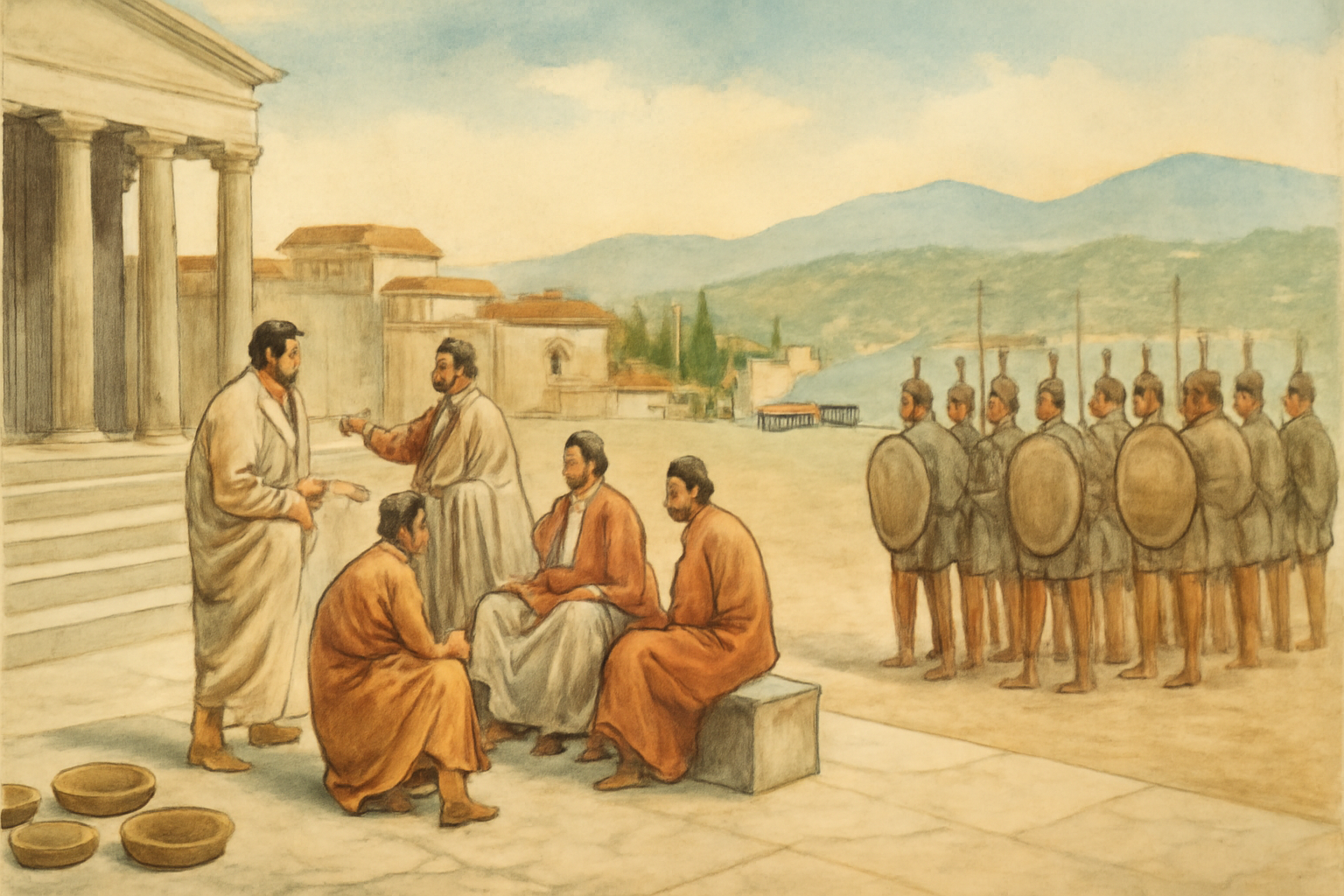
Central Question
Why did small Greek city-states create such durable political identities, and why did their freedom also produce rivalry, exhaustion, and imperial vulnerability?
Start With These Dates
- c. 550 BCEAchaemenid Empire Founded
Cyrus the Great built the Achaemenid Empire from a Persian power base, creating an imperial system that connected Iran, Mesopotamia, Anatolia, and Central Asia.
- 539 BCECyrus Conquers Babylon
Cyrus the Great captured Babylon, absorbing the Neo-Babylonian kingdom into the expanding Achaemenid Empire.
- 508 BCECleisthenes Reforms Athens
Cleisthenes reorganized Athenian political participation around new tribes and demes, helping create the institutional foundations of Athenian democracy.
- 490 BCEBattle of Marathon, 490 BCE: Summary, Sides, Winner, and Significance
The Battle of Marathon happened in 490 BCE on the plain of Marathon near Athens. An Athenian-led force, joined by Plataeans, defeated a Persian expedition sent after the Ionian Revolt and Athenian involvement in it. The battle did not end Persian power, but it gave Athens a powerful memory of citizen defense before later Persian War battles such as Thermopylae and Salamis.
- 480 BCEBattle of Thermopylae
A small Greek force led by Sparta delayed the Persian army at Thermopylae during the second Persian invasion of Greece.
- 312 BCESeleucid Empire Founded
Seleucus I Nicator established the Seleucid Empire from part of Alexander the Great's former realm, linking Greek-Macedonian rule with western Asian political geography.
- 27 BCEFounding of the Roman Empire
Octavian accepted the title Augustus and reorganized Roman power around a new imperial settlement that preserved republican language while concentrating authority.
Sources Used Here
- The Metropolitan Museum of Art - Ancient Greece, 1000 B.C.-1 A.D.
Used to verify the city-state frame, colonization, and wider Greek cultural chronology.
- Encyclopaedia Britannica - Ancient Greek civilization, Sparta and Athens
Used to cross-check Athens, Sparta, city-state politics, and Greek institutional contrast.
- National Geographic Society - Greek City-States
Used to verify the basic polis explanation and how city-states structured Greek interaction.
Greek City-States is a civilization hub about political scale. The polis was small compared with Persia, Rome, Han China, or the Maurya Empire, but that smallness made identity intense. Citizens, assemblies, councils, laws, festivals, hoplite armies, temples, colonies, rivalries, and local myths gave Greek communities a strong sense of themselves. The hub is not a simple celebration of democracy. It asks why city-state freedom could produce creativity and participation while also producing exclusion, faction, war, and vulnerability.
Cleisthenes' reforms in Athens give the route its first institutional anchor. The event matters because it shows political order being redesigned inside a city, not imposed across an empire. But Athens is only one pole of the story. Sparta, Corinth, Thebes, island communities, colonies, and allied cities all remind readers that the Greek world was plural. A city-state was not one model; it was a field of competing ways to organize citizens, land, status, military service, and public honor.
The Persian Wars make city-state identity visible under pressure. Marathon and Thermopylae became memories of resistance, but they also reveal how fragile Greek cooperation could be. Some communities fought, some hesitated, some medized, and later generations turned selected moments into moral stories. This hub treats memory as part of the history. A battle is a military event, but a remembered battle becomes political education.
The Peloponnesian War gives the route its darker center. Athens and Sparta did not only disagree about policy; they represented rival alliance systems, strategic fears, economic interests, and different claims about freedom and order. The war shows how independent city-states could exhaust one another while trying to preserve autonomy. It also gives readers a reason to keep going: the same political intensity that produced public life and culture could also deepen mistrust and violence.
Alexander and the Hellenistic successor world show the afterlife of the city-state system. Gaugamela and the Seleucid Empire are not polis events in the narrow sense, but they reveal what happened when Macedonian and Hellenistic power scaled Greek language, cities, armies, and culture across older Persian spaces. The city-state did not simply vanish. It became embedded in kingdoms, leagues, colonies, and cultural networks that were larger than any single polis.
The social boundary of the polis also deserves attention. Citizen politics depended on exclusions: women, enslaved people, resident foreigners, subject allies, and poorer inhabitants often stood outside the full political story even when their labor, taxes, bodies, and skills sustained the city. This is why the hub does not let the language of freedom become too smooth. Greek city-states produced influential arguments about participation and law, but those arguments were built inside societies with sharp inequalities. A reader who keeps that tension visible will understand both the brilliance and the limits of the polis. The route treats citizenship as a historical question, not a slogan: who counted, who spoke, who fought, who paid, and who was remembered?
The best way to read this hub is to keep two questions open at once. First, what did small-scale political belonging make possible? Second, what did it make hard? The answer explains why Greek city-states generated influential ideas about citizenship, politics, law, philosophy, warfare, and memory, while also remaining vulnerable to internal conflict and larger imperial systems. That tension is what makes them essential to the Ancient Empires cluster even though they were not empires in the usual sense. The route also helps readers understand why later empires wanted Greek cities, teachers, soldiers, and symbols: the polis was small, but its cultural and political vocabulary traveled far beyond its walls. The hub makes that paradox memorable enough for the next comparison between city power and imperial power, especially after Alexander changed the later scale of Greek influence across regions.
A deeper Greek city-state route begins with scale. The polis was smaller than the Achaemenid, Roman, Han, or Mauryan imperial systems, but small scale did not mean small historical importance. City-states made political belonging intense. Citizens saw law, cult, land, memory, war, honor, and public speech as local matters tied to a specific community. The hub asks what that intensity made possible and what it made dangerous.
Periodization starts before the famous Persian Wars. Archaic developments such as colonization, lawgivers, social conflict, hoplite warfare, tyranny, sanctuaries, and trade shaped the world in which classical city-states operated. Cleisthenes' reforms then give Athens a clear institutional anchor. The Persian Wars made some city-state identities sharper under external pressure. The Peloponnesian War exposed the violence inside Greek rivalry. Macedonian and Hellenistic power then changed the scale without erasing Greek cities.
The political layer resists using Athens as the whole Greek world. Athens matters because democracy, empire, naval power, drama, philosophy, and public debate became historically influential. Sparta matters because it offers a different model of discipline, hierarchy, military organization, and fear of internal revolt. Corinth, Thebes, island poleis, colonies, and smaller communities remind readers that the Greek world was a network of experiments, not a single constitution.
The social layer is essential because citizen language can become too smooth. Political participation often excluded women, enslaved people, resident foreigners, subject allies, and many poorer or dependent people. Even within citizen bodies, wealth, family, age, military service, and reputation mattered. The hub keeps the attraction of public participation and the reality of exclusion on the same page. Greek freedom was powerful, but it was never universal.
The economic layer includes landholding, agriculture, trade, silver, tribute, pottery, ports, colonies, slavery, and warfare. Athens' naval empire and tribute system cannot be separated from its democratic culture and military strategy. Sparta's land system and dependence on helot labor cannot be separated from its politics and fear. City-state identity was built in assemblies and temples, but it was sustained through material systems that distributed labor, risk, and benefit unequally.
The religious and cultural layer ties politics to sanctuaries, festivals, myths, temples, oracles, sacrifices, athletic games, drama, and philosophical schools. A polis was not a secular machine. Public religion made community visible, marked calendars, authorized memory, and linked local identity to wider Greek networks such as Delphi and Olympia. Cultural achievement belongs inside this civic world rather than in a separate list of great works.
The military layer distinguishes hoplite battle, naval power, siege warfare, alliances, mercenaries, and Macedonian combined arms. Marathon and Thermopylae are not just heroic episodes; they show how later memory turns military moments into civic lessons. The Peloponnesian War then shows a different lesson: city-states could become trapped in security dilemmas, tribute systems, fear, plague, civil strife, and ideological claims about freedom.
Geography explains much of the story. Mountains, islands, narrow plains, harbors, colonies, sea lanes, and proximity to Anatolia helped produce a world of many poleis rather than one unified Greek state. The Aegean made connection and rivalry possible at the same time. The map shows Athens, Sparta, Marathon, Thermopylae, the Aegean, western Anatolia, Sicily, and the routes that connected colonies and alliances. Without geography, Greek fragmentation looks like a personality trait rather than a structural condition.
The before-and-after frame prevents the hub from ending at classical Athens. Before the classical period, communities experimented with law, settlement, aristocratic power, colonization, and military organization. During the classical period, city-state politics reached a high point of visibility and conflict. After Macedonian conquest, Greek cities continued to matter as civic communities inside kingdoms and empires. Hellenistic rulers founded, controlled, patronized, and used Greek cities as administrative and cultural instruments.
The memory layer needs direct treatment. Later readers often inherited idealized stories of democracy, heroic resistance, philosophy, and Western origins. Those memories can be useful, but they can also hide slavery, imperial tribute, gender exclusion, oligarchy, civil war, and dependence on non-citizen labor. The hub does not replace admiration with dismissal. It teaches readers how to admire and question at the same time.
Comparison gives the hub its world-history value. Persia shows city-states encountering imperial scale. Rome later shows a city becoming an empire, which raises a different question about political expansion. Han and Maurya show large agrarian imperial systems where bureaucracy, court, and moral authority operated differently from polis politics. Greek city-states therefore let readers compare small-scale participation with large-scale administration rather than treating one as more advanced.
The first screen makes the paradox clear: Greek city-states were small enough for citizens to imagine politics as personal, yet divided enough to exhaust themselves in rivalry and vulnerable enough to be absorbed into larger powers. That paradox gives the page its reason to exist. The polis is not a museum label; it is a test case for the costs and possibilities of intense political belonging.
A second paradox keeps the page alive: city-states could produce extraordinary public culture while relying on exclusion, forced labor, tribute, and rivalry. Holding achievement and cost together makes the route more honest and more memorable than a simple celebration of Greek origins.
The institutional layer makes public life concrete. Assemblies, councils, magistrates, courts, military musters, festivals, inscriptions, oaths, and civic spaces taught citizens how to recognize authority. Even when institutions differed from city to city, they made politics visible in repeated actions. This is why the hub does not define the polis only as a city. It was a set of practices that connected land, worship, law, memory, and military obligation.
The page also needs a source-awareness layer. Much of what readers know about Greek politics comes through literary authors, inscriptions, archaeology, later copying, and elite male voices. Those sources can be rich and brilliant, but they make some experiences easier to see than others. Women, enslaved people, foreigners, rural laborers, and subject allies often appear through the concerns of citizen writers. A strong hub tells readers to notice that imbalance.
The afterlife of the polis did not end when Macedonian power expanded. Hellenistic kings used Greek cities as foundations, administrative partners, cultural symbols, and strategic nodes. Local civic identities continued even under royal patronage or pressure. That survival matters because it complicates the idea that empire simply replaced the city-state. Instead, larger states reused the prestige, language, institutions, and urban forms of the polis for new purposes.
The final Greek layer is the danger of origin stories. Modern readers often meet Greek city-states as the beginning of democracy, philosophy, drama, or Western politics. Those labels can be useful entry points, but they can also turn a diverse ancient world into a simplified ancestor myth. The hub keeps the route historical: specific cities, specific exclusions, specific wars, specific evidence, and specific later reinterpretations. That makes the polis more interesting than a monument.
The practical route is simple but rich: start with Cleisthenes to see institutional redesign, read Marathon and Thermopylae for external pressure and later memory, use the Peloponnesian War for internal rivalry, then move to Gaugamela and the Seleucids for afterlife. By the end, the polis appears as both a local community and a form that traveled.
This route also gives readers a useful comparison question: when does political participation strengthen a community, and when does it intensify fear, exclusion, faction, or war? Keeping both answers open is what makes the city-state route worth reading as history, not as civic mythology or inherited slogan.
The stronger Greek route begins by refusing a single-Greece shortcut. Athens, Sparta, Corinth, Thebes, Miletus, Syracuse, and smaller poleis shared language and ritual reference points, but they organized land, citizenship, labor, gender, war, law, and memory differently. A reader who treats the polis as one political form misses the route's real drama: city-states competed over what public life could become.
The page also needs exclusion near the front. Citizen debate, assembly practice, law courts, and philosophical argument were historically important, yet they rested beside slavery, women's exclusion from formal citizenship, metic labor, rural dependence, and imperial tribute. Greek political history becomes richer when participation and exclusion are visible in the same paragraph instead of being split between admiration and correction.
A useful reading path follows scale: household, deme, agora, hoplite formation, harbor, colony, league, and empire. Marathon and Thermopylae show how city-state rivalry could become common defense; the Peloponnesian War shows how alliance systems, naval money, fear, plague, and ideology could turn that rivalry inward. The route is compelling because Greek freedom language was always entangled with coercion, hierarchy, and war.
Ask how citizenship, cult, law, land, public speech, and military service made a city feel politically meaningful.
Avoid making either city the whole Greek world. Use their contrast to see different answers to power, discipline, participation, and fear.
Read Marathon and Thermopylae as events and as later stories. Memory can simplify what the evidence makes complicated.
The Peloponnesian War is easier to understand as a network problem: allies, tribute, sea power, land power, and strategic anxiety.
Follow Alexander and the Seleucids to see how Greek cities, language, and culture operated inside larger imperial worlds.
Ask how small political scale made citizenship vivid, and why that same intensity could deepen rivalry and exclusion.
Use Athens, Sparta, Thebes, Corinth, islands, colonies, and smaller poleis as competing experiments rather than one model.
Keep citizens, women, enslaved people, resident foreigners, allies, and poorer inhabitants in the same analysis.
Read Marathon, Thermopylae, democracy, and philosophy as later memories as well as historical developments.
Compare Athens, Sparta, Corinth, Thebes, colonies, and leagues before treating the city-state as one model.
Choose a Reading Path
Need the Short Version
Start with Cleisthenes, Marathon, Thermopylae, and the Peloponnesian War. That gives reform, resistance, memory, and civil conflict.
Start with c. 550 BCE: Achaemenid Empire FoundedWant Politics
Use the Athens and Sparta lens to compare participation, discipline, citizenship, exclusion, and public identity.
Start with 539 BCE: Cyrus Conquers BabylonWant War
Read Persian War pages before the Peloponnesian War so external danger and internal rivalry can be compared.
Start with 508 BCE: Cleisthenes Reforms AthensWant Afterlife
Move from Gaugamela to the Seleucids to see Greek political and cultural forms moving into Hellenistic kingdoms.
Start with 490 BCE: Battle of Marathon, 490 BCE: Summary, Sides, Winner, and SignificanceFor Politics
Start with Cleisthenes, then compare Athens with Sparta and other poleis to avoid making democracy the whole story.
Start with 480 BCE: Battle of ThermopylaeFor War Memory
Read Marathon and Thermopylae as battles, memories, and political stories about resistance and unity.
Start with 312 BCE: Seleucid Empire FoundedFor Conflict
Use the Peloponnesian War to study alliances, fear, tribute, naval power, land power, and the breakdown of cooperation.
Start with 27 BCE: Founding of the Roman EmpireFor Afterlife
Move from Gaugamela to the Seleucid Empire to see Greek cities and culture operating inside larger Hellenistic kingdoms.
How the Story Builds
Cleisthenes gives the route a political laboratory: the city becomes a place where belonging and authority can be rearranged.
Marathon and Thermopylae show city-state identity under Persian pressure, while also exposing the limits of unity.
The Peloponnesian War turns the lens inward, showing how alliances and fear could make autonomy destructive.
Gaugamela shifts the scale from polis politics to Macedonian imperial victory and the reuse of Greek forms across Asia.
The Seleucid route shows cities and Greek culture embedded in royal power, older Persian spaces, and long-distance exchange.
Lawgivers, colonization, sanctuaries, tyrannies, trade, and hoplite communities created the conditions for later polis politics.
Cleisthenes lets the route examine reform, tribes, demes, participation, elite rivalry, and the redesign of civic belonging.
Marathon and Thermopylae show external danger sharpening memory while also revealing disagreement among Greek communities.
The Peloponnesian War exposes how alliance systems, imperial tribute, ideology, and fear could turn autonomy destructive.
Alexander and the Seleucids show Greek cities, language, and culture moving into kingdoms that were much larger than any polis.
- Did the polis make freedom possible, or did it make conflict more likely?
- Why do Athens and Sparta remain powerful comparisons even though they cannot represent every Greek city-state?
- How did Persian pressure strengthen some Greek identities while exposing Greek disunity?
- What changed when Greek forms moved from city-state politics into Hellenistic kingdoms?
- Who was excluded from the citizen-centered story: women, enslaved people, foreigners, poorer residents, or subject allies?
- What did small political scale make possible that empire could not easily reproduce?
- Which exclusions made citizen freedom possible in practice?
- How did later memory simplify Greek wars and political experiments?
- Why did Greek cities remain useful to larger empires after city-state independence weakened?
- How does Greek political history change when citizen participation and slavery are read together?
- Which mattered more for a polis: public debate, military discipline, harbor wealth, rural land, or alliance pressure?
Interactive Timeline
Follow Greek City-States by sequence
Achaemenid Empire Founded
Cyrus the Great built the Achaemenid Empire from a Persian power base, creating an imperial system that connected Iran, Mesopotamia, Anatolia, and Central Asia.
Read the full event pageMap Layer
Greek City-States geography
Gold pins mark the approximate locations of published event pages. This is a schematic locator map, not a historical border map.
Coordinates are approximate and are used to help readers orient themselves before opening a full event page.
Route Events
Events in This Topic
Achaemenid Empire Founded
Cyrus the Great built the Achaemenid Empire from a Persian power base, creating an imperial system that connected Iran, Mesopotamia, Anatolia, and Central Asia.
Cyrus Conquers Babylon
Cyrus the Great captured Babylon, absorbing the Neo-Babylonian kingdom into the expanding Achaemenid Empire.
Cleisthenes Reforms Athens
Cleisthenes reorganized Athenian political participation around new tribes and demes, helping create the institutional foundations of Athenian democracy.
Battle of Marathon, 490 BCE: Summary, Sides, Winner, and Significance
The Battle of Marathon happened in 490 BCE on the plain of Marathon near Athens. An Athenian-led force, joined by Plataeans, defeated a Persian expedition sent after the Ionian Revolt and Athenian involvement in it. The battle did not end Persian power, but it gave Athens a powerful memory of citizen defense before later Persian War battles such as Thermopylae and Salamis.
Battle of Thermopylae
A small Greek force led by Sparta delayed the Persian army at Thermopylae during the second Persian invasion of Greece.
Peloponnesian War Begins
Athens and Sparta entered a long war that drew in allied city-states and exposed the fragility of Greek interstate order.
Battle of Gaugamela
Alexander the Great defeated Darius III at Gaugamela, breaking Persian imperial power and opening the way to Macedonian control over the empire.
Seleucid Empire Founded
Seleucus I Nicator established the Seleucid Empire from part of Alexander the Great's former realm, linking Greek-Macedonian rule with western Asian political geography.
Founding of the Roman Empire
Octavian accepted the title Augustus and reorganized Roman power around a new imperial settlement that preserved republican language while concentrating authority.
References
Where to Check the Facts
- The Metropolitan Museum of Art - Ancient Greece, 1000 B.C.-1 A.D.Used to verify the city-state frame, colonization, and wider Greek cultural chronology.
- Encyclopaedia Britannica - Ancient Greek civilization, Sparta and AthensUsed to cross-check Athens, Sparta, city-state politics, and Greek institutional contrast.
- National Geographic Society - Greek City-StatesUsed to verify the basic polis explanation and how city-states structured Greek interaction.