At a Glance
The shape of the event
- Date
- 27 BCE
- Place
- Rome
- Type
- State Formation
Octavian accepted the title Augustus and reorganized Roman power around a new imperial settlement that preserved republican language while concentrating authority.
27 BCE; place the event in Rome before comparing causes or consequences.
The imperial settlement shaped Mediterranean government, law, urban life, and military organization for centuries.
Augustus are the first names or groups to compare before widening the story.
Rome entered the principate, a system of one-man rule wrapped in republican offices and public rituals.
Rome entered the principate, a system of one-man rule wrapped in republican offices and public rituals.
The imperial settlement shaped Mediterranean government, law, urban life, and military organization for centuries.
Follow the subsequent events to see how the principate operated in practice: how later emperors strengthened, adapted or abused the settlement Augustus established; how provincial communities responded; and how law an...
Background
The Roman world entering 27 BCE was not a blank slate. Decades of expansion, civil war, shifting alliances and elite rivalry had hollowed out many republican institutions while enlarging Rome’s responsibilities across the Mediterranean. Republican offices and rituals still mattered: Senate debates, consular elections and popular assemblies carried political weight and cultural legitimacy. Yet military command increasingly depended on personal loyalty to generals and their capacity to pay and maintain troops far from Italy. Provincial administration had grown complex, while cities, trade routes and legal practices expanded under Roman dominion. Against this backdrop, a leader who could claim military success, popular support and a veneer of constitutional respect had unusual leverage.
Historians differ over whether Augustus’s settlement was principally the product of his personal strategy or the predictable outcome of deeper structural pressures — military realities, economic integration and elite exhaustion. This page keeps both forces in view: individual choice and institutional momentum together produced the settlement labeled the founding of the Roman Empire. The founding of the Roman Empire is not best understood as one day when a republic became a monarchy. It was a political settlement built after decades of civil war, elite fear, military loyalty, provincial expansion, and public exhaustion. Octavian had to solve a problem Caesar had not solved: how to hold extraordinary power without making that power look like the destruction of Roman tradition.
The answer was not honesty in a modern constitutional sense. It was a careful arrangement of titles, offices, honors, command, money, and public language. The context begins with victory. Actium, Antony's defeat, Cleopatra's death, and control of Egypt gave Octavian resources and prestige no rival could match. But force alone could not stabilize Roman politics. Romans had memories of kingship, republican offices, civil conflict, and Caesar's murder. A ruler who looked too openly like a king might provoke fear; a ruler who gave up real command might invite renewed competition. The settlement had to make concentrated authority feel compatible with Roman habits. The provinces make the event larger than Rome itself.
By 27 BCE, Roman rule stretched across a Mediterranean world of cities, armies, tax systems, client rulers, veterans, local elites, and subject communities. The old city-state republic had grown into a system governing distance. That map required decisions about legions, governors, revenue, frontier command, and elite cooperation. The empire was not only an idea in the Senate; it was a practical answer to governing many peoples through Roman institutions.
The Turning Point
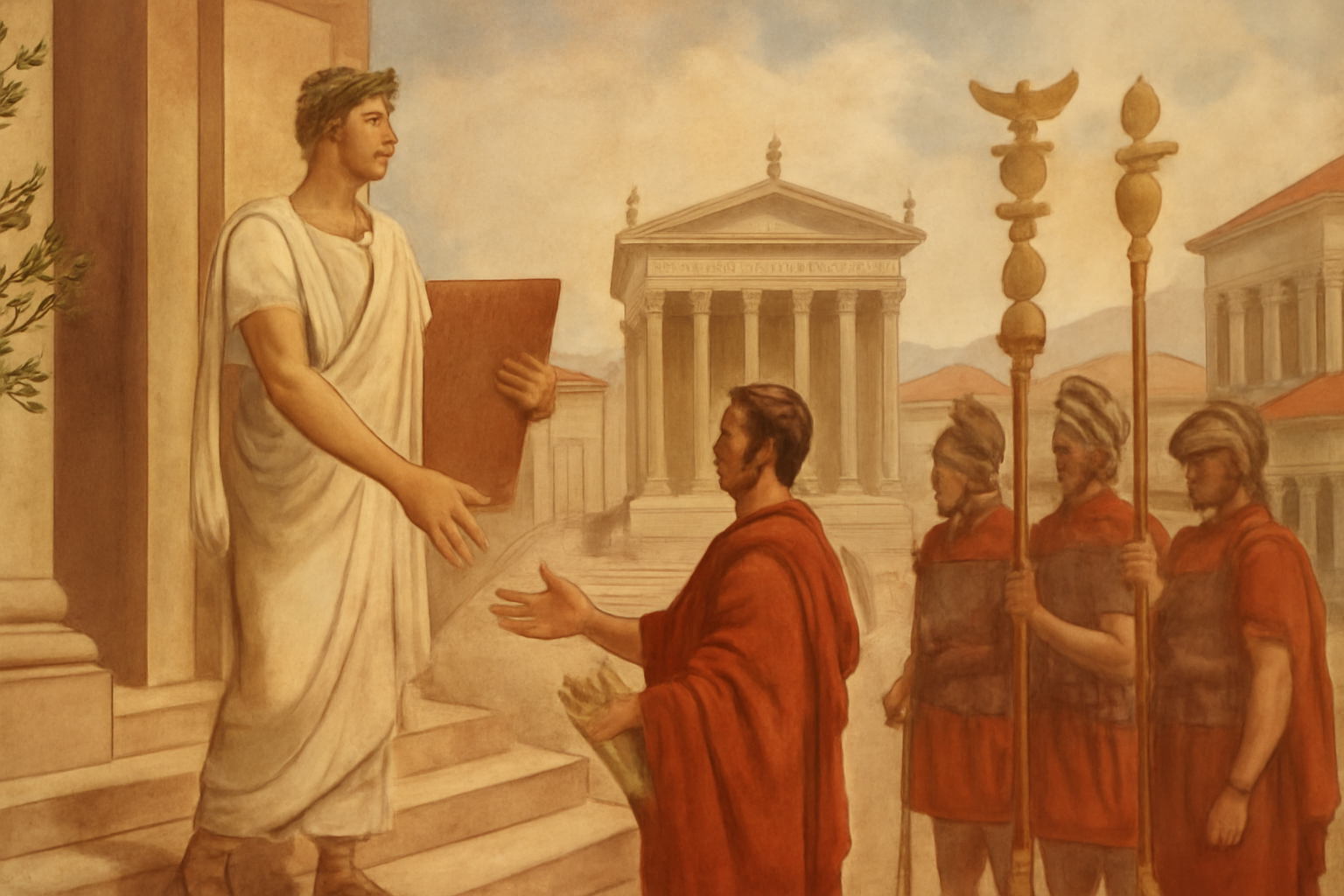
What changed in 27 BCE was the architecture of authority as much as its occupant. Octavian accepted the name Augustus and used it to present a new political arrangement: not a simple abolition of republican forms but a reordering that concentrated key powers while leaving public offices and ceremonies intact. In concrete terms, Augustus retained the outward trappings of the republic — assemblies, magistrates, the Senate — but established mechanisms that made his will decisive in practice. He controlled major military commands, the distribution of key provincial provinces, and the means of patronage that bound officers and local elites to his household.
The choice to cloak new powers in traditional republican language was intentional: it reduced resistance by preserving familiar institutions while redirecting their effective authority. Actors mattered: Augustus as strategist and symbol; senators and rival elites who accepted or acquiesced; provincial elites whose local influence was reshaped by imperial settlement. This combination of deliberate institutional design and negotiated acquiescence transformed political competition from open contention among equals into a system centred on a single dominant figure operating through republican forms. The turning point lies in the settlement's double language. Octavian accepted the name Augustus and presented himself as a restorer while retaining the military and political leverage that made restoration possible. Republican forms remained visible: Senate, magistracies, elections, laws, public honors.
Yet the center of gravity shifted. Real security rested on imperial command, personal prestige, control of key provinces, and the loyalty of soldiers. This double language is why the event has to be read slowly. If it is called a monarchy, readers may miss how much republican vocabulary survived. If it is called a restored republic, readers miss how much power had narrowed. Augustus' achievement was to turn ambiguity into stability. People could tell different stories about the same system: old offices had returned, civil war had ended, Rome had order, and one man stood above the rest without always saying so plainly. The human layer was broad. Senators could keep honor if they accepted new limits.
Veterans could receive settlement and rewards. Provincial elites could work with a more predictable center. Urban Romans could associate the regime with peace, grain, games, building, and religious renewal. Subject communities still faced taxation, hierarchy, and military power. The founding of empire therefore brought order and inequality together.
Consequences
The near-term consequence was a relatively stable political order in Rome known as the principate: a system of one-man rule wrapped in republican offices and public ritual. That stability reduced the frequency of large-scale civil wars, reconfigured elite careers, and changed how provincial governance worked by linking local authorities to imperial oversight. Over the longer term the settlement reshaped law, urban life and military organization across the Mediterranean. Imperial administration standardized certain legal and fiscal practices, influenced city planning and public building programs, and transformed military loyalty by anchoring soldiers’ service to an emperor rather than to a senator or itinerant general.
These shifts had cultural effects too: civic identities adjusted to imperial patronage, and public rituals were repurposed to reaffirm a ruler’s legitimacy. Interpretations diverge about causation: some emphasize Augustus’s calculated decisions, others point to structural pressures already steering Rome toward single-person rule. Both perspectives matter because the settlement was neither entirely planned nor wholly inevitable; it was a negotiated institutional outcome that endured and adapted, shaping centuries of governance without erasing local variation or subsequent contestation. The immediate consequence was a durable political model. The principate gave Rome a way to avoid returning to open civil war while preserving enough familiar language to feel legitimate.
Succession remained dangerous, and no settlement could remove ambition, court politics, frontier pressure, or elite resentment. Still, Augustus created a structure later emperors could inhabit, adapt, and sometimes damage without inventing rule from scratch. The longer consequence was an imperial memory that outlived the western empire. Roman law, citizenship, roads, cities, military organization, provincial government, Latin and Greek culture, and later Christian imperial authority all developed inside or through the imperial frame. The year 27 BCE matters because it marks the moment when Rome's political vocabulary was rearranged for rule over distance. For world history, the page is most useful as a comparison. Qin unified through open centralization and standardization. Han made that frame more durable.
Achaemenid Persia governed through satrapies and royal accommodation. Rome built a monarchy that avoided naming itself too simply. Comparing those answers helps readers see empire as a set of political technologies, not merely a large map.
Interpretation Notes
Founding of the Roman Empire raises a debate about scale: did the decisive change come from the visible state formation, or from older pressures around Roman Empire and Augustus that had already narrowed what people could do?
Why Keep Reading
Follow the subsequent events to see how the principate operated in practice: how later emperors strengthened, adapted or abused the settlement Augustus established; how provincial communities responded; and how law and military structures evolved under imperial oversight. Reading the next chapters reveals the everyday consequences of imperial rule—public works, taxation, justice and the lives of soldiers and provincial elites—and shows where the settlement held firm and where it frayed. If you want to understand how a single political design produced both order and new vulnerabilities across the Mediterranean, the transitions that follow are where those tensions become visible. Move next to Caesar's assassination, the Han Dynasty, and the Roman Empire vs Han Dynasty comparison.
Caesar explains the danger Augustus had to avoid. Han China gives another model of durable imperial rule after a harsh unification. The comparison page then turns Rome from a familiar story into one answer among several ancient solutions to distance, legitimacy, military command, and memory.
Reading Path
Follow the story without losing the thread
Before This
- Assassination of Julius CaesarMarch 15, 44 BCE
- Zhang Qian's Western Mission138 BCE
- Han Dynasty Founded202 BCE
After This
- Kushan Empire Risesc. 30 CE
- Edict of Milan313 CE
- Council of Nicaea325 CE
Same Period
Wider Timeline
Mind Map
How to think about Founding of the Roman Empire
constitutional camouflage
Augustus preserved republican offices and language while concentrating decisive powers in his hands
Map Layer
Where this event sits geographically
Gold pins mark the approximate locations of published event pages. This is a schematic locator map, not a historical border map.
Coordinates are approximate and are used to help readers orient themselves before opening a full event page.
References
Where to Check the Facts
- The Metropolitan Museum of Art: The Roman EmpireMuseum reference for Roman imperial chronology, Augustus, prosperity, art, and provincial rule.
- Primary Source: Res Gestae Divi AugustiPrimary-source reference for Augustus's public account of power, offices, and benefactions.
- Encyclopaedia Britannica: AugustusSpecific reference for Augustus as first emperor and the transition from republic to empire.
- Encyclopaedia Britannica: Government and Administration of AugustusContext reference for the constitutional settlement and the principate's political design.